Evidence: Unsubstantiated Explanation: Not enough data yet
Pompeii wardrobe: what the untouched 79 CE discovery really reveals
Pompeii excavations reported by Archaeology Magazine describe a wooden wardrobe sealed since the eruption of 79 CE, preserving coins, charms, and everyday personal keepsakes. The assemblage offers an intimate snapshot of Roman domestic storage, personal adornment, and household conditions during a time of active architectural renovation. While media reports highlight the evocative contents attributed to a female occupant, full archaeological evaluation remains ongoing and currently unsubstantiated by comprehensive peer-reviewed documentation.
Why AENIGMA is covering this
The AENIGMA Institute covers discoveries of this nature because domestic material culture from Pompeii frequently becomes the subject of romanticised narratives that obscure the meticulous reality of field archaeology. When media outlets report sensational personal 'time capsules,' general audiences often receive an interpretation presented as an absolute fact, without understanding the rigorous verification steps required to validate such claims. By examining this find through an evidence-first framework, this publication separates physical observations from interpretive storytelling. The recovery of organic furniture, trade weights, coins, and childhood charms in a single context offers genuine scientific value for understanding daily life in the ancient Mediterranean, illustrating how ordinary people lived amidst urban rebuilding and imminent disaster. Highlighting the distinction between confirmed artefacts and preliminary media narratives ensures that readers appreciate the real complexities of archaeological research without succumbing to unwarranted embellishment. Furthermore, this case serves as a valuable case study in how modern archaeological science operates. From micro-excavation of decayed organics to bioarchaeological analysis of household pests, contemporary field methods reveal far more about the ancient past than early treasure-hunting ever could. Documenting the pathway from an initial press report to full scientific validation reinforces the fundamental standards of evidence that guide serious historical inquiry.
What happened
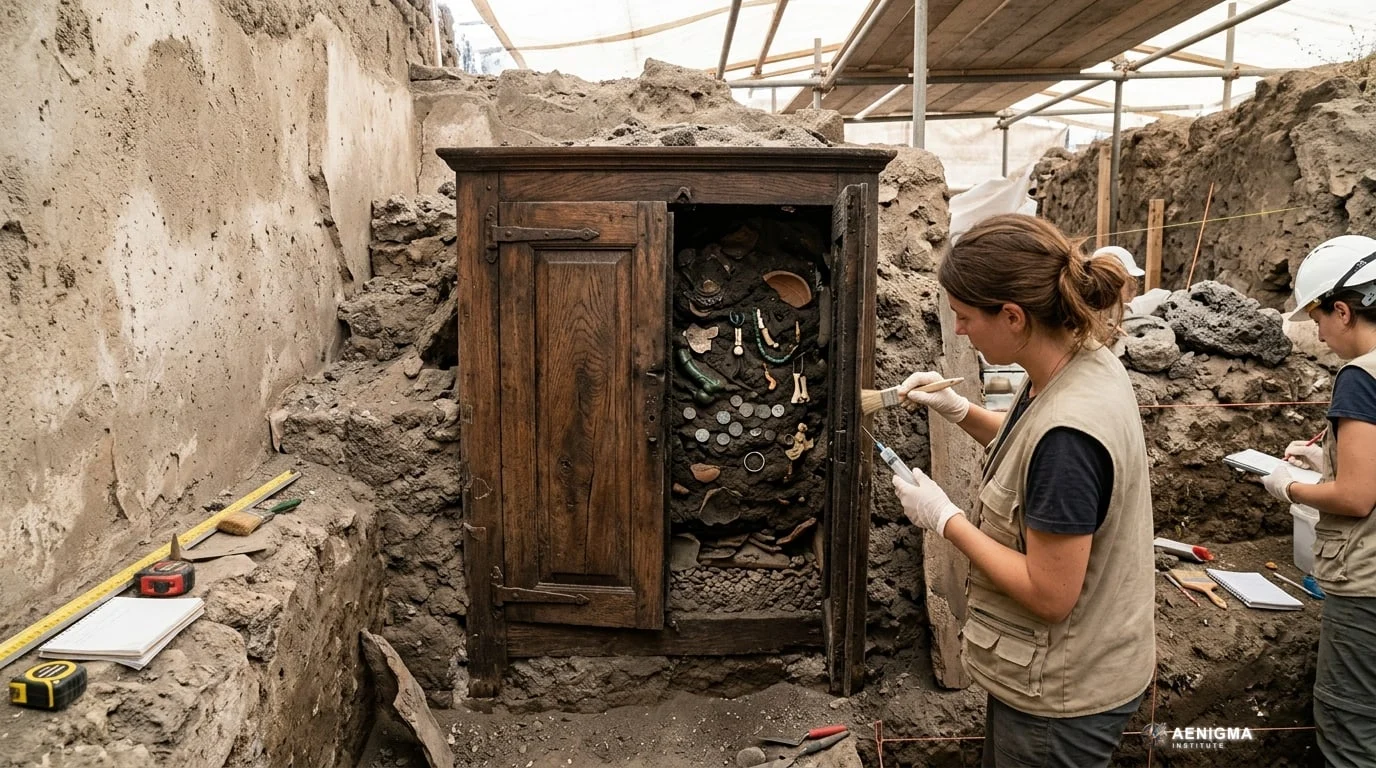
Archaeology Magazine reports that excavators working in the ancient Roman city of Pompeii uncovered an intact wooden wardrobe sealed beneath volcanic deposits since the eruption of Mount Vesuvius in 79 CE. Within the surviving structure of the cabinet, researchers identified an array of domestic artefacts, including monetary coins, personal grooming implements, cosmetic accessories, balance weights, and miniature amulets known historically as crepundia. Alongside these manufactured objects, excavators recorded organic and faunal material, including the skeletal remains of small rodents that had nested inside the furniture prior to the catastrophic burial of the city. The discovery comes from an ongoing campaign of systematic excavations in the Vesuvian archaeological park, where modern field techniques are being applied to unexcavated or partially cleared insulae. Unlike early antiquarian operations that focused primarily on recovering wall paintings and marble sculptures while neglecting degraded organic matter, contemporary stratigraphic excavation permits the recovery of fragile wooden joinery, vegetable fibres, and minute faunal traces. Specialists working on the find have utilised delicate micro-excavation methods, consolidated fragile carbonised timber, and documented the precise coordinates of every artefact before removal. The recovery of organic furniture from Pompeii is an exceptional occurrence, made possible only by unique taphonomic conditions. When Mount Vesuvius erupted in late summer or autumn of 79 CE, an initial fallout of pumice lapilli was followed by fast-moving pyroclastic density currents consisting of superheated ash and volcanic gases. In certain sealed rooms and protected ground-floor recesses, these deposits smothered domestic items without completely incinerating them, creating an oxygen-deprived environment that preserved cellular structures in charcoal or left crisp spatial voids suitable for plaster casting. The newly reported wardrobe appears to have occupied such a sheltered architectural context, preserving its shelves and internal contents in their final configuration. Following the discovery, site conservators initiated stabilisation protocols to protect the deteriorating wood and organic residues from environmental shock, humidity changes, and fungal blooms. The contents were transferred under controlled conditions to laboratory facilities within the archaeological park for cleaning, non-destructive imaging, and material characterisation. As reporting of the discovery reached the broader public, international interest focused heavily on the personal nature of the assemblage, prompting discussions among specialists regarding how such private domestic items should be contextualised within first-century Roman cultural norms.
What we know
Archaeological science possesses a detailed, rigorously documented understanding of how domestic spaces operated in Pompeii immediately prior to the catastrophe of 79 CE. The town had suffered repeated seismic tremors in the decades following a major earthquake in 62 CE, leaving numerous residences in a perpetual state of rebuilding, re-plastering, and spatial reorganisation. In many excavated houses across Regio V and adjacent districts, archaeologists routinely find signs of active masonry work, stacks of building lime, unhung decorative panels, and compressed living quarters where families concentrated their belongings into a handful of habitable rooms. Within this urban domestic reality, wooden storage chests (arcae) and upright cupboards or wardrobes (armaria) functioned as the primary depositories for household wealth, textiles, legal documents, and personal possessions. Roman legal texts, including excerpts preserved in the Digest, along with literary references in Pliny the Elder, Martial, and Juvenal, frequently mention these pieces of furniture as standard domestic fixtures. In modest or middling homes, a single armarium often held an eclectic mixture of tools, balance scales, family records, medicinal jars, and personal ornaments, rather than serving an exclusively specialised function. The specific items reported within the newly discovered wardrobe align closely with known categories of first-century Roman material culture. Small bronze, silver, or lead weights were routine domestic implements used to verify the purity and weight of coinage or dry goods in everyday market transactions. Cosmetics, balms, and ointments were commonly kept in miniature glass unguentaria, bone pyxides, or carved wooden boxes, preserved alongside personal hygiene tools such as bronze spatulae, tweezers, and ear-picks. Particularly significant among the contents is the reported presence of miniature amulets, commonly identified in Latin scholarship as crepundia. In Roman society, crepundia were strings of tiny metal, bone, amber, or terracotta pendants given to infants and young children to serve both as protective apotropaic charms and as identifying tokens. These charms frequently depicted everyday tools, solar symbols, phallic figures, or deities such as Isis and Bacchus, intended to ward off the evil eye and childhood ailments. Scholarly consensus recognises that while crepundia were primarily associated with childhood, they were frequently retained by women into adult life, preserved in private jewel caskets or domestic shrines as sacred mementos of maternal lineage and childhood milestones. Finally, the presence of rodent remains inside the cabinet provides direct faunal evidence of urban living conditions during antiquity. Bioarchaeological analysis of micro-mammal bones from Pompeian deposits routinely demonstrates that commensal rodents, particularly black rats and house mice, thrived in urban settings where grain, olive oil, and organic waste were stored. Their presence inside a piece of functioning furniture points to quiet corners of houses where stored textiles or foodstuffs attracted pests, especially in residences disrupted by persistent structural repairs.
What we don't know
Despite the compelling details published by media outlets, substantial gaps remain regarding the precise archaeological context, ownership, and chronology of the assemblage. Official publications have not yet released a definitive stratigraphic sequence linking the wardrobe's room to the overarching architectural history of the specific property. Without published plan drawings, section diagrams, and detailed soil phase descriptions, independent scholars cannot yet verify whether the wardrobe stood in its original primary location or had been hastily relocated during ongoing household renovations. It is also not currently known whether the assemblage represents the property of a single individual, multiple family members, or enslaved household residents. In popular accounts, personal ornaments, cosmetics, and protective amulets are frequently assigned to an aristocratic matron or a young woman. However, in Roman archaeology, establishing gendered ownership of small portable artefacts requires rigorous contextual evidence. Domestic slave managers (dispensatores) and household freedwomen also maintained secure storage boxes containing tools, weights, and small sums of money, making any definitive attribution of social status speculative at this stage. The exact composition, mint dates, and total value of the coins found inside the cabinet remain unpublished. In numismatic analysis, coin hoards and purse contents provide vital terminus post quem dates that can clarify whether money was accumulated slowly as personal savings or represented active operational cash on hand. Until high-resolution photographs, weight metrics, and mint marks for every coin are catalogued and made accessible to scholars, conclusions regarding the household’s economic standing cannot be confirmed. Furthermore, the precise organic nature of the associated materials has yet to undergo full biochemical confirmation. Media reports identify cosmetics, perfumes, and herbal residues, but gas chromatography-mass spectrometry (GC-MS) data has not yet been presented in a peer-reviewed monograph to confirm the organic signatures of the substances. Similarly, the rodent bones require osteological and taphonomic verification to establish whether the animals died inside the cabinet prior to the volcanic eruption or represent post-depositional intrusions through fractured ash layers.
What is claimed
Archaeology Magazine and associated press summaries have reported that the discovery preserves an untouched, personal time capsule belonging to an ancient Roman woman who fled the 79 CE eruption. Public-facing descriptions have emphasised the emotional and narrative resonance of the find, portraying the wardrobe as a deeply intimate repository containing treasured childhood charms, family keepsakes, precious coins, and vanity items, preserved exactly as they were abandoned during the panic of the disaster. Media presentations have placed special emphasis on the protective charms, presenting them as unambiguous proof of female domestic piety and sentimental attachment to childhood identity. News reports have framed the cabinet not merely as domestic storage, but as an extraordinarily rare personal shrine or jewel armoire that provides direct, unfiltered access to the private thoughts and domestic routines of an individual victim of Mount Vesuvius. Additionally, coverage has highlighted the discovery of rodent skeletons as a striking, novel glimpse into ancient household realities. Several reporting outlets have suggested that the juxtaposition of fine cosmetic containers and nesting rodents reveals surprising hygiene compromises within a wealthy or fashionable Roman home, suggesting an intimate look at domestic neglect amid the broader social disruption that preceded the volcanic catastrophe.
What is verified
At present, the independently verified facts are restricted to the primary excavation baseline: an unlooted piece of Roman wooden furniture containing various inorganic and organic artefacts has been uncovered in Pompeii, and preliminary reporting has been published through Archaeology Magazine. The preservation of wooden cellular outlines, mineralised hardware, bronze and bone implements, coins, and faunal residues within the volcanic matrix has been observed directly by the on-site excavation team. It is also verified that the types of objects described—specifically balance weights, grooming instruments, loose coins, and apotropaic crepundia pendants—conform closely to authentic first-century CE Roman material culture excavated elsewhere in Pompeii, Herculaneum, and Roman Italy. The taphonomic mechanism that preserved the assemblage, involving rapid burial by volcanic ash and subsequent preservation in an anoxic environment, is a well-documented physical phenomenon across the Bay of Naples. Beyond these baseline observations, however, the narrative layers surrounding the find remain classified as unverified. Because peer-reviewed scientific papers detailing the conservation report, the micro-stratigraphic layers, and the complete artefact catalogue have not yet been placed in the public academic domain, the claim remains catalogued under an unsubstantiated evidentiary status. While the material is authentic and the excavation is legitimate, the overarching interpretations concerning individual ownership, personal psychology, and exact room functionality await complete technical documentation.
Competing explanations
- Possible: The wardrobe served as standard domestic storage for personal effects, cosmetics, trade weights, and keepsakes, left behind during the panic of the 79 CE Vesuvius eruption.
What would change our assessment
The assessment of this discovery would advance from unsubstantiated to fully substantiated upon the publication of a comprehensive, peer-reviewed excavation report authored by the site directors and specialist researchers. Such documentation would need to include high-resolution stratigraphic section drawings, detailed photogrammetric 3D reconstructions of the cabinet in situ, and a complete catalogue listing every recovered object with its exact spatial coordinates, dimensions, and material composition. To confirm the economic and chronological implications of the find, specialists would require a complete numismatic study detailing the coin types, minting authorities, wear patterns, and date ranges. If the coins show clear signs of uniform minting dates shortly before 79 CE, it would substantiate claims of active cash circulation, whereas a broad range of older, heavily worn coinage would support the interpretation of a long-term accumulated domestic hoard. Determining the functional identity of the contents would be significantly advanced by scientific chemical testing. Applying gas chromatography-mass spectrometry and infrared spectroscopy to residue samples extracted from the cosmetic vials, unguent jars, and wood fibres would confirm whether the vessels held luxury imported oils, medicinal compounds, or common household preparations. Zooarchaeological analysis of the rodent bones, including bone surface modification studies, would clarify whether the animals were trapped during the eruption or nested months beforehand. Conversely, the current popular interpretation could be revised or abandoned if subsequent architectural analysis demonstrates that the room was being used purely as temporary storage for secondary debris during building works. If further excavation reveals that the items were discarded refuse, building materials, or salvaged objects gathered from across a damaged insula, the romantic narrative of an individual woman's untouched jewel cabinet would have to be set aside in favour of a more utilitarian post-earthquake salvage model.
Sources
- Archaeology Magazine (supports)
Protocol AENIGMA-EF-0.1