Evidence: Supported Explanation: Explained
Ancient Han-Jin Boats Unearthed in Beijing Riverbed
Three flat-bottomed wooden vessels dating to the Han and Jin periods have been excavated from an ancient riverbed in Beijing by the Beijing Academy of Archaeology, as reported by Xinhua and municipal broadcasters. The discovery provides rare, direct physical evidence of early inland water transport and state-managed craft in the capital region. The find is supported by institutional field excavation and verified woodworking analysis.
Why AENIGMA is covering this
Waterlogged wooden watercraft from the Han and Jin periods are exceptionally rare in northern China, where alternating flood cycles and dry, alkaline soils typically destroy structural timber within decades. The Yongding River boats provide concrete physical evidence for ancient naval architecture that was previously known predominantly through brief administrative texts and pictorial tomb bricks. The discovery also illustrates the logistical dynamics of ancient Beijing long before the construction of the Grand Canal in later imperial dynasties. It demonstrates that natural waterways across the northern plain supported organized, state-administered cargo transport networks capable of moving heavy freight through shallow, meandering river corridors. Covering this find allows AENIGMA to document verified archaeological fieldwork, detailing the exact woodworking mechanics, riverbed formation processes, and preservation challenges inherent in saving ancient timber structures from rapid urban development.
What happened
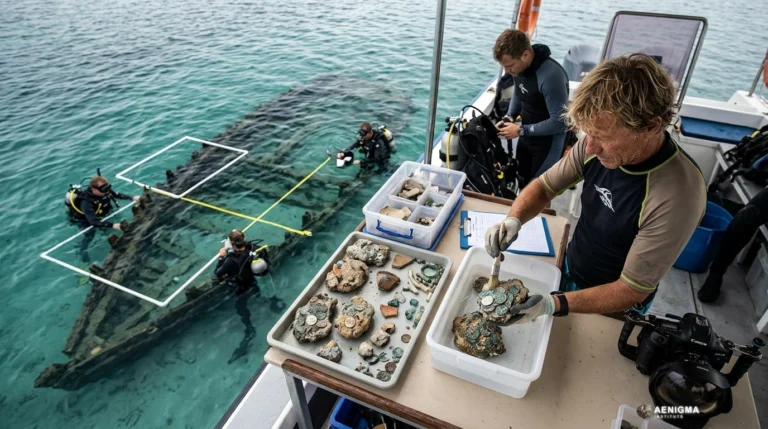
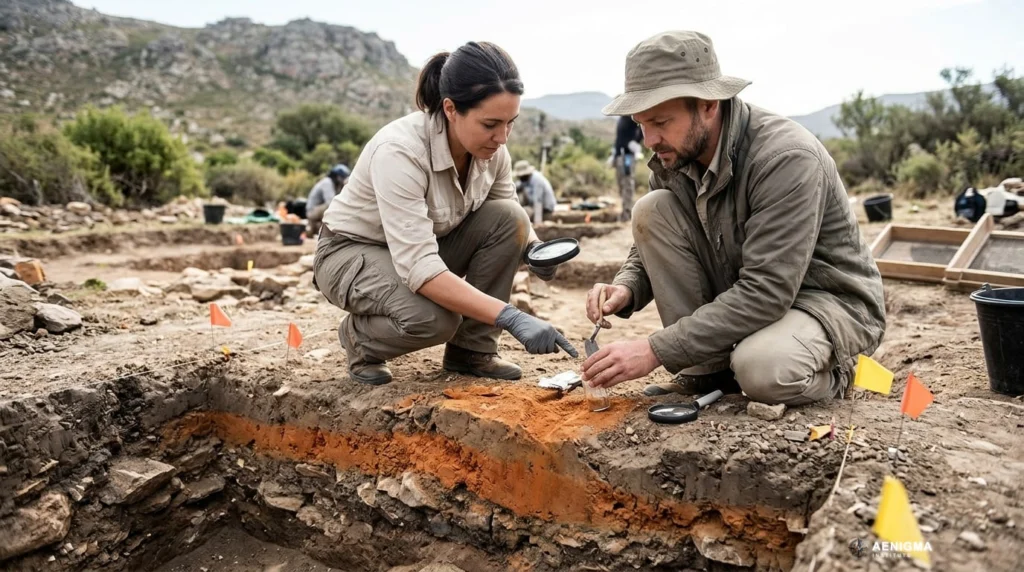
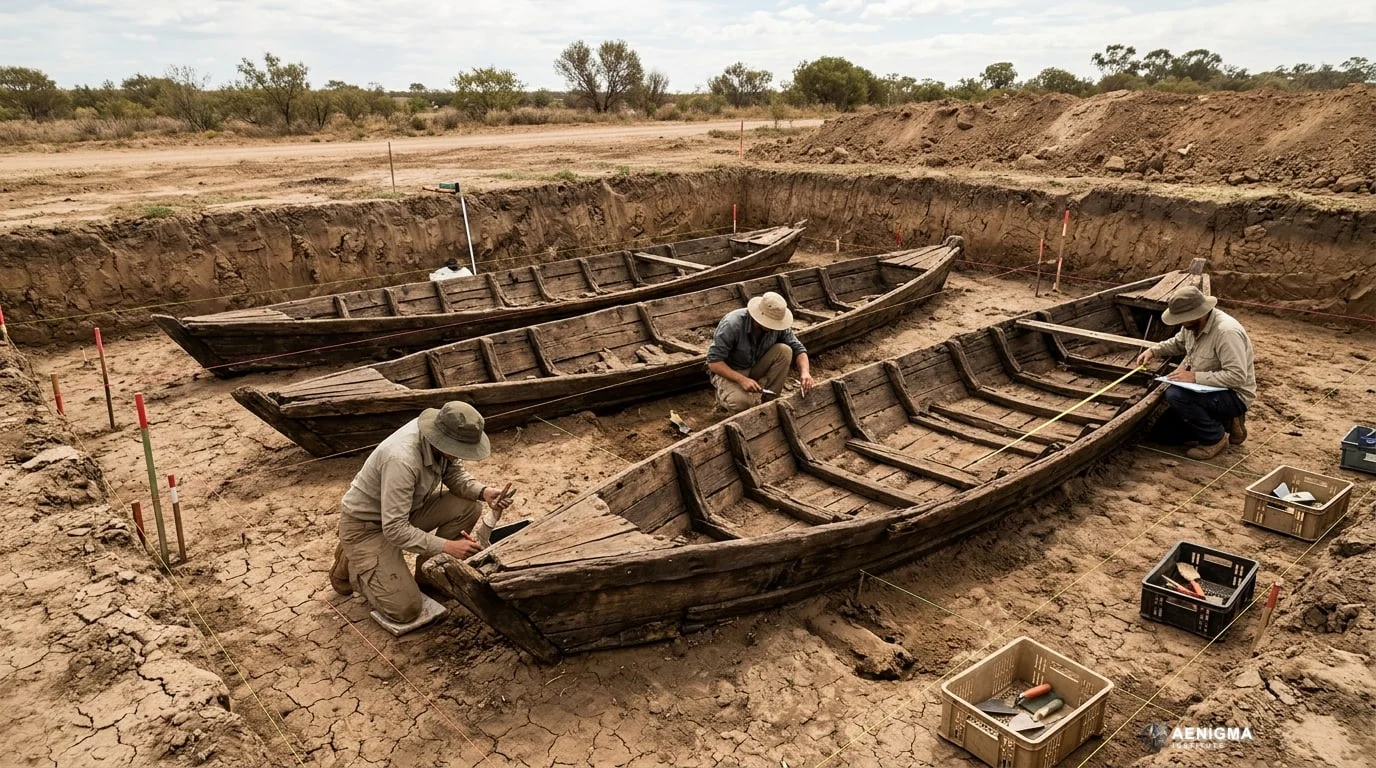
Excavations conducted by the Beijing Academy of Archaeology have uncovered the structural remains of three ancient flat-bottomed wooden boats buried seven meters beneath the surface in the palaeochannel of the Yongding River. The field campaign, reported through official releases by Xinhua and regional news agencies including the Beijing News and Beijing Media Network, documented three separate vessels preserved within waterlogged riverine sediment. The recovery took place as part of a planned rescue archaeology operation carried out ahead of urban infrastructure work. Controlled removal of the thick sedimentary overburden revealed timber hulls resting directly within the alluvial strata of the ancient watercourse. The sealed, anaerobic riverbed environment prevented the complete biological decay that normally destroys organic materials in northern Chinese soils. Following detailed in situ recording, conservators and field archaeologists cleared the overlying silt to evaluate the orientation, construction, and preservation state of the craft. Among the critical observations was the identification of branded marks impressed into the timber fabric reading Guan, denoting official state administration or ownership. The fieldwork identified specialized structural carpentry on the best-preserved vessel, known as Boat Number 2, illustrating regional riverine shipwright traditions dating between the Han and Jin dynasties.
What we know
Archaeological documentation confirms that the three vessels are flat-bottomed craft designed specifically for navigating shallow inland rivers. They rested within a buried palaeochannel of the Yongding River, buried approximately seven meters beneath modern ground level. This river system has shifted its course repeatedly across the Beijing plain over millennia, leaving stratified alluvial deposits that sealed the crafts beneath deep layers of clay, sand, and fine gravel. Boat Number 2 yielded the most detailed structural evidence during salvage operations. Its lower assembly utilizes tenon-and-peg joinery to lock adjacent bottom planks into a continuous, rigid plane without relying on heavy external framing. The side strakes display hooked overlapping planking, an ancient edge-joining technique that allowed shipbuilders to form tight, water-resistant seams capable of withstanding lateral shear forces generated by river currents and commercial loads. Branded seal impressions bearing the single character Guan, meaning official, were identified directly on surviving timbers. Such markings indicate that the vessels operated under government supervision or formed part of the bureaucratic transport infrastructure rather than purely private, artisanal traffic. Official oversight of transport craft was a standard practice in northern administrative centers during the Han and Jin eras, ensuring the transit of grain, military stores, and state construction supplies. The excavation occurred within an urban mitigation framework and has concluded its primary field phase. The timbers were lifted under controlled conditions for ongoing consolidation and timber conservation, eliminating risks of ongoing exposure to outdoor weathering or unregulated access.
What we don't know
The precise calendar year in which each vessel foundered or was abandoned remains open to further laboratory determination. While diagnostic woodworking features, stratigraphy, and associated material place the group firmly between the Han and Jin eras, high-precision dendrochronological sequences and radiocarbon measurements are still pending release from specialist laboratories. The exact cargoes carried by the boats during their final voyages could not be determined from the surviving hull timbers. River silts swept through the open hulls when they settled into the channel bed, dispersing loose personal possessions or organic freight that was not securely fastened. Future micro-stratigraphic residue analyses from bilge seams may shed light on whether they hauled bulk agricultural produce, quarried stone, or military supplies. It is also not known whether the vessels sank during a catastrophic seasonal flood event or were intentionally stripped of reusable fittings and abandoned in a dead-end slough. Northern rivers such as the Yongding were notorious for violent summer spates and rapid channel migration, which frequently trapped heavy cargo barges in shoals or sudden siltation pockets before crews could refloat them. Finally, the full extent of the surrounding ancient anchorage or river landing remains unexplored beyond the legal boundaries of the construction mitigation zone. Whether these three vessels represent an isolated mooring loss or the fringe of a larger riverine transfer hub active throughout antiquity is a question that requires broader regional surveying.
What is claimed
Coverage across municipal outlets such as the Beijing News, Qianlong, and Sohu highlighted the rarity of finding organic watercraft preserved at such depth in northern China. Media reporting noted that finding multiple flat-bottomed boats intact within the Yongding River valley provides tangible material proof of inland shipping routes described in historical chronicles of ancient Youzhou and Jicheng. Commentators and regional reporting stressed that the branded Guan marks establish a direct link between regional river navigation and imperial administrative logistics. These reports suggest the vessels served as part of a formal fleet deployed for official regional provisioning, highlighting Beijing's longstanding role as a logistical gateway between the central plains and northern frontiers. Some popular summaries posited that the vessels provide a direct window into military river transport associated with northern campaigns during the Late Han and Three Kingdoms to Western Jin transition. While these historical connections align chronologically with regional political developments, researchers emphasize that flat-bottomed barges served varied economic and logistical roles across both peace and wartime.
What is verified
The institutional identity of the excavating body is verified as the Beijing Academy of Archaeology, an accredited provincial research organization responsible for statutory heritage management in the municipality. The team conducted standard stratigraphic recording, total-station mapping, and formal recovery in accordance with national archaeological protocols. The structural configuration of Boat Number 2 is physically verified through detailed field photography and technical drawings. The tenon-and-peg bottom joins and hooked overlapping side planking represent known, highly specialized carpentry techniques documented in ancient Chinese naval architecture. The presence of the branded Guan seal impressions on the wooden surfaces was recorded directly on the recovered timber members prior to lifting. The geological setting is similarly verified by sedimentary core profiles taken across the mitigation zone. The seven-meter depth corresponds to water-laid silt and gravel strata matching the ancient hydrology of the Yongding River prior to historic levee construction and modern channel alteration. Official salvage protocols have concluded, with the vulnerable structural members transferred to specialized conservation laboratories equipped for wet-wood treatment.
Competing explanations
- Accepted: Archaeological excavation by the Beijing Academy of Archaeology confirmed three flat-bottomed wooden boats buried 7 meters below ground in the palaeochannel of the Yongding River, displaying branded seal marks reading 'Guan' (official) and specialized joinery techniques.
What would change our assessment
New radiometric dates, particularly high-precision accelerator mass spectrometry dates obtained from annual rings of outer sapwood, could refine the chronology of the hulls. If dates cluster tightly around a specific decade, the vessels could be correlated with known historical construction campaigns or recorded river flood events in early administrative annals. Should systematic timber analysis reveal species identification across the bottom planks, ribs, and pegs, researchers might discover that the timbers originated from distant river basins. A non-local timber source would indicate either broad inter-regional supply networks or the long-distance movement of vessels into the Yongding system via canal connections, altering current assumptions of purely local manufacture. Conversely, if subsequent wood-anatomy analyses were to demonstrate that the branded marks or carpentry assemblies belong to a later historic restoration or maintenance episode, the operational timeline of the craft would be extended. Any additional recovery of inscribed cargo tags, weights, or ballast stones from related sediment layers would further resolve the question of official commercial transit versus military transport.
Sources
- 新华网客户端 (supports)
- 搜狐 (树洞心语) (supports)
- 新浪财经 (千龙网 / 新京报) (supports, primary)
- 搜狐 (木子说事儿) (supports)
- 新浪财经 (BRTV新闻) (supports)
Protocol AENIGMA-EF-0.1