Evidence: Unsubstantiated Explanation: Not enough data yet
Marcomannic Wars and what the Roman soldiers in wells really show
The Marcomannic Wars frame an unusual archaeological discovery involving Roman soldiers recovered from ancient wells and ditches with their valuable equipment still intact. The finds offer a rare look at frontier crises under Marcus Aurelius, highlighting how sudden events disrupted standard military mortuary customs.
Why AENIGMA is covering this
AENIGMA covers discoveries of this nature because they highlight how controlled archaeological science can untangle moments of severe crisis in the ancient world. Popular perceptions of the Roman army often focus on triumphant architecture and orderly imperial expansion, yet frontier archaeology regularly documents the physical toll of military collapse and emergency survival. The recovery of these soldiers illustrates the utility of non-destructive laboratory methods in modern field research. By employing block lifting and X-ray imaging, conservators can reconstruct the precise form of organic gear that disintegrated centuries ago, transforming corroded metal nails into tangible evidence of ancient logistics and individual lives. These techniques demonstrate how laboratory science extracts vital historical information without destroying fragile contextual relationships. These finds provide a direct physical window into the harsh realities of the Marcomannic Wars, showing how the pressures of war and epidemic disease could upend the most deeply entrenched religious and military norms. Examining these unusual mortuary deposits allows historians to move beyond grand narratives of imperial campaigns and evaluate the concrete human consequences of frontier crises as recorded in the soil.
What happened
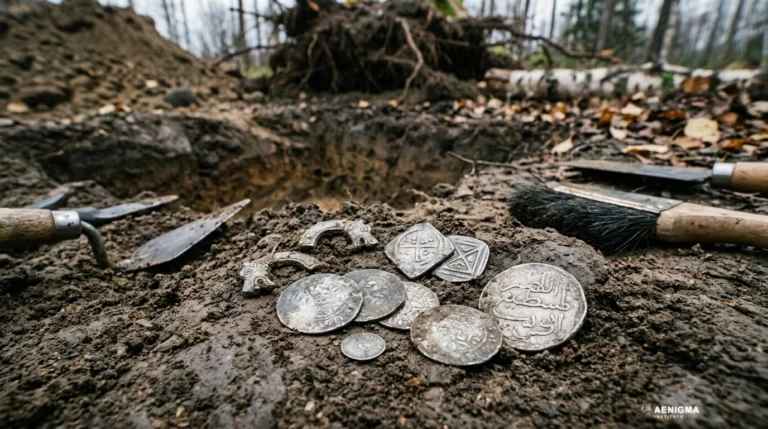
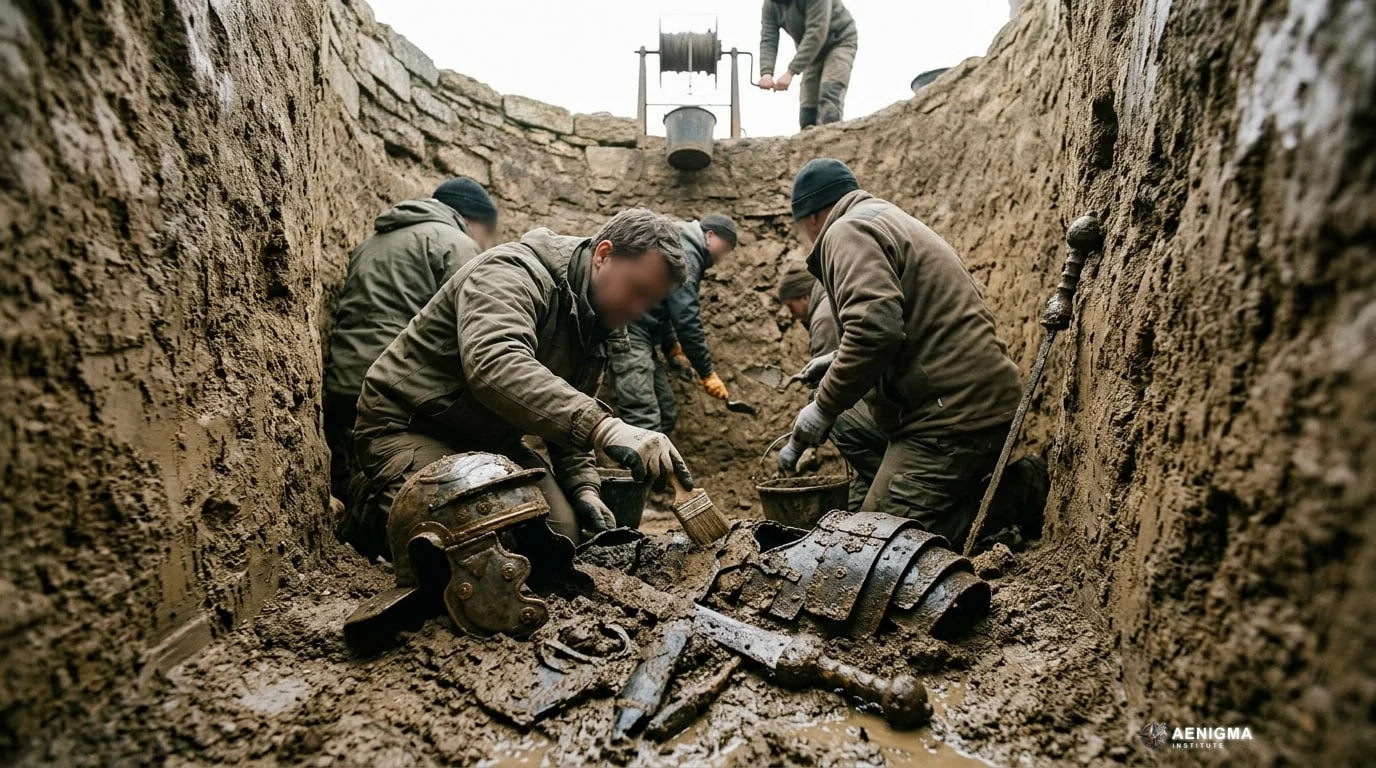
According to reporting by Futura Sciences, archaeologists documented an unexpected find dating back nearly eighteen centuries: the remains of Roman soldiers deposited in wells and defensive ditches. What made the discovery remarkable was the presence of intact military equipment still worn by the deceased. Roman marching camps relied on external trenches, known as fossae, cut into the earth to break an infantry charge or impede cavalry, while wells were engineered shafts lined with timber or stone to supply clean water. Encountering deceased soldiers inside either feature is highly anomalous under ordinary Roman operating procedures. Among the key details recovered from the ground was the footwear worn by the soldiers. Field conservators recognised that degraded organic materials and corroded iron components could not withstand standard exposure or manual handling. Rather than attempting to separate the boots from the surrounding soil on site, the excavators isolated the entire deposits in blocks of clay, encased them in rigid supports, and lifted them intact for laboratory analysis. At the conservation laboratory, specialists examined the blocks using industrial X-ray imaging. This non-destructive technique revealed the spatial arrangement of the iron hobnails, known as clavi, embedded in the soil matrix. By recording the positions of the dense metal fasteners while they remained undisturbed, the team reconstructed the shape, proportions, and wear patterns of the leather caligae whose organic skins had long since decayed. The recovery of fully equipped soldiers from features designed for camp drainage and water supply points to a sudden disruption of normal life. Wells often act as anaerobic chambers where the absence of oxygen slows bacterial decomposition, preserving leather, wood, and bone that would otherwise vanish in acidic topsoils. Finding soldiers in these shafts indicates that burial was neither ritual nor deliberate in the traditional sense, but hurried, leaving their gear unrecovered despite the substantial value of military equipment.
What we know
The historical setting of the finds corresponds to the Marcomannic Wars, a grueling series of conflicts fought between roughly 166 and 180 AD during the reign of Marcus Aurelius. Germanic coalitions, led by the Marcomanni and Quadi, alongside Sarmatian groups such as the Iazyges, breached the fortified Danubian frontier and raided deep into imperial territory, reaching as far south as northern Italy. The empire responded with protracted campaigns across the middle Danube, establishing fortified strongpoints and temporary marching camps across central Europe. Roman military operations required tight logistics and enormous capital expenditure. A soldier's kit represented a considerable investment of money and labor, typically including an iron helmet, segmented or scale body armor, a shield, a short sword, and heavy javelins. Much of this equipment was funded through systematic deductions from the legionary's stipendium, making personal weapons and protective gear valuable assets that units routinely salvaged from battlefields whenever circumstances permitted. The caligae worn by legionaries were heavy sandals designed for long marches over uneven ground. Crafted from multiple layers of thick cattle hide, the soles were studded with dozens of iron hobnails that gave soldiers traction on mud and wet turf. While the iron studs provided stability, they also absorbed friction, frequently wearing down or dropping out during extended campaigns. Over centuries of burial, moisture corrodes the iron into mineralized crusts, while soil microbes consume the untreated leather, leaving only clusters of rust where the sole once rested. To preserve the positional evidence of these fragile assemblies, conservators rely on block lifting followed by radiography. Dense iron hobnails attenuate X-rays far more effectively than surrounding silts or clays, producing high-contrast shadowgraphs that show the exact alignment of every surviving nail. This imaging permits researchers to distinguish specific nailing patterns associated with particular centuries or workshops, and to measure individual foot sizes without disturbing the fragile matrix. Roman religious custom and civil law regulated the treatment of the dead with great strictness. The ancient Twelve Tables forbade cremation or burial within the legal boundary of a city or camp, and Roman military units routinely established designated burial grounds outside fort gates. Deceased legionaries were traditionally cremated on funeral pyres or buried in marked graves along approach roads. Dropping bodies into a working well violated these fundamental religious mandates while also contaminating the water supply, a resource imperial engineers took extraordinary measures to protect. Historians and archaeologists recognize that such actions only occurred under extreme military pressure, tactical retreat, or immediate crisis.
What we don't know
Despite the physical evidence recovered from the shafts, several critical details about the sequence of events remain unanswered. Researchers do not yet know the exact year in which the abandonment took place. The broad material culture aligns with the late second century, but determining whether the event occurred in the early phases of the Marcomannic conflict or during the counter-offensives of the 170s AD requires additional scientific data. The demographic profile of the individuals also remains incomplete. Anthropological assessment can estimate age at death and general physical development, but it cannot clarify unit affiliations without accompanying epigraphic evidence, such as inscribed tags, marked weapons, or official camp records, none of which were reported with the remains. Furthermore, researchers do not know whether the entire camp was destroyed by fire or systematically dismantled upon departure. Some frontier camps show evidence of deliberate burning by retreating Roman engineers to deny timber and defenses to the enemy, while others were sacked and leveled by tribal warriors. The extent of destruction across the rest of the site has not yet been fully correlated with the depositions in the wells.
What is claimed
The principal interpretation advanced by researchers is that the soldiers were deposited during an urgent abandonment of the military position. This reading rests primarily on the fact that valuable equipment remained on the bodies. In the ancient Mediterranean, working iron, bronze, and conditioned leather were valuable commodities that neither victors nor retreating soldiers routinely discarded. Standard military practice in the Roman world involved reclaiming equipment from fallen comrades to reissue to recruits or return to legionary armories. Similarly, opposing tribal forces routinely stripped defeated enemies of weapons, armor, and footwear to augment their own arsenals or exchange for resources. Finding deceased soldiers buried while still wearing studded caligae suggests that those who placed them in the shafts acted under severe time constraints that prevented even basic scavenging. Under this model, the camp faced an emergency so pressing that normal logistical and religious procedures collapsed entirely. Whether caused by an approaching hostile force that made orderly retreat impossible or a sudden, uncontrollable outbreak of fatal disease within the perimeter, the priority was rapid departure. Disposing of bodies into existing shafts and trenches required minimal time and effort, effectively functioning as an emergency measure before the garrison or the victorious raiders abandoned the site.
What is verified
Several key aspects of the discovery are firmly verified by archaeological documentation. As reported by Futura Sciences, the physical remains of Roman soldiers were recovered from ancient wells and ditches alongside significant elements of their personal military equipment. The presence of intact iron-studded footwear on the individuals demonstrates that they were deposited before their gear could be stripped. The conservation methods used during the recovery are verified standard techniques in modern field archaeology. Block lifting fragile soil matrices containing deteriorating leather and iron, followed by high-resolution laboratory radiography, is an established procedure for recording degraded footwear. The resulting radiographic plates provide verifiable structural maps of the hobnail patterns within the undisturbed sediment. The broader historical context of the Marcomannic Wars is independently documented by substantial historical and material evidence. Archaeological excavations across the modern Czech Republic, Slovakia, and Austria have revealed dozens of temporary marching camps, watchtowers, and destruction layers dating to the reign of Marcus Aurelius. Classical texts, including the writings of Cassius Dio and the biographical histories of the era, corroborate the intense fighting, massive casualties, and logistical strains experienced along the Danubian limes during this period.
Competing explanations
- Possible: The soldiers were hastily deposited in wells and ditches without being stripped of their valuable equipment, suggesting a sudden abandonment of the camp due to battle or disease.
What would change our assessment
Refining the historical interpretation of these burials requires several specific scientific investigations. High-resolution osteological analysis of the skeletons would provide direct evidence regarding potential combat trauma. If forensic anthropologists document unhealed cuts, weapon punctures, or cranial fractures, the argument for violent death during an enemy assault would gain strong physical backing. The absence of perimortem trauma would instead support the hypothesis of an infectious outbreak. Biomolecular research could directly test the plague hypothesis. Extracting ancient pathogen DNA from the dental pulp of the soldiers could determine whether the individuals were infected with ancient strains of variola virus or another deadly bacterium at their time of death. Because teeth provide a protected environment that can preserve microscopic genetic material, paleogenomic sequencing represents the most reliable way to confirm or refute epidemic disease in such contexts. Radiocarbon dating of associated organic items, including surviving leather fragments or timber linings from the well shafts, could narrow the chronological window to a specific decade. In addition, strontium and oxygen isotope analysis performed on tooth enamel would reveal the geographic signatures of the water consumed during the soldiers' early lives, establishing whether they originated from the Mediterranean heartland, the Danubian provinces, or other imperial recruitment zones. Stratigraphic micro-analysis of the sediments within the shafts could also confirm whether the individuals were deposited simultaneously in a single event or accumulated over several successive phases.
Sources
- Futura Sciences (supports)
Protocol AENIGMA-EF-0.1