Evidence: Unsubstantiated Explanation: Not enough data yet
Viking Age silver hoard in the Leningrad region and what the reports show
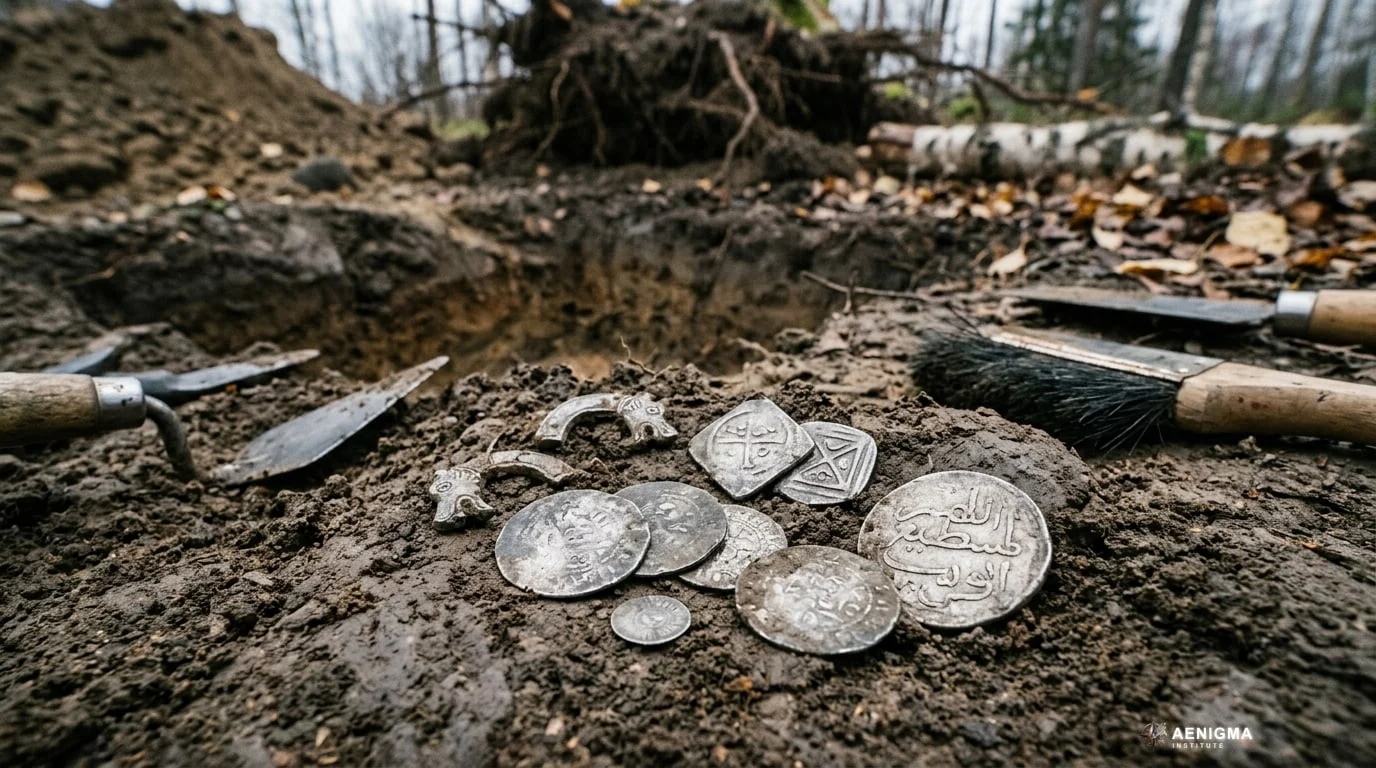
Russian media outlets have reported the discovery of a silver coin hoard in the Leningrad region, dating from the tenth to the fourteenth centuries. The accounts describe a collection containing rare Uppsala bracteates, Arab dirhams, and artifacts featuring Norse mythological iconography. While the historical context of such trans-Eurasian trade is well established, the specific archaeological details of this find remain unsubstantiated.
Why AENIGMA is covering this
The intersection of Scandinavian, Rus, and Islamic material culture consistently generates significant public and historical interest. The Viking Age and the subsequent medieval period represent a time of profound global connectivity, long before the modern era. Discoveries that highlight these vast trade networks, such as the river routes connecting the Baltic to the Caspian and Black Seas, offer tangible connections to a dynamic past. The specific details mentioned in the reports—rare Uppsala bracteates, Arab silver, and the mythological imagery of Odin's ravens—create a compelling narrative that captures the imagination. These elements speak to a world where merchants, warriors, and explorers traversed immense distances, carrying with them not only wealth but also their beliefs, languages, and artistic traditions. Tracking reports of such discoveries is important because, if documented, they add valuable data points to our understanding of medieval economics, state formation, and cultural exchange. Even in the preliminary stages, when details are scarce and the physical evidence is not yet available for study, the discussion surrounding these reports highlights the enduring fascination with the complex history of Eurasia and the physical remnants left behind by its past inhabitants. Understanding how wealth was accumulated, stored, and ultimately lost provides a window into the daily lives and anxieties of people living centuries ago.
What happened
Russian media outlets recently circulated reports regarding the discovery of a silver hoard in the Leningrad region. The accounts describe a collection of coins and artifacts spanning a broad chronological period, from the tenth to the fourteenth centuries. Among the specific items mentioned in the coverage are rare Uppsala bracteates, at least one Arab dirham, and objects bearing the mythological iconography of Odin's ravens. The story first gained traction through Channel 5 and was subsequently disseminated by other news services, including the National News Service, Vologda Poisk, and NEWS.ru. The narrative presented to the public outlines a significant archaeological find that bridges multiple medieval cultures and vast geographic distances. The items are said to reflect manufacturing origins in Scandinavia, the early Rus territories, and the Arab world. The reports suggest the hoard was intentionally buried for safekeeping, a common practice during periods of unrest or simply as a method of securing wealth before the advent of formal banking systems. The timeframe provided spans several centuries, indicating either a collection amassed over generations, a later deposition containing older, curated silver, or a generalized dating applied to a mixed assemblage. The inclusion of specific numismatic details, particularly the Uppsala bracteates and the Arab dirham, adds a layer of specificity to the media accounts. Bracteates are a distinct type of medieval coinage, and their presence alongside Islamic silver highlights the complex economic networks of the era. The mention of Odin's ravens further introduces a strong cultural and religious element to the reported assemblage, suggesting a direct link to Norse belief systems. The news coverage synthesizes these details to present a picture of accumulated wealth derived from extensive trans-Eurasian trade routes that once crisscrossed the region.
What we know
The Leningrad region occupies a crucial geographic position in the history of medieval Eurasia. During the period spanning the tenth to the fourteenth centuries, this area served as a primary conduit for trade connecting the Baltic Sea to the vast river systems of Eastern Europe, notably the Volkhov, the Lovat, the Dnieper, and the Volga. Settlements such as Staraya Ladoga functioned as major emporia where Scandinavian merchants, local Finno-Ugric populations, and Slavic groups interacted. This network facilitated the movement of goods over immense distances, linking the frozen north with the wealthy Islamic caliphates of the Middle East and the Byzantine Empire in the south. The presence of Arab dirhams in northern Europe is a well-documented historical phenomenon. Millions of these silver coins flowed northward between the eighth and eleventh centuries, exchanged primarily for furs, amber, honey, wax, and enslaved people. The dirham, typically struck with Kufic script detailing the mint and the ruler, became a standard unit of currency and a primary source of high-quality silver bullion across the Viking world. These coins are frequently found in hoards throughout Scandinavia, the Baltic states, and modern-day Russia. They were often tested for purity by pecking with a knife or bending, and sometimes cut into smaller pieces, known as hacksilver, to facilitate smaller transactions based on weight rather than face value. Uppsala bracteates represent a different facet of medieval numismatics. Bracteates are thin, single-sided coins struck on a soft die, leaving the design in relief on one side and incuse on the other. Uppsala, a major political and religious center in Sweden, produced its own coinage during the Middle Ages. Finding such regional Scandinavian currency deep within the river networks of the east illustrates the reciprocal flow of people and goods, and the eventual transition from a bullion economy to a monetized one. The iconography of Odin's ravens, Huginn and Muninn, is deeply embedded in Norse mythology. According to the poetic and prose Eddas, these ravens, whose names translate to Thought and Memory, flew across the world of Midgard to bring information to the god Odin. Their depiction on metalwork, jewelry, and coinage is a hallmark of Scandinavian artistic influence. Artifacts bearing these motifs found along the eastern trade routes are typically interpreted as evidence of the presence or cultural influence of the Varangians, the Norsemen who traveled, traded, and settled in the lands of the Rus. The practice of hoarding silver was widespread during the Viking Age and the subsequent medieval period. Wealth was often buried in ceramic vessels, wrapped in cloth, or placed in wooden boxes. The reasons for non-recovery vary; owners may have died in conflict, succumbed to disease, or simply been unable to return to the location. These buried economies provide modern historians with invaluable snapshots of the economic conditions, trade relations, and cultural exchanges of the time. The combination of Islamic silver, Scandinavian regional coinage, and Norse mythological items in a single context aligns perfectly with the established historical dynamics of the Leningrad region during the specified centuries. The transition from the Viking Age into the later medieval period saw shifts in these trade routes, with the rise of the Hanseatic League and the Republic of Novgorod altering the flow of goods, making a hoard spanning the tenth to fourteenth centuries a complex reflection of changing economic eras.
What we don't know
Despite the detailed descriptions provided in the media reports, critical information regarding the discovery remains unavailable. The exact location of the find within the Leningrad region is not specified. While the withholding of precise coordinates is standard practice to protect sites from unauthorized interference, it also means the geographical context cannot be independently assessed. It is unknown whether the hoard was discovered in an isolated rural setting, along a known historical riverbank, or within the stratified layers of a documented medieval settlement. The full inventory of the hoard has not been released. While the reports highlight the Uppsala bracteates, the Arab dirham, and the raven iconography, the total number of coins, the presence of any hacksilver, and the inclusion of other artifacts like jewelry, ingots, or the container itself are not detailed. The exact dates of the individual coins are also unspecified, which is crucial for determining the terminus post quem—the earliest possible date the hoard could have been buried. A hoard containing a tenth-century dirham and a fourteenth-century bracteate would represent a highly unusual accumulation period, but without a catalog, the chronological distribution remains a mystery. Furthermore, the identities of the archaeologists who made the discovery and the institutional backing of the excavation are not mentioned in the available data. It is unclear if this was a planned academic excavation, a rescue archaeology project ahead of construction, or a chance find reported to authorities. The current location and conservation status of the artifacts are similarly unknown. Silver that has been buried for centuries requires careful stabilization to prevent degradation upon exposure to the air and changes in humidity. Without knowing where the items are being held or studied, the physical evidence cannot be examined by the wider historical community. The stratigraphy of the find spot—the layers of soil and associated material culture surrounding the hoard—is entirely absent from the narrative. This contextual data is often more valuable than the objects themselves, as it can reveal how, why, and exactly when the items were deposited into the ground.
What is claimed
The central narrative presented by the news outlets is that a significant hoard of silver coins and artifacts has been unearthed in the Leningrad region. The reports assert that this collection spans a broad chronological period, from the tenth to the fourteenth centuries. It is presented as a physical manifestation of the accumulated wealth generated by trans-Eurasian trade networks. The specific claim is that the hoard contains items manufactured in three distinct cultural spheres: Scandinavia, the early Rus territories, and the Arab world. The inclusion of rare Uppsala bracteates and an Arab dirham is highlighted as evidence of this vast geographic reach. Additionally, the presence of items featuring the mythological iconography of Odin's ravens is claimed to underscore the Scandinavian cultural element within the assemblage. The media accounts propose that this wealth was intentionally buried for safekeeping, a standard interpretation for such concentrated deposits of precious metals. The synthesis of these numismatic and mythological details is offered as a comprehensive overview of the hoard's significance, painting a picture of a highly connected medieval world where goods, currency, and symbols traveled thousands of miles across diverse landscapes.
What is verified
The verifiable elements of this story currently reside in the media landscape and the broader historical record. It is confirmed that Channel 5 broadcasted the initial report regarding the discovery of the silver hoard in the Leningrad region. It is also verified that this story was subsequently disseminated by other Russian news organizations, including the National News Service, Vologda Poisk, and NEWS.ru, creating a consistent media narrative. The historical context framing the claims is entirely factual. The Leningrad region was indeed a vital node in the trans-Eurasian trade networks during the tenth to fourteenth centuries. The flow of Arab dirhams into northern Europe and the existence of Scandinavian bracteates are well-documented realities of medieval economics, supported by thousands of previous finds. The cultural significance of Odin's ravens in Norse mythology and their appearance on contemporary artifacts are established facts of art history and archaeology. Furthermore, the practice of burying wealth for safekeeping during this era is a recognized historical phenomenon, supported by hundreds of similar discoveries across Europe and Russia. However, the specific existence of this newly reported hoard, its exact contents, and its archaeological recovery remain unsubstantiated by the provided data. The transition from a media report to a verified archaeological finding requires documentation that is currently absent.
Competing explanations
- Possible: The hoard represents accumulated wealth from trans-Eurasian trade, containing items manufactured in Scandinavia, Rus, and the Arab world, buried for safekeeping between the 10th and 14th centuries.
What would change our assessment
To move the status of this reported discovery from unsubstantiated to a verified historical finding, several standard archaeological procedures must be completed and made public. The most crucial step is the release of a formal site report by a recognized archaeological institution, museum, or university department. This report would need to detail the methodology of the excavation, the exact stratigraphy of the find spot, and the environmental context in which the hoard was located. A complete and detailed inventory of every item recovered is essential. This includes high-resolution photography, precise weight measurements, and metallurgical analysis of the silver to determine its origin, purity, and manufacturing techniques. Numismatic experts would need to examine the coins to confirm their minting locations, dates, and any signs of wear or testing, such as pecking marks or bending. The Uppsala bracteates and the Arab dirham would require specific identification by specialists in Scandinavian and Islamic coinage, respectively, to read the inscriptions and confirm the minting authorities. The artifacts bearing the iconography of Odin's ravens would need to be analyzed stylistically to confirm their dating and cultural origin, distinguishing them from later reproductions or items from different cultural contexts. Furthermore, the artifacts must be formally accessioned into a state repository, where they can be stabilized, conserved, and made available for study by the broader historical community. The conservation of archaeological silver is a delicate process, often requiring the removal of silver chloride and other corrosion products without damaging the underlying surface or the historical integrity of the object. The publication of these findings in established historical or archaeological literature would provide the necessary foundation to fully integrate this hoard into our understanding of medieval trans-Eurasian trade, allowing researchers to compare its contents with other known assemblages from the region.
Sources
- Пятый канал (supports)
- Национальная Служба Новостей - НСН (supports)
- vologda-poisk.ru (supports)
- NEWS.ru (supports)
Protocol AENIGMA-EF-0.1