Evidence: Unsubstantiated Explanation: Not enough data yet
Knossos Palace Flush Toilet and What the Ruins Really Show
Knossos Palace flush toilet claims frequently portray the Bronze Age complex as the home of the world's first modern bathroom fixture. While archaeological fieldwork has documented sophisticated terracotta piping and gravity-fed drainage systems dating to 1700 BC, the surviving ruins represent manual and rainwater-assisted latrines rather than mechanized cisterns.
Why AENIGMA is covering this
Examining popular claims about ancient technology is essential for maintaining historical accuracy and appreciating the genuine achievements of past civilizations. The water management system at Knossos represents one of the most impressive feats of Bronze Age civil engineering anywhere in the Mediterranean. When sensational retellings recast gravity-fed channels as modern mechanized toilets, they obscure the true nature of ancient technical innovation. Appreciating Minoan engineering requires understanding how Bronze Age builders solved complex domestic challenges using the materials and natural laws available to them. Without modern metal pipes, rubber seals, or automated valves, the builders on Crete utilized gravity, local stone, durable ceramics, and seasonal rainfall to manage wastewater in multi-story buildings. Recognizing these solutions as passive architectural infrastructure highlights their authentic ingenuity far better than anachronistic comparisons. Addressing exaggerated claims also helps the public understand how archaeological conclusions are reached and tested. Rigorous fieldwork separates durable physical features, like terracotta pipes and stone channels, from modern technological assumptions projected onto antiquity. By presenting the physical reality of the Knossos ruins, readers gain a grounded, evidence-first perspective on human engineering during the Second Palace period.
What happened
The Minoan civilization flourished across Crete during the Bronze Age, establishing complex administrative centers, multi-story residences, and intricate urban layouts. Knossos, situated just inland from the northern coast near modern Heraklion, was the largest and most influential of these palatial settlements. During the Second Palace period around 1700 BC, the palace underwent extensive reconstruction following catastrophic seismic events, emerging as a monumental architectural complex. For more than a century, popular retellings of the excavations at Knossos have highlighted the advanced plumbing integrated into the building foundations. Sir Arthur Evans, who began systematic clearance of the site at the turn of the twentieth century, marvelled at the sophisticated drainage channels beneath the residential quarters. Evans and later chroniclers compared these ancient hydraulic networks directly to the domestic conveniences of modern European cities. Over decades of publication in guidebooks, popular history collections, and digital media, this observation transformed into a sweeping cultural assertion. Writers and documentary features routinely describe the residential quarter of the palace as containing the earliest known flush toilet in human history. The claim captured global curiosity because it seemed to collapse thousands of years of technological difference, presenting Bronze Age royalty enjoying domestic luxuries usually associated with the late Industrial Era. The physical environment of Crete played a central role in shaping how the Minoans approached the movement of water. The island has always experienced severe seasonal variation, marked by heavy winter downpours followed by prolonged summer droughts. To maintain monumental structures on the Kephala hill, builders had to engineer durable methods for diverting torrential rainwater away from foundational masonry while simultaneously securing clean supplies for daily domestic needs. Urban hygiene in such a densely populated administrative center required deliberate architectural planning. The builders embedded stone-lined conduits, vertical shafts, and clay pipes directly into the core fabric of multi-level buildings. Because these systems handled both stormwater disposal and domestic wastewater, modern commentators gradually conflated general hydraulic management with specialized sanitary appliances, laying the groundwork for the persistent legend of the Minoan flush toilet.
What we know
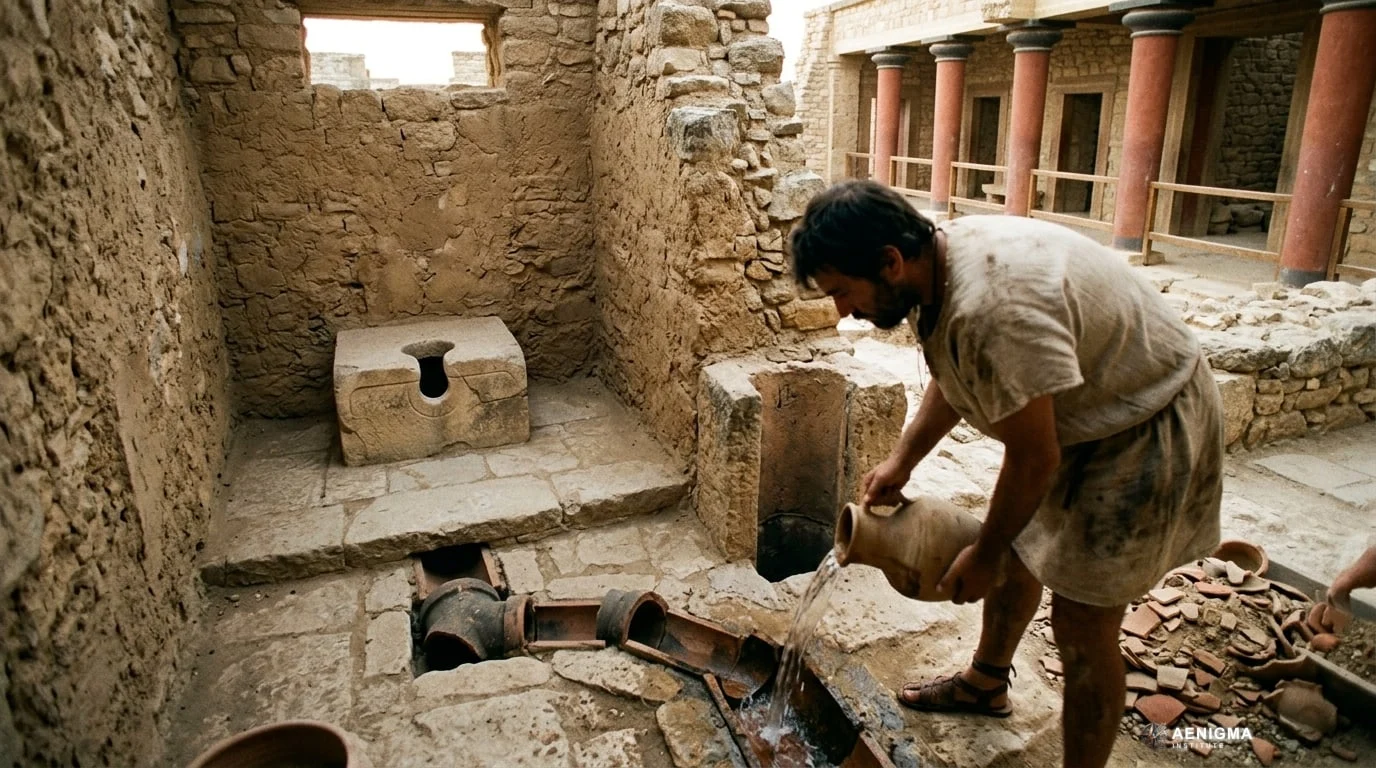
Field investigations and decades of architectural analysis at Knossos have established the physical reality of an exceptionally advanced hydraulic network. Minoan masons constructed subterranean channels lined with carefully dressed limestone blocks, often coated with waterproof hydraulic plaster to prevent seepage into surrounding foundations. These channels traversed the subfloor levels of the palace, following the natural downward gradient of the hill toward the adjacent Kairatos river valley. Alongside stone masonry conduits, the site preserves extensive installations of specialized terracotta piping. These fired clay pipes were manufactured in standardized segments, featuring tapered collars that interlocked tightly with neighboring sections. The tapering accelerated water velocity and helped prevent the deposition of sediment, demonstrating that Minoan craftsmen possessed a practical grasp of hydraulic movement and sedimentation. The residential sector of the palace, traditionally designated by excavators as the Domestic Quarter or the Queen's Megaron, contains the specific installation at the center of the controversy. In an enclosed ground-floor chamber, archaeologists identified a limestone flagstone arrangement configured as a latrine seat, positioned directly over an opening that drops into a primary stone drainage conduit. The conduit ran beneath the room, sloped deliberately to convey waste outward from the interior living spaces. Water cleared the latrine through natural precipitation and manual effort rather than automated mechanical flushing. During the wet winter months, rainfall collected from adjacent light wells and flat terrace roofs cascaded into drainage shafts connected to the main sewer line, washing through the system with considerable force. During the dry season, occupants or attendants had to pour water manually from ceramic jars or pithoi into the opening to flush waste into the subterranean channel. Comparable Bronze Age hydraulic features have been documented across the Aegean and Eastern Mediterranean, demonstrating that Knossos belonged to a wider tradition of regional engineering. At the contemporaneous Minoan sites of Phaistos, Malia, and Zakros, archaeologists have uncovered stone conduits and plastered drains designed to evacuate winter runoff and household waste. Similar urban drainage projects emerged in the Indus Valley at Mohenjo-daro and Harappa, where brick-lined channels served domestic latrines through gravity-assisted flow. The study of ancient sanitation relies on strict archaeological methodologies, including precise stratigraphy, architectural recording, and material conservation. Specialized researchers examine ceramic fabrics, mortars, and stone weathering to reconstruct how water infrastructure operated without damaging fragile structural remains. These established protocols confirm that the Knossos latrines functioned through thoughtful passive design, gravity, and labor rather than mechanical pressure.
What we don't know
Significant gaps persist regarding the day-to-day operation, maintenance, and broader social use of the Minoan sanitation network. While stone channels and fired terracotta pipes endure in the archaeological record, organic materials have entirely decomposed over the millennia. Researchers do not have surviving physical remains of the wooden seating, lids, or partition screens that almost certainly accompanied the masonry latrines. The structural collapse of the upper stories of Knossos creates substantial interpretive challenges. The domestic quarters stood several levels high, but only ground-level masonry remains intact, along with fragments of vertical stone shafts embedded in fallen walls. It remains unknown how many individual latrines operated on the upper residential floors, or precisely how waste shafts dropped through multiple stories without producing severe odors or structural contamination. Daily sanitary routines within the palace also remain unrecorded in surviving linear inscriptions. The Linear B tablets discovered at Knossos focus predominantly on economic administration, livestock inventories, and agricultural commodities, offering no textual commentary on personal hygiene or domestic labor. Scholars do not know whether dedicated palace servants were tasked with hauling water to flush the latrines, or how frequently the subterranean conduits required manual desiltation to clear accumulated debris. The social reach of this sanitation system is equally uncertain. The documented latrines at Knossos are situated exclusively within high-status residential suites, indicating that advanced indoor drainage was an elite privilege rather than a standard civic utility. Fieldwork in the wider domestic settlements surrounding the palace has not revealed whether non-elite Minoan households used simpler pit latrines, communal facilities, or dry waste disposal methods. Questions also linger regarding how the drainage network handled severe blockages or extreme climatic events. Torrential Mediterranean storms could easily overload subterranean conduits with gravel and silt washed from unpaved courtyards. Archaeologists have found inspection openings along certain channel lines, but the exact maintenance tools, dredging procedures, and repair protocols employed by Minoan maintenance workers remain completely unrecorded.
What is claimed
Popular historical accounts, digital media, and travel publications frequently assert that the Minoans invented the world's first flush toilet at Knossos around 1700 BC. These narratives routinely present the ancient installation as the direct technological forerunner of modern domestic bathrooms. The description is usually delivered without technical qualification, leaving audiences with the impression that Bronze Age Crete enjoyed sanitary hardware fundamentally comparable to twenty-first-century plumbing. In widespread online retellings, the latrine is described as possessing an automated flushing mechanism, occasionally accompanied by modern illustrations or digitally generated graphics that depict water tanks mounted on walls. Some enthusiasts claim that the Minoans developed overhead cisterns equipped with valves and levers, allowing users to release a controlled volume of water at will. These depictions exaggerate the archaeological remains, converting passive drainage architecture into sophisticated mechanical plumbing. Further claims suggest that the Minoan installation included an ancient version of the modern U-bend or water trap, the curved pipe section that holds standing water to block sewer odors from entering living quarters. Enthusiastic accounts claim that Minoan engineers solved the problem of sewer gases through ingenious trap designs integrated into the stone floors. This assertion portrays the palace as completely free of foul air through technological innovations that only appeared centuries later. The core of the popular narrative rests on conflating the physical act of flushing—clearing waste with water—with the modern mechanical flush toilet. While pouring water from a jar into a drain is indeed a form of flushing, modern domestic sanitation relies on a closed system of automated cisterns, float valves, and hydraulic seals designed during the Industrial Revolution. By using the phrase "flush toilet" to describe a gravity conduit, popular culture projects modern industrial engineering backward onto the Bronze Age.
What is verified
Extensive stratigraphic excavation and systematic architectural survey have verified that the palace of Knossos possessed an exceptional hydraulic system for the second millennium BC. The presence of interlocking terracotta pipes with tapered joints is an established, physical fact documented across several sectors of the site. Excavators have mapped comprehensive stone-built drainage channels beneath the ground-floor rooms, confirming that wastewater and rainwater were deliberately routed away from living areas. It is verified that the installation in the residential quarter operated as an indoor latrine. The surviving architectural features include a stone flagstone base positioned directly above an opening that leads into the underlying drainage conduit. This spatial arrangement proves that Minoan builders designed the domestic quarters with integrated sanitary facilities that connected straight into the main subterranean sewer network. The operational mechanism of this latrine is also firmly established through physical examination of the site gradient and architectural alignments. Waste disposal relied on gravity and water flow, supplied seasonally by stormwater runoff captured from roofs and light wells, and supplemented manually by water carried in ceramic vessels. There are no automated cisterns, mechanical valves, levers, or siphon-based water traps anywhere in the archaeological record of Knossos or any other Minoan settlement. The surviving evidence documents a high degree of architectural foresight and hydraulic skill. Minoan masons effectively harnessed topography, durable terracotta, and waterproof plaster to maintain sanitary conditions inside a sprawling, multi-tiered palace. What is verified is an extraordinary achievement in passive architectural drainage, functioning through gravity and manual pouring, rather than a mechanized appliance operating like modern indoor plumbing.
Competing explanations
- Possible: Archaeological excavations at Knossos confirmed advanced terracotta piping, gravity-fed drainage channels, and latrines flushed by rainwater and poured water during the Second Palace period.
- Possible: Popular accounts often conflate gravity-assisted manual or storm runoff flushing with fully mechanized modern cistern flush toilets, oversimplifying the operational reality of ancient latrines.
What would change our assessment
The established understanding of Minoan sanitation could evolve if future scientific investigations reveal previously undetected technological components within Bronze Age sites. Non-invasive geophysical surveys, including ground-penetrating radar and electrical resistivity tomography carried out by authorized teams, occasionally map buried conduits and secondary branches of palatial drainage systems. Documenting complete, unexcavated channel networks in peripheral settlement sectors could show whether sophisticated plumbing extended beyond royal quarters. Micro-stratigraphic analysis and chemical residue sampling within undisturbed conduit sediments could also refine current interpretations. If laboratory researchers extract lipid markers, ancient parasite eggs, or coprostanol compounds from protected sections of channel silt, they could confirm the exact nature of the waste processed through specific drains. Such data would help differentiate domestic wastewater conduits from pure rainwater overflows, clarifying how different channels functioned throughout the year. Residue testing on the interior walls of terracotta piping could provide crucial data regarding water sourcing. Identifying microscopic mineral encrustations, isotopic signatures, or freshwater algae traces could determine whether certain conduits carried spring water under slight pressure, or merely drained episodic precipitation. This evidence would clarify whether clean water was permanently piped directly into residential chambers to facilitate regular manual flushing. An architectural discovery would be required to support claims of mechanical flushing. Researchers would need to document clear physical evidence of an elevated stone or ceramic cistern with surviving attachment points for control valves, or a conduit section unmistakably shaped to maintain a permanent water seal against sewer gases. Until verifiable material remains demonstrate mechanized control, the historical consensus will continue to view the Knossos installation as a gravity-fed, manually cleared latrine.
Sources
- History Collection (supports)
- Wikipedia - History of water supply and sanitation (context, unverified)
Protocol AENIGMA-EF-0.1