Evidence: Unsubstantiated Explanation: Not enough data yet
Ancient Chinese tomb minerals: what the Wushi assemblage really shows
An ancient Chinese tomb has yielded a collection of five distinct minerals, prompting questions about their ritual significance. Analysis suggests they form a Wushi assemblage intended to protect the soul of the deceased, rather than serving medical or alchemical purposes. The specific combination of stones differs from traditional textual accounts, highlighting variations in historical burial practices.
Why AENIGMA is covering this
This discovery is significant because it highlights the vital intersection between advanced archaeometric science and the study of ancient belief systems. By applying rigorous analytical techniques like Raman spectroscopy and X-ray diffraction to funerary objects, researchers can move beyond aesthetic descriptions and uncover the precise material reality of ancient rituals. This case demonstrates how physical evidence can actively challenge and refine our understanding of historical texts. The contrast between the discovered minerals and the traditional written accounts of the Wushi assemblage serves as a reminder that ancient practices were often more varied and localized than standardized texts suggest. It underscores the importance of relying on primary archaeological data to reconstruct the past, rather than assuming that written histories provide a complete or entirely accurate picture of lived cultural practices. Furthermore, the careful ruling out of the alchemical hypothesis based on the absence of cinnabar showcases the methodical process of archaeological deduction. Ultimately, the analysis of these five stones provides a tangible connection to the complex cosmological worldview of ancient China, offering a glimpse into how early societies utilized the natural world to navigate the profound mysteries of death and the afterlife.
What happened
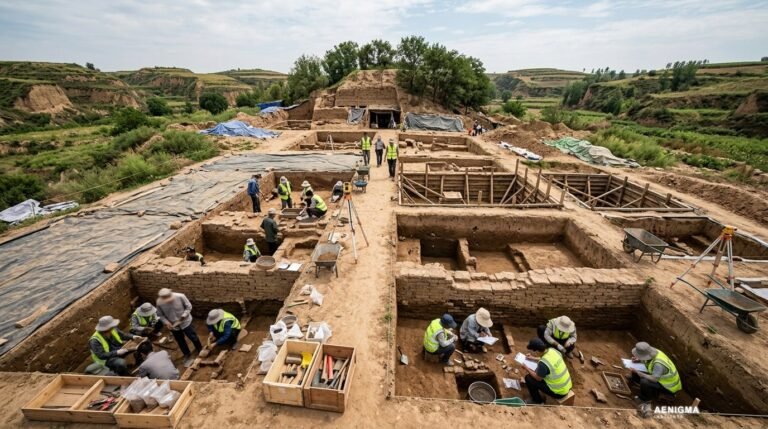
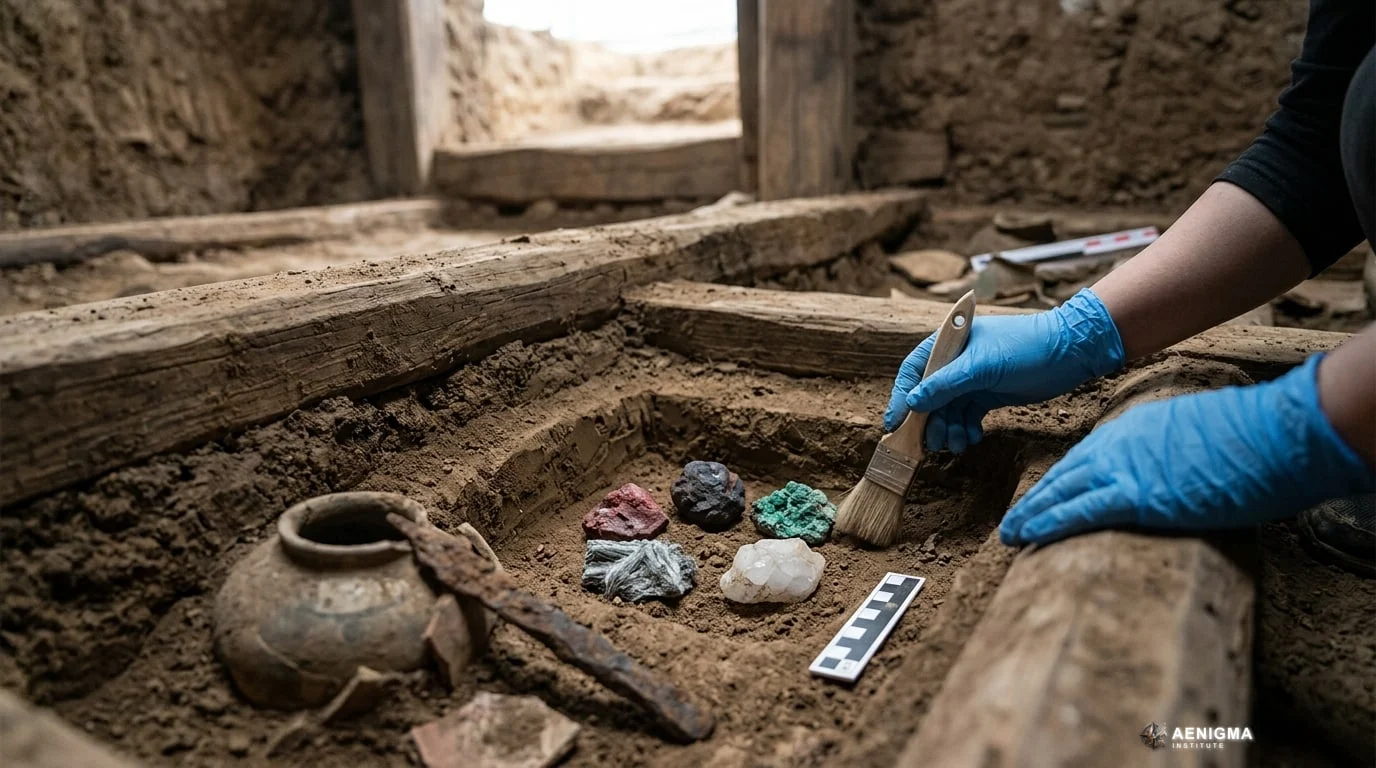
The discovery of five distinct minerals within an ancient Chinese tomb has brought renewed attention to the complex burial customs of early dynasties. Funerary practices in ancient China were deeply intertwined with beliefs about the afterlife, where the physical preservation of the body and the spiritual protection of the soul were paramount concerns. Tombs were often constructed as subterranean dwellings, provisioned with everyday objects, ritual vessels, and symbolic items meant to serve the deceased in the next world. Among these provisions, minerals and stones held a special place, valued not only for their aesthetic qualities but also for their perceived cosmological power. In this particular excavation, archaeologists encountered a secondary burial. This practice involves the intentional relocation of human remains after the soft tissues have decomposed in a primary resting place. The bones are gathered, often cleaned or arranged, and then interred in their final tomb. Secondary burials represent a significant investment of time and ritual effort, indicating that specific cultural protocols demanded this multi-stage funerary process. The context of a secondary burial often alters how artifacts are interpreted, as the items placed with the bones in the final stage are specifically chosen for this concluding ritual rather than the initial interment. Accompanying these relocated remains was a carefully curated collection of five minerals: lapis lazuli, realgar, orpiment, magnetite, and rock crystal. In the broader context of Chinese archaeology, the number five is highly significant, corresponding to the Wuxing, or the Five Elements theory. This philosophical framework categorizes all natural phenomena into wood, fire, earth, metal, and water, each associated with specific colors, directions, and cosmic forces. The deliberate grouping of five distinct minerals strongly suggests an intentional assemblage rather than a random accumulation of stones. The presence of these specific materials raises immediate questions about their function. While individual minerals like rock crystal or lapis lazuli are occasionally found as ornaments or inlays, their presentation here as a collective group points toward a unified ritual purpose. The arrangement aligns with the concept of a Wushi, or Five Minerals, assemblage. Historically, such groupings were utilized in various esoteric practices, ranging from the pursuit of physical longevity to the spiritual fortification of the tomb environment. Understanding the exact nature of this discovery requires separating the physical reality of the stones from the extensive mythology that surrounds ancient Chinese mineralogy.
What we know
The precise identification of the five minerals was achieved through a battery of advanced archaeometric techniques. Modern archaeological science relies heavily on non-destructive or micro-destructive analytical methods to determine the exact composition of artifacts without compromising their integrity. In this case, researchers employed X-ray diffraction, Raman spectroscopy, and electron microscopy to analyze the crystalline and molecular structures of the tomb samples. X-ray diffraction is a foundational technique in mineralogy. By directing a beam of X-rays at a sample and measuring the angles and intensities of the scattered beams, scientists can produce a three-dimensional model of the atomic structure within the crystal. This method provides a definitive fingerprint for crystalline materials. Raman spectroscopy complements this by using a laser to observe vibrational, rotational, and other low-frequency modes in a system. The resulting spectrum offers highly specific information about the chemical bonds and molecular composition of the sample, allowing researchers to distinguish between minerals that might look identical to the naked eye. Electron microscopy, particularly scanning electron microscopy, provides high-resolution imaging of the surface topography and maps the elemental distribution across the sample. Through these rigorous methods, the five stones were definitively identified. The first is lapis lazuli, a deep blue metamorphic rock prized since antiquity. Its presence is notable because lapis lazuli is not widely found in central China; it was typically imported from regions further west via early trade networks, making it a material of high value and exotic origin. The second and third minerals are realgar and orpiment. Both are arsenic sulfide minerals; realgar is known for its striking ruby-red color, while orpiment presents as a vibrant, golden yellow. These minerals often occur together in hydrothermal vents and were widely used in the ancient world as pigments and in esoteric rituals. The fourth mineral is magnetite, a naturally magnetic iron oxide. It is typically black or brownish-black and possesses a metallic luster. The magnetic properties of this stone were recognized early in Chinese history. In a ritual context, its unseen magnetic force was often attributed to mystical or cosmological energies. The final mineral is rock crystal, a transparent, colorless variety of macroscopic quartz. Valued for its clarity and purity, rock crystal was frequently carved into ornaments or used in contexts requiring a symbol of unblemished spiritual clarity. Crucially, the archaeometric analysis confirmed the complete absence of cinnabar in this assemblage. Cinnabar, a bright red mercury sulfide, is perhaps the most famous mineral in ancient Chinese funerary and alchemical traditions. It was used extensively to line tombs, coat coffins, and was a primary ingredient in traditional esoteric formulas. The definitive lack of cinnabar in this specific group of five minerals is a critical data point that fundamentally shapes how the assemblage is interpreted.
What we don't know
Despite the precise identification of the materials, significant gaps remain in our understanding of this specific Wushi assemblage. The primary area of uncertainty lies in the deviation of this mineral group from traditional textual descriptions. Historical Chinese texts, particularly those related to medicine, alchemy, and esoteric practices, frequently mention the Five Minerals. However, the specific recipes and lists of stones vary widely across different eras and authors. The combination of lapis lazuli, realgar, orpiment, magnetite, and rock crystal found in this tomb does not perfectly align with the most common classical formulas. It is currently unknown whether this specific grouping represents a localized regional tradition, a chronological variation specific to the era of the tomb, or a personalized selection made by the family of the deceased. Furthermore, the exact mechanism by which these minerals were believed to protect the soul remains a matter of interpretation. While the symbolic colors of the stones—blue, red, yellow, black, and clear/white—roughly correspond to the Wuxing cosmological system, the specific ritual actions associated with their placement in a secondary burial are lost to time. We do not know if they were ground into powder, placed in specific cardinal directions around the remains, or kept together in a perishable container that has since vanished. The physical evidence shows their presence, but the intangible beliefs animating their use can only be inferred. The broader prevalence of this exact mineral combination is also unclear. Without a comprehensive comparative study of contemporary tombs in the same region, it is difficult to determine if this was a standard practice for secondary burials or an isolated occurrence. The status and identity of the deceased are similarly obscured. Secondary burials often lack the primary contextual clues—such as the original spatial arrangement of the body and primary grave goods—that help archaeologists reconstruct the social standing of the individual. Consequently, we cannot definitively link this specific mineral assemblage to a particular social class or profession.
What is claimed
Based on the physical evidence and the context of the find, researchers have put forward competing explanations for the purpose of the minerals. The primary claim, which is considered possible given the available data, is that the stones form a ritual Wushi assemblage designed specifically to protect the soul of the deceased. This interpretation relies heavily on the context of the secondary burial. Because the remains were moved and re-interred, the accompanying grave goods were likely chosen for their symbolic and protective qualities rather than their practical utility in the afterlife. The distinct colors of the five minerals support the idea that they were meant to create a harmonized, spiritually secure environment for the relocated soul. Conversely, a secondary hypothesis regarding the minerals has been definitively ruled out. In ancient China, collections of specific minerals were frequently associated with practical medical treatments or the alchemical pursuit of longevity. These formulas, often ingested by the living, relied heavily on the transformative properties of certain volatile compounds. However, the possibility that this tomb assemblage was intended for such practical medical or alchemical purposes is contradicted by the physical evidence. The absence of cinnabar is the deciding factor here. Cinnabar was the cornerstone of traditional Chinese alchemy; its ability to yield liquid mercury when heated made it the ultimate symbol of transformation. Without cinnabar, the collection lacks the essential active ingredient required for these traditional esoteric formulas, rendering the alchemical explanation unviable. The traditional concept of the Wushi is complex, often blurring the lines between medicine, magic, and metallurgy. By ruling out the alchemical consumption model for this specific find, the focus shifts entirely to their role as passive, environmental protectors within the architecture of the tomb.
What is verified
The verified facts of this case rest entirely on the physical and chemical analysis of the recovered materials. It is a documented fact that a collection of five distinct minerals was excavated from the context of an ancient Chinese secondary burial. The spatial association of these stones with the relocated human remains is confirmed by the archaeological record of the excavation. The identities of the five minerals have been scientifically verified through established archaeometric protocols. The application of X-ray diffraction, Raman spectroscopy, and electron microscopy has provided conclusive data confirming that the stones are lapis lazuli, realgar, orpiment, magnetite, and rock crystal. The chemical signatures and crystalline structures match the known parameters for these specific geological materials. Furthermore, the analytical data verifies the absence of cinnabar within this specific grouping. The spectroscopic and elemental mapping techniques used are highly sensitive to mercury and sulfur compounds; their failure to detect these signatures confirms that cinnabar was not part of this assemblage. This negative evidence is as firmly established as the positive identification of the other five stones. The contrast between the physical composition of this discovered group and the standard mineral lists found in surviving historical texts is also a verifiable observation, highlighting a tangible discrepancy between the archaeological record and the written history of the Wushi tradition.
Competing explanations
- Possible: The minerals were placed in the tomb as a ritual Wushi assemblage to protect the soul of the deceased, supported by the specific context of a secondary burial and the symbolic colors.
- Ruled out: The assemblage was intended for practical medical or alchemical purposes, which is ruled out due to the absence of cinnabar, a key traditional component for such uses.
What would change our assessment
The current assessment of this mineral assemblage as a soul-protecting ritual deposit is based on the available, yet limited, data. Several future discoveries or analytical breakthroughs could significantly alter or refine this interpretation. The most impactful development would be the excavation of similar, undisturbed tombs containing the exact same combination of lapis lazuli, realgar, orpiment, magnetite, and rock crystal. If this specific grouping is found repeatedly in secondary burials of a certain period or region, it would elevate the interpretation from a possible explanation to a recognized, standardized cultural practice. Additionally, the discovery of contemporary textual evidence could bridge the gap between the physical find and historical theory. If archaeologists were to uncover bamboo slips, silk manuscripts, or tomb epitaphs that explicitly list these five specific minerals and describe their use in secondary burial rituals, the purpose of the assemblage would be definitively resolved. Such texts would provide the missing instructions for the ritual, explaining exactly how the colors and properties of these stones were thought to interact with the soul. Further scientific analysis could also provide new insights. Isotopic tracing of the minerals, particularly the lapis lazuli, could pinpoint their exact geographical origins. If the lapis lazuli is proven to have traveled along specific early trade routes, it might indicate the social wealth of the deceased or the far-reaching cultural connections of the community. Similarly, trace element analysis of the surrounding soil or the bones themselves might reveal if the minerals were processed, ground, or treated in any way before being placed in the tomb, offering clues about the physical actions involved in the burial ritual.
Sources
- Naked Science (supports)
Protocol AENIGMA-EF-0.1