Evidence: Insufficient data Explanation: Not enough data yet
Late Warring States Mausoleum Investigated Amid Hypotheses of Qin Royal Identity
A large tomb complex from the late Warring States period has been identified as a Qin state mausoleum, prompting media speculation that it belongs to Empress Dowager Huayang. However, peer-reviewed research on the site has focused primarily on the satellite tombs and the social identities of the laborers buried there, leaving the central occupant's identity unconfirmed.
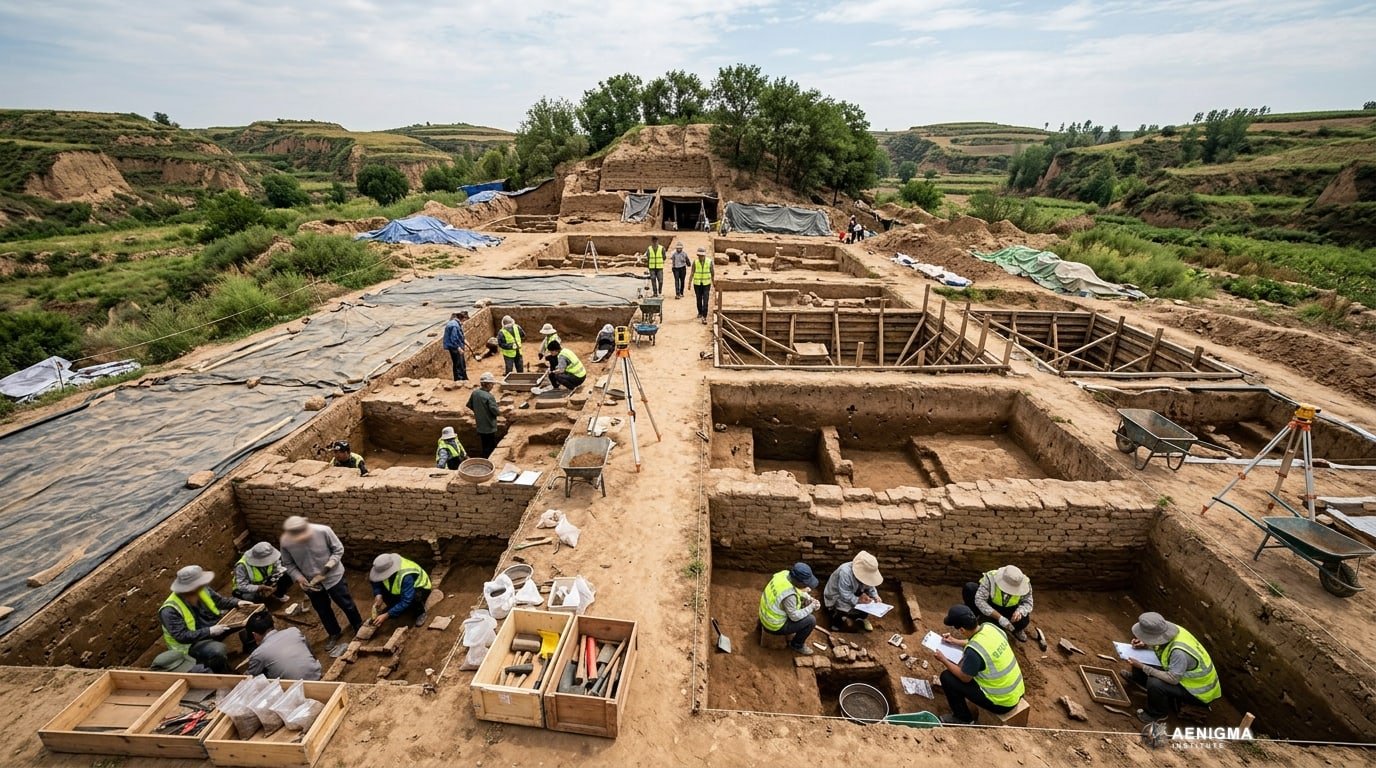
Why AENIGMA is covering this
The AENIGMA Institute is covering this site to clarify the distinction between observed archaeological data and historical interpretation. When a large, ancient structure is discovered, public discourse often gravitates toward identifying it with famous historical figures. It is essential to separate these compelling hypotheses from the physical evidence actually recovered from the ground. Furthermore, this coverage highlights the value of the peer-reviewed research being conducted at the site. While the media focuses on the unverified identity of the central tomb's occupant, the academic focus on the satellite tombs provides concrete, verified data about the laborers of the Qin state. By emphasizing this distinction, we aim to promote a more accurate understanding of how archaeological knowledge is constructed and where the current evidence truly leads.
What happened
Recent media reports have highlighted the investigation of a large archaeological tomb complex, suggesting it could be the final resting place of a prominent historical figure. Outlets such as HeritageDaily and Ancient Origins have published articles discussing the possibility that the site is the mausoleum of Empress Dowager Huayang. These reports focus heavily on the potential royal identity of the central tomb's occupant, drawing attention to the scale and historical significance of the site. Alongside these media reports, peer-reviewed research regarding the site has been published in the academic journal Antiquity. However, the focus of the formal academic literature diverges significantly from the narrative emphasized in the popular press. The Antiquity publications center on the analysis of satellite tombs associated with the main complex, rather than the central tomb itself. Specifically, the peer-reviewed studies investigate the social identities and physical remains of the laborers who were buried in these satellite locations. This distinction is crucial for understanding the current state of research at the site. While the media highlights a specific, high-profile historical hypothesis, the verified academic work currently available provides context regarding the broader social structures and labor practices of the era. The divergence between public reporting and academic focus is a common occurrence in archaeological discourse. Media outlets often prioritize the identification of named historical figures, which resonates strongly with general audiences. In contrast, contemporary archaeological methodology frequently prioritizes understanding the lives of ordinary people, such as laborers and craftspeople, whose experiences are rarely documented in historical texts.
What we know
Based on the available data, the site is a mausoleum complex dating to the late Warring States period. This era, which preceded the unification of China, was characterized by intense political and military competition among several regional powers. The architectural layout and material evidence indicate that the complex belongs to the Qin state, the power that eventually conquered its rivals and established the first Chinese empire. The physical layout of the site features a large central tomb surrounded by a series of satellite tombs. This spatial arrangement is consistent with the burial practices of high-ranking individuals in the Qin state during this period. The central tomb was designed to house the primary occupant, while the satellite tombs were utilized for secondary burials, which in this context included laborers associated with the construction or maintenance of the complex. Radiocarbon dating has been utilized to establish the chronological framework for the site. This method, which measures the decay of carbon-14 in organic materials, has provided dates that align with the late Warring States period. The application of radiocarbon dating is a standard procedure in modern archaeology, allowing researchers to anchor physical remains to specific historical epochs with a high degree of confidence. The peer-reviewed research published in Antiquity focuses on the individuals interred within the satellite tombs. Osteological analysis of these remains provides data regarding the physical condition, age, and sex of the laborers. Such analyses can reveal patterns of physical stress, dietary habits, and overall health, offering a window into the lived experiences of the lower social strata within the Qin state. The study of these laborers contributes to a broader understanding of the massive mobilization of human resources required for monumental construction projects during the Warring States period. The Qin state, in particular, was known for its highly organized and often coercive labor systems. The physical evidence from the satellite tombs serves as a direct material record of these historical labor practices. Furthermore, the scale and complexity of the mausoleum reflect the increasing social stratification and centralization of power that characterized the late Warring States period. As regional rulers consolidated their authority, their burial complexes grew in size and elaboration. These sites were not merely resting places but were designed as enduring monuments to the power and status of the ruling elite.
What we don't know
Despite the extensive scale of the mausoleum and the data gathered from the satellite tombs, the specific identity of the individual buried in the central tomb remains unknown. The archaeological evidence currently available does not provide a definitive name or title for the primary occupant. This absence of explicit identification is a frequent challenge in the study of ancient burial sites. To date, no definitive name-bearing inscription has been recovered from the central tomb. Inscriptions on bronze vessels, stone steles, or personal seals are typically required to conclusively link a burial site to a specific historical figure. Without such direct textual evidence, any identification remains a matter of interpretation rather than established fact. It is not known whether the central tomb belongs to Empress Dowager Huayang, as suggested by some media reports. While the dating and scale of the complex make it a royal tomb of the correct era, these factors alone are insufficient to confirm her identity. Multiple high-ranking individuals within the Qin royal family lived and died during the late Warring States period, and many would have commanded mausoleums of similar grandeur. Additionally, the specific contents and internal condition of the central tomb's burial chamber are not detailed in the provided facts. The extent to which the central tomb may have been impacted by historical looting, structural collapse, or environmental degradation is unknown. Such factors often obscure or destroy the very artifacts that could provide definitive identification. We also do not know the precise nature of the relationship between the laborers in the satellite tombs and the central occupant, beyond their spatial proximity. Whether these individuals were conscripted workers who died during construction, retainers, or victims of other burial practices cannot be entirely determined without further specialized analysis of the burial contexts.
What is claimed
A primary claim circulating in media reports is that the central tomb is the resting place of Empress Dowager Huayang. This hypothesis is constructed upon several observed characteristics of the site. Proponents of this interpretation point to the massive scale and complex layout of the mausoleum, which clearly indicate it was built for a figure of royal status within the Qin state. Furthermore, the radiocarbon dating of the site places its construction and use firmly within the late Warring States period. This chronological window aligns with the historical lifespan of Empress Dowager Huayang. Because she was a highly influential figure in the Qin court—serving as the adoptive grandmother of the future First Emperor, Qin Shi Huang—she is considered a plausible candidate for a burial of this magnitude. However, it is crucial to distinguish this hypothesis from an established archaeological finding. The attribution to Empress Dowager Huayang is an interpretation derived from circumstantial evidence—scale, layout, and dating—rather than direct, identifying proof. It represents a possible explanation for the site's origins, but it is not the only one. Another competing explanation, which is also considered possible based on the current data, is that the site is simply a late Warring States mausoleum belonging to an unidentified royal figure of the Qin state. This more conservative interpretation acknowledges the royal nature of the site without assigning a specific, unverified historical name to the occupant. An earlier claim regarding the site's origins has been formally ruled out. Initially, the tomb was suspected to belong to an emperor of the Northern Zhou dynasty, a period that occurred many centuries after the Warring States era. Subsequent archaeological investigations, likely involving more precise dating and architectural analysis, definitively corrected this initial assumption, confirming the site's origins in the much earlier Qin state.
What is verified
Several key facts regarding the site have been verified through archaeological investigation and peer-reviewed publication. It is established that the site is a large mausoleum complex featuring a central tomb and multiple satellite tombs. The physical layout and architectural characteristics are documented observations. It is verified that the complex belongs to the Qin state and dates to the late Warring States period. This chronological and cultural attribution is supported by radiocarbon dating and the material culture found at the site. The earlier hypothesis that the tomb belonged to a Northern Zhou dynasty emperor has been definitively ruled out by these subsequent investigations. The research published in the journal Antiquity is verified as peer-reviewed context. It is established that this academic work focuses on the satellite tombs and the osteological analysis of the laborers buried within them. The findings regarding the social identities and physical conditions of these laborers constitute the primary verified academic output currently associated with the site. Conversely, it is verified that no definitive name-bearing inscription has been found in the central tomb. Therefore, the claim that the central tomb belongs to Empress Dowager Huayang remains an unverified hypothesis. The distinction between the observed physical evidence of a Qin royal tomb and the historical interpretation of its specific occupant is a verified aspect of the current discourse.
Competing explanations
- Possible: The site is a late Warring States mausoleum belonging to an unidentified royal figure of the Qin state, as no definitive name-bearing inscription has been found.
- Possible: The central tomb belonged to Empress Dowager Huayang, a hypothesis based on the site's scale, layout, and radiocarbon dating matching the late Warring States period.
- Ruled out: The tomb was originally suspected to belong to an emperor of the Northern Zhou dynasty, but subsequent investigations confirmed it is from the earlier Qin state.
What would change our assessment
The assessment of the central tomb's occupant would change significantly if direct, identifying evidence were to be discovered and documented. The recovery of a definitive name-bearing artifact, such as a personal seal, an inscribed bronze vessel, or a jade artifact bearing specific titles, is the standard requirement for confirming the identity of an ancient royal burial. Any such artifacts would need to be excavated under controlled archaeological conditions to ensure their provenance and context. Following discovery, the inscriptions would require translation and verification by specialists in ancient Chinese epigraphy and history. Only through this rigorous process could a specific historical name be confidently attached to the site. Further peer-reviewed publications focusing specifically on the architecture, stratigraphy, and material contents of the central tomb would also alter the current assessment. If academic literature shifts its focus from the satellite tombs to the primary burial chamber, new data regarding the status, wealth, and specific cultural practices of the central occupant might emerge. Additionally, comparative studies analyzing this mausoleum alongside other confirmed Qin royal tombs could provide stronger circumstantial evidence. If the architectural anomalies or specific burial customs at this site perfectly match historical descriptions of Empress Dowager Huayang's burial, the hypothesis would gain weight, though it would still fall short of absolute confirmation without inscribed evidence.
Sources
- HeritageDaily (supports, unverified)
- Ancient Origins (context)
- Antiquity (context, primary)
- Antiquity (context)
Protocol AENIGMA-EF-0.1