Evidence: Unsubstantiated Explanation: Not enough data yet
Maya Urn with Jaguars and Skulls: What the Artifact Really Shows
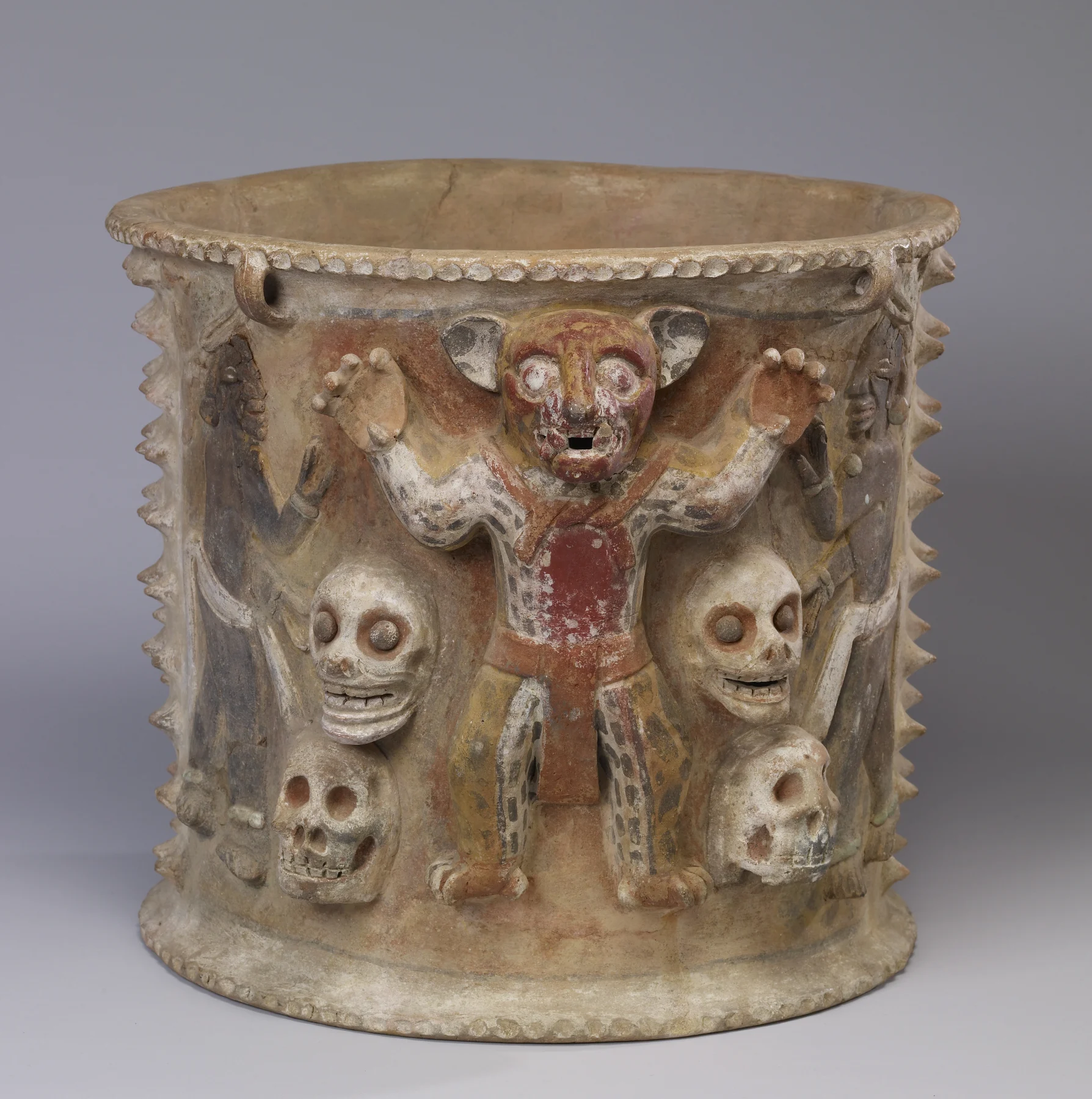
Maya underworld urn reports describe a 1,400-year-old ceramic burial container decorated with jaguars, human skulls, and spiked tree motifs. Popular accounts present the vessel as a depiction of a deceased ruler descending into the realm of the dead, yet archaeological analysis maintains a distinction between physical craftsmanship and symbolic interpretation. Current evidence leaves critical aspects of the vessel's original archaeological context unresolved.
Why AENIGMA is covering this
The vessel merits attention because it showcases the exceptional sophistication of Classic Maya ceramic artists and their complex engagement with questions of mortality, lineage, and cosmic balance. Funerary objects from Mesoamerica frequently capture the popular imagination, serving as visual entry points through which the public encounters pre-Columbian religious philosophies and symbolic systems. Reporting on such artifacts also provides an important opportunity to clarify how archaeologists separate observable physical traits from interpretive iconographical models. While popular treatments tend to condense nuanced symbolic traditions into dramatic single narratives, responsible archaeological reporting highlights both the brilliance of the artistic craft and the scientific boundaries of what the material can currently prove. By examining the vessel through the dual lenses of material evidence and comparative iconography, readers can appreciate the depth of ancient Mesoamerican cosmology without mistaking interpretive reconstructions for fully documented historical facts. Maintaining this objective perspective ensures that the material heritage of the ancient Americas is treated with appropriate precision, scholarly rigor, and cultural respect.
What happened
Public interest recently surged following reports detailing a remarkably intricate, 1,400-year-old ceramic vessel attributed to the ancient Maya civilization. Coverage by Live Science and complementary cultural commentary in JSTOR Daily highlighted the vessel as an elaborate funerary container designed to receive the remains of an elite individual. Visual depictions on the container feature stylized feline attributes, human cranial imagery, and prominent conical projections reminiscent of indigenous flora. Commentators focused on the narrative power of the vessel's sculptural program, framing it as an explicit journey undertaken by an ancient sovereign passing from life into the supernatural realm of Xibalba. Such representations capture broad public attention because they unite tangible ceramic craft with the complex mythology of the Classic Maya period. The striking combination of predatory imagery and skeletal features reinforces enduring popular interest in how ancient societies confronted mortality and the afterlife. At the same time, the sudden prominence of individual artifacts in news reporting often simplifies complex archaeological debates. The popular narrative quickly adopted the view that the container literally illustrates an elite ruler's arrival in the underworld, treating a single iconographic reading as an established historical event. Archaeologists and museum specialists, however, approach such objects through systematic analysis of material composition, regional decorative conventions, and depositional contexts.
What we know
The artifact under discussion belongs to the rich tradition of Mesoamerican ceramic craft, broadly dated by stylistic and comparative criteria to roughly 1,400 years ago, placing it within the Classic Maya era. During this vibrant epoch, urban centers across modern southern Mexico, Guatemala, Belize, and western Honduras developed sophisticated ceramic workshops that produced both daily utilitarian ware and highly decorated ceremonial objects. Funerary containers, censers, and offering urns played distinct roles in royal court rituals and ancestral veneration. Among the identifiable physical characteristics of the container are distinct conical spikes protruding across its exterior surface. In Mesoamerican iconographical research, these projections are well documented as stylized representations of the ceiba tree, specifically the young kapok tree (*Ceiba pentandra*), whose trunk bears sharp, conical thorns. In Maya cosmology, the ceiba serves as the central axis mundi, the sacred world tree whose roots penetrate the underworld while its trunk traverses the earthly realm and its branches support the celestial levels. Feline imagery on the container draws directly upon established Classic Maya artistic conventions regarding the jaguar. The jaguar held profound ideological significance across Mesoamerica, functioning as an emblem of royal power, martial prowess, nocturnal strength, and the underworld sun as it travels beneath the earth before morning rebirth. Classic period rulers frequently adopted jaguar pelt vestments, feline masks, and feline appellatives to assert their supernatural authority and continuity across cosmological realms. Cranial motifs, including skulls and skeletal jaws, are also well attested throughout Classic Maya mortuary art. These elements do not merely signify death as a terminal end, but represent transitional states of transformation, seed germination, and ancestral presence. Ceramic vessels decorated with ancestral iconography were frequently placed within tomb structures, cave sanctuaries, or architectural caches to serve as active ceremonial conduits between living descendants and honored lineage forebears. Scholars study such artifacts through specialized methods that combine non-destructive visual examination with technical diagnostic tests. Ceramicists catalog rim morphology, paste inclusions, surface slips, and modeling techniques to identify regional artistic traditions, such as those of the Usumacinta basin, the Petén lowlands, or the Chiapas highlands. When preserved, residues within ceramic matrices can be evaluated for traces of aromatic tree resins, copal, tobacco, or organic remains associated with mortuary ceremonies.
What we don't know
Despite the detailed physical features visible on the urn, several fundamental pieces of archaeological information remain unrecorded or unavailable in public accounts. Primary among these gaps is the exact provenience and stratigraphic context in which the vessel was situated prior to modern documentation. Without undisturbed stratigraphic data, researchers cannot determine whether the object was buried inside an elite masonry tomb, cached in a natural cave, or deposited as part of a temple termination ritual. It is also unconfirmed whether the container held osseous remains, cremated fragments, or perishable burial goods when it was originally interred. In the Maya lowlands and adjacent highlands, ceramic vessels performed diverse ceremonial roles, including serving as ossuaries, cinerary urns, incense burners, or symbolic focal points without containing skeletal material. Without rigorous chemical sampling or physical osteological evidence, identifying the artifact strictly as an urn for human remains remains an inference. Furthermore, the precise identity of the human figure depicted on the vessel cannot be definitively established from iconography alone. While the motifs denote status, supernatural proximity, and leadership attributes, ancient Maya artisans frequently utilized standardized iconographic conventions to depict generalized ancestors, cosmological deities, or composite supernatural beings rather than a specific historical individual. Without decipherable hieroglyphic name captions or an associated royal burial chamber, naming the figure as a specific sovereign remains speculative. Finally, the technological biography of the object—including the exact sourcing of its clay and mineral pigments—remains unpublished. Scientific provenance studies, which rely on petrographic thin-section analysis or instrumental neutron activation analysis, are necessary to establish where the clay was mined and whether the vessel was crafted locally or imported as a diplomatic gift. Until such studies are completed and verified, key dimensions of the vessel's manufacture and regional circulation remain unresolved.
What is claimed
The central claim advanced in media reports is that the ceramic container depicts a deceased Maya ruler at the precise threshold of his arrival in the underworld. According to this interpretation, the combination of feline characteristics, skeletal jaws, and kapok thorns serves as a direct pictorial narrative showing the sovereign assuming supernatural characteristics to survive the dangerous trials of the nocturnal realm. Proponents of this view suggest that the container functioned not merely as a decorative receptacle, but as an active ritual device facilitating the deceased's spiritual voyage. In this framing, the vessel encapsulates the ruler's dual role as both an earthly authority and an ancestral mediator capable of communicating across cosmological boundaries. The imagery is read sequentially, suggesting that the artistic composition captures an episodic transition from mortality to immortal ancestral presence. Another component of the claim relates the container to wider funerary practices surrounding elite lineage veneration. It has been proposed that the urn served as a permanent repository meant to be reopened or consulted during cyclical commemorative rites conducted by subsequent generations. While such ancestral rites were standard in various regions of ancient Mesoamerica, interpreting this specific container as an active ancestral portal relies on theoretical frameworks rather than physical proof recovered from an intact burial context.
What is verified
What can be positively confirmed from the physical artifact is its identity as a finely modeled ceramic vessel exhibiting iconography diagnostic of ancient Mesoamerican manufacturing traditions. The modeled feline features, the carved cranial forms, and the applique thorns correspond in design and technique to Classic period ceramic artifacts documented across the Maya area. The presence of the conical spikes is verified through visual inspection, and their structural resemblance to the ceiba tree trunk is fully consistent with established Mesoamerican artistic vocabularies. Comparative studies of pottery from the Maya highlands and lowlands confirm that artisans frequently integrated plant-based cosmology into ceremonial ceramics to evoke the central world tree and its connecting axis. It is also verifiable that the jaguar attributes and skeletal motifs reflect well-documented iconographical concepts associated with authority, predatory power, and the cyclical nature of life and death in Mesoamerican thought. However, distinguishing between what is physically present on the clay surface—the decorative program—and what the figures represent in theological terms requires careful adherence to the limits of material evidence.
Competing explanations
- Possible: The ceramic vessel served as a funerary container to hold ancestral remains, utilizing jaguar and kapok tree motifs to symbolize the deceased ruler mediating between the living and the underworld.
What would change our assessment
The current assessment status of the vessel as unsubstantiated and data-deficient would change if systematic archaeological and scientific investigations are conducted and published. First and foremost, securing comprehensive provenance documentation that details the discovery history, find-spot, and institutional custody of the object would provide an essential baseline for scholarly evaluation. Direct physical and chemical analyses would substantially elevate the state of knowledge regarding its intended purpose. Instrumental organic residue analysis, utilizing gas chromatography-mass spectrometry, could detect traces of incense resins, cacao, fats, or organic matter absorbed into the porous ceramic fabric. Demonstrating that the vessel contained specific mortuary substances, copal offerings, or decomposed organic materials would clarify whether it served as an incense burner, a food container, or an ossuary. In addition, mineralogical and petrographic testing of the clay matrix would allow researchers to match its mineral signature against documented clay deposits in Mesoamerica. Such material testing would determine whether the vessel originated from a known regional workshop center, such as the Palenque region, the Chiapas highlands, or the central Petén, thereby grounding its stylistic program within a verified local school of pottery. Finally, if the vessel is directly associated with an intact, scientifically excavated burial context that includes associated grave goods, radiocarbon-datable organic samples, and skeletal remains, the hypotheses concerning its funerary role could be tested definitively. Until contextual or analytical data of this caliber are published, the interpretation of the vessel will remain an informed but unproven hypothesis.
Sources
- Live Science (supports)
- JSTOR Daily (context)
Protocol AENIGMA-EF-0.1