Evidence: Unsubstantiated Explanation: Not enough data yet
Voynich Manuscript: What Scrambled Pages Really Mean for Its Decipherment
The Voynich Manuscript may owe much of its legendary impenetrability to pages shuffled and rebound out of order, according to a report published by Naked Science. Understanding whether the parchment folios were disarranged by an early bookbinder addresses long-standing puzzles about thematic breaks, scribal transitions, and abrupt shifts in botanical and astronomical illustrations. Physical rearrangement alone, however, leaves the underlying script and linguistic system entirely unread, leaving the core mystery unresolved.
Why AENIGMA is covering this
The Voynich Manuscript occupies a prominent position in the study of historical enigmas, frequently attracting sensational claims of sudden solutions and total decipherment. Responsible reporting requires separating tangible physical facts—such as the structure of parchment gatherings, the presence of multiple scribal hands, and evidence of historical rebinding—from speculative linguistic breakthroughs that have not been demonstrated. Examining structural proposals like page scrambling allows readers to understand the practical disciplines involved in manuscript studies. Before any ancient or medieval cipher can be decoded, conservators and historians must first understand the material object itself. Highlighting the boundary between codicological assembly and linguistic decipherment helps prevent public misunderstandings about how complex historical artifacts are analyzed and ultimately understood.
What happened
A report published by Naked Science highlights an analytical hypothesis proposing that the Voynich Manuscript's resistance to decipherment stems partly from pages bound out of their original sequence. The proposal suggests that an early binder, handling loose vellum leaves without understanding the writing or the intricate drawings, stitched the gatherings together in a corrupted order. If the physical leaves were reshuffled prior to the volume reaching modern collections, textual continuity and thematic progression would be broken across adjacent openings. This structural observation reframes how researchers look at the book's confusing divisions. For decades, cryptanalysts and linguists have treated the codex as a continuous narrative or a systematically arranged manual, searching for statistical patterns that bridge consecutive folia. Discovering that consecutive physical leaves might not represent consecutive thoughts alters the groundwork for any quantitative study of the writing. At the same time, this codicological proposal does not translate a single word or identify the language underlying the script. Codicology addresses the material anatomy of the book—the parchment sheets, folding patterns, sewing holes, and ink distribution across gutters. While correcting the page order can restore visual or thematic continuity, it does not decode the glyphs or verify the text as genuine language rather than an elaborate artificial construction.
What we know
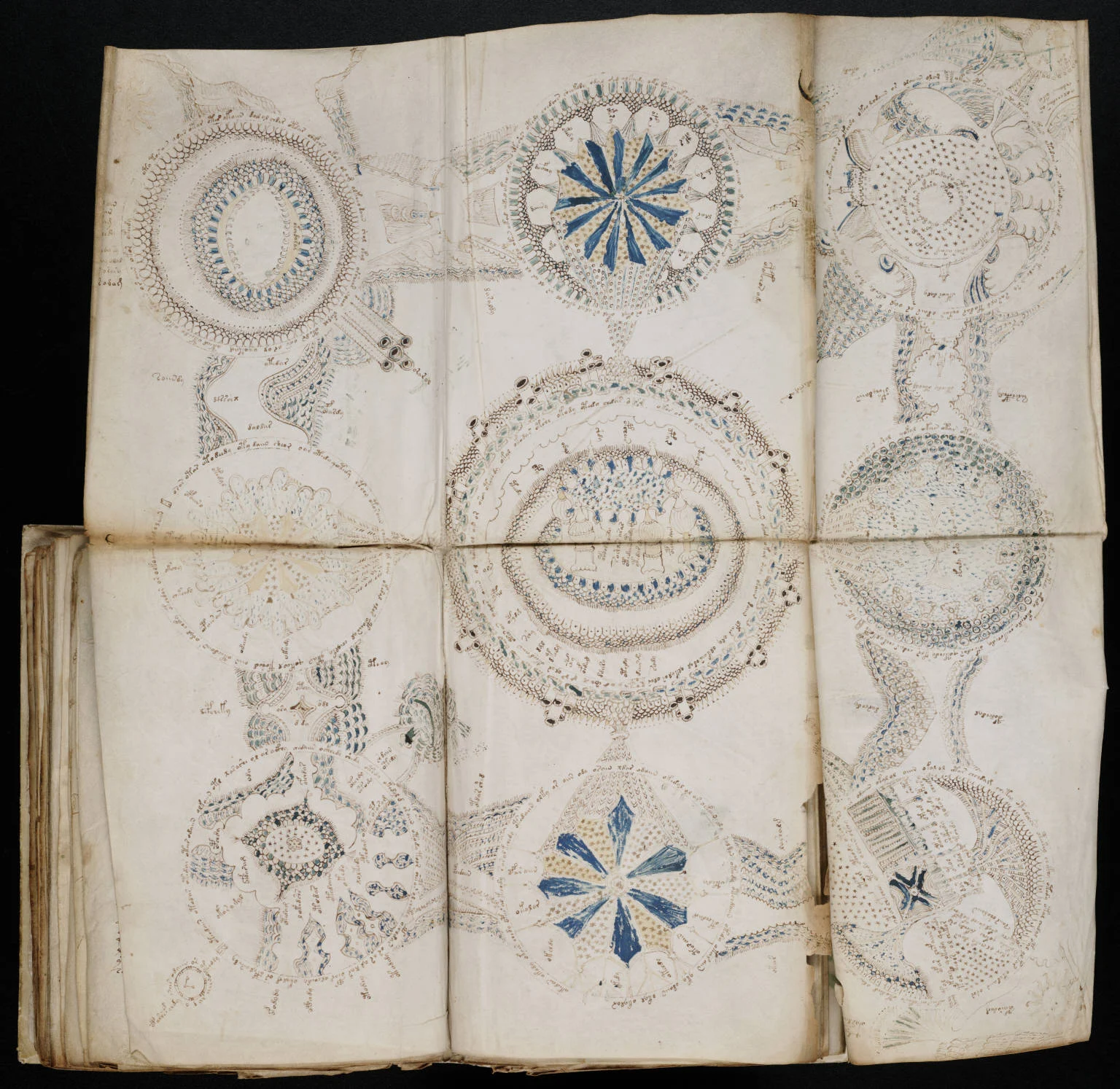
The physical reality of the Voynich Manuscript is well recorded through modern archival examination and conservation imaging. The codex consists of parchment bifolia—sheets folded in half to create two leaves and four pages—grouped into quires or gatherings, sewn into a binding that has been repaired and altered over centuries. Radiocarbon testing performed on samples of the vellum placed the animal skins in the early fifteenth century, firmly within the late medieval or early Renaissance period. The document is written in an otherwise unknown script featuring dozens of recurring glyphs, commonly termed Voynichese. These characters combine to form word-like units that follow distinct statistical rules, such as rigid word-initial and word-terminal conventions, yet lack the typical phonetic or grammatical flexibility found in natural European languages of the era. Accompanying the text are hundreds of hand-drawn illustrations tinted with colored washes, depicting unidentified botanical specimens, celestial diagrams, zodiac arrangements, intricate plumbing networks filled with human figures, and pharmaceutical vessels. Scholars have long documented that the manuscript is not a uniform, single-sitting work. Detailed examination of the handwriting demonstrates the presence of multiple scribal hands, each displaying distinct ductus, stroke sequences, and preferred character clusters. Furthermore, several illustrations cross the central gutter of open bifolia, proving that certain facing pages were planned and drawn together before or during the binding process, while other folios appear completely isolated in style and subject matter. Physical bindings from the late medieval and early modern periods were rarely permanent. Books were frequently sold as loose quires, rebound by subsequent collectors, trimmed, repaired, and rearranged to suit changing library shelves or to preserve damaged edges. Early numbering systems on the leaves—such as folio numerals added in early modern hands—indicate that observers centuries ago were already attempting to bring order to an assemblage of sheets whose original sequence had become unclear.
What we don't know
The true original sequence of the manuscript's leaves remains unverified. Because several quires are incomplete, with leaves cut away or missing entirely, scholars cannot reconstruct with absolute certainty how the maker arranged the gatherings when the parchment was first inscribed. The original sewing stations and early binding structures were repeatedly disturbed during historic repairs, erasing much of the physical thread and stitch evidence that could conclusively prove which sheet preceded another. It is also unknown whether the text is a natural human language disguised by a complex substitution cipher, a constructed artificial language, or an elaborate phonetic transcription of an unwritten dialect. Equally plausible under current data is the possibility that the text represents an intricate fifteenth-century hoax or an exercise in asemic writing, designed to appear meaningful without encoding any linguistic message whatsoever. Statistical analyses have yielded conflicting results, with some measures suggesting linguistic entropy comparable to natural speech and others pointing toward repetitive mechanical generation. Furthermore, researchers do not know who created the codex, in what exact geographic scriptorium or workshop it originated, or who owned it during its earliest decades. While historical records trace the manuscript through central European collections in the seventeenth century before its eventual acquisition by Wilfrid Voynich in the early twentieth century, its primary provenance remains filled with significant chronological gaps.
What is claimed
The core claim discussed in the Naked Science report is that early binding errors created an artificial labyrinth that has misled generations of decoders. According to this model, an early artisan who could not read the script received the manuscript as a collection of loose, unbound bifolia or disarranged quires and bound them haphazardly. The resulting disorder fragmented coherent herbal entries, interrupted astronomical sequences, and scattered related sections across distant parts of the codex. Advocates of this hypothesis contend that conventional cryptanalysis failed because it assumed the leaves follow an intentional, continuous narrative order. Under this view, statistical analyses that search for transitional probabilities across page boundaries inevitably produce noise rather than signal. By identifying misplaced bifolia and reconstructing their original thematic sequence, researchers claim that clearer structural patterns will emerge, finally allowing linguistic tools to be applied effectively. In addition, some interpretations suggest that recognizing multiple scribal hands working on separate, unbound leaves explains why different parts of the manuscript exhibit contrasting statistical properties. Rather than representing different stages of a cryptographic algorithm, these variations are claimed to reflect individual scribes copying distinct source materials onto separate quires that were never intended to be read in the arbitrary sequence established by the bookbinder.
What is verified
Archival and codicological inspection verifies that the Voynich Manuscript shows clear signs of historical disarrangement and repair. Several quires do not follow standard late medieval collation formulas, and the presence of missing folios, misplaced foldouts, and anomalous quire signatures confirms that the volume's current structure does not perfectly match its initial state. Conservators have documented that the manuscript was rebound at least once before entering modern institutional care. It is also verified that several large illustrations extend across the central fold of specific bifolia. In these instances, the drawings could only have been executed while the sheet of parchment was flat, demonstrating that the two conjoined leaves shared a definite structural relationship from the moment they were illuminated. However, this physical link applies only to leaves that form a single physical piece of parchment; it does not verify the intended sequence between different quires or between nested bifolia within a gathering. What remains entirely unverified is the claim that reordering the leaves enables the decipherment of the text. No proposed reorganization of the manuscript has resulted in a verified translation, a deciphered vocabulary, or a reproducible linguistic key. While rearranging the folios can create more plausible visual groupings—such as placing similar plant drawings together—it has not yielded readable sentences or authenticated historical prose.
Competing explanations
- Possible: The manuscript was originally composed of independent bifolia that were bound out of sequence by an early binder who did not understand the text.
- Possible: The manuscript was written and bound intentionally in traditional quires, and the apparent randomness stems from deliberate cipher mechanisms or multiple unrelated scribes.
What would change our assessment
A decisive shift in the assessment of the codex would occur if independent codicological evidence definitively established the complete original collation formula. Such evidence could include high-resolution multispectral analysis of the spine folds, revealing matching sewing holes, shared parchment flaws, contiguous ink offset patterns across leaves, or microscopic parchment grain alignments that prove two separate folios originally nested together in a specific sequence. On the linguistic side, an assessment would change fundamentally if a proposed page reordering revealed clear syntactical continuity across previously separated sheets. If placing folio A before folio B systematically resolved broken sentences, eliminated anomalous word endings at page transitions, and produced coherent text verifiable through external historical and linguistic benchmarks, the disarrangement hypothesis would move from an interesting structural possibility to an established reality. Conversely, the hypothesis would be weakened if rigorous material analysis demonstrated that the quires were written, illuminated, and sewn in an unbroken, deliberate sequence that matches medieval workshop conventions. Evidence showing that ink strokes consistently cross over the central sewing thread of gathered quires, or that catchwords and historical quire marks were applied by the primary scribes themselves, would confirm that the current arrangement was intentional from the outset.
Sources
- Naked Science (supports)
Protocol AENIGMA-EF-0.1