Evidence: Unsubstantiated Explanation: Not enough data yet
Hosanna trawler disappearance: What the English Channel wreck really shows
The French trawler Hosanna vanished with its five-man crew in 1980, leaving behind a decades-long maritime mystery. Recent dives in the English Channel have located a wreck matching its description, showing severe hull damage that suggests a collision. While dive teams have documented the site, formal verification of the vessel's identity and the exact cause of its sinking remains under investigation.
Why AENIGMA is covering this
The disappearance of a vessel with all hands is a profound trauma for coastal communities, leaving families and colleagues without answers or a place to mourn for decades. The discovery of the Hosanna 46 years later offers a rare opportunity to close a painful chapter in regional maritime history, providing long-awaited clarity to the descendants of the five lost sailors. Beyond the immediate human impact, the case highlights the evolving capabilities of underwater exploration. Modern diving technology, improved sonar, and dedicated research teams can now locate and document wrecks that easily eluded searchers in the past. Understanding the fate of the Hosanna also contributes to the broader study of maritime safety. By analyzing how and why vessels were lost in the crowded, hazardous waters of the English Channel before the advent of modern collision-avoidance systems, historians and maritime experts gain valuable insights into the historical risks faced by the fishing industry and the evolution of safety protocols at sea.
What happened
In 1980, the French fishing trawler Hosanna disappeared without a trace while navigating the waters of the English Channel. The vessel was carrying a crew of five sailors, all of whom were lost in an event that left no immediate debris field, distress signals, or survivors to explain the tragedy. For decades, the sudden vanishing of the ship remained an unsolved mystery, casting a long shadow over the coastal communities connected to the crew. The English Channel, known in France as La Manche, is one of the busiest and most treacherous shipping lanes in the world. It is characterized by heavy commercial traffic, unpredictable weather patterns, sudden fogs, and powerful tidal currents. In the era before the mandatory implementation of modern satellite tracking, Automatic Identification Systems, and advanced GPS, a small fishing vessel could easily slip beneath the waves unnoticed if a catastrophic event occurred rapidly. Forty-six years after the disappearance, the narrative shifted dramatically. In 2026, specialized underwater exploration teams conducted a series of dives in the Channel. The operations involved personnel from Mutiny Diving, who focused on gathering identification details from a newly located anomaly on the seabed, and Stichting OMV, who documented the physical state of the sunken vessel. Operating in the challenging, murky, and cold environment of the Channel floor, these divers managed to locate a wreck that closely matched the dimensions and profile of the long-lost Hosanna. The discovery dives brought the first visual evidence of the vessel to the surface in nearly half a century, transitioning the story from a historical vanishing act to an active underwater investigation.
What we know
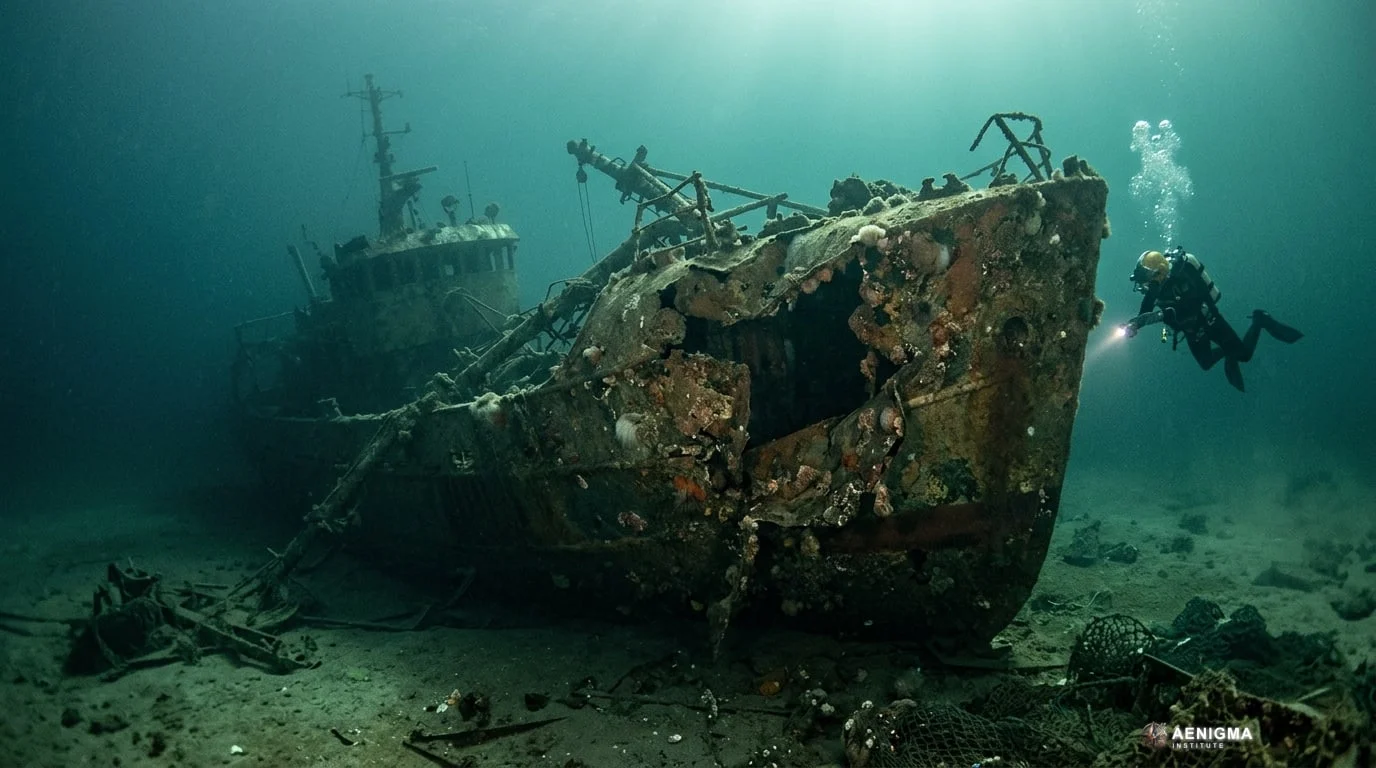
The physical evidence gathered from the seabed provides a grim picture of the vessel's final moments. The wreck rests in the English Channel, an environment where cold, oxygen-rich waters support abundant marine life. Over 46 years, sunken structures in this area typically become heavily encrusted with anemones, barnacles, and rust, complicating visual inspections. Despite these conditions, the synthesis of the identification details provided by Mutiny Diving and the physical evidence reported by Stichting OMV paints a consistent picture of a catastrophic event. The dive teams documented severe structural trauma to the vessel. Specifically, Stichting OMV reported finding a large crack and severe deformation on the hull of the wreck. In maritime forensics, the nature of hull damage is a primary indicator of how a ship was lost. Metal hulls subjected to massive blunt force trauma exhibit specific buckling and tearing patterns that differ significantly from the slow degradation of rust or the structural failure caused by heavy seas. The sheer scale of the deformation observed on this wreck points to a sudden, high-energy impact. Furthermore, the general layout, size, and remaining structural features of the wreck align with the known specifications of the Hosanna. The process of identifying a wreck usually involves looking for specific machinery, the arrangement of the decks, or unique modifications made by the owners. While the marine growth obscures many finer details, the broad strokes of the vessel's architecture have allowed the dive teams to confidently associate the wreck with the missing 1980 trawler. The synthesis of these two independent dive reports establishes that a vessel matching the Hosanna is on the seabed and that it suffered a massive structural breach before sinking.
What we don't know
Despite the compelling visual evidence from the 2026 dives, several critical aspects of the Hosanna's disappearance remain unknown. Chief among these is the identity of the other vessel presumed to be involved in the collision. There are no known distress calls, radio transcripts, or historical shipping logs from 1980 that detail a strike in that specific area at the time the trawler vanished. It is entirely unknown whether the crew of the other ship was aware of the impact. In the busy shipping lanes of the English Channel, it is historically possible for massive commercial freighters or tankers to strike a small wooden or light-steel fishing boat in the dark or fog without the larger ship's crew feeling the impact or realizing a collision occurred. The exact sequence of events on the night of the disappearance is also a blank page. We do not know the precise time the vessel went down, the weather conditions at the exact moment of the sinking, or what actions the five sailors took in their final minutes. Furthermore, the interior condition of the wreck has not been fully detailed. It is unknown if the internal compartments remain intact, if the ship's logbook survived in any readable form, or if any personal effects of the crew are preserved within the silt. Finally, while the dive teams have provided strong circumstantial evidence, formal and legal identification by state maritime authorities or government marine archaeologists has not yet been completed. The current understanding relies entirely on the initial reports and visual data gathered by the private dive teams.
What is claimed
Based on the physical state of the wreck, it is proposed that the Hosanna sank rapidly following a collision with another vessel. The large crack and the severe deformation on the hull are presented as the primary indicators of this violent encounter. Observers suggest that the damage is entirely inconsistent with a slow foundering, a fire, or a grounding event. The mechanics of maritime collisions support this theory. When a large merchant ship, carrying thousands of tons of cargo, strikes a small fishing trawler, the kinetic energy transfer is immense. Such an impact can instantly breach the hull, compromise the structural integrity of the smaller vessel, and cause it to take on water at a catastrophic rate. This rapid sinking scenario is put forward to explain the complete lack of debris, life rafts, or communication in 1980. If the Hosanna was struck and rolled over or pushed under the surface within minutes, the crew would have had no time to broadcast a Mayday signal or abandon ship. The collision theory effectively answers the long-standing question of why a seaworthy vessel manned by experienced sailors would vanish so completely and suddenly from one of the most heavily trafficked waterways in Europe.
What is verified
The existence of a trawler wreck on the floor of the English Channel is a verified fact, documented through the video and photographic evidence captured during the 2026 dives. The visual records clearly show a sunken vessel that has been resting on the seabed for decades. It is also verified that the hull of this wreck exhibits significant structural deformation and a large crack, confirming that the ship suffered severe physical trauma. The historical record confirms that the French trawler Hosanna and its five crew members were lost at sea in 1980, and that no trace of them was found at the time of their disappearance. The involvement of Mutiny Diving and Stichting OMV in the 2026 discovery and documentation process is a matter of record, with their respective underwater surveys providing the baseline data for the current understanding of the site. The synthesis of their findings—matching the physical dimensions of the wreck to the Hosanna and documenting the collision damage—forms the core of the verified observational data available today.
Competing explanations
- Possible: The trawler sank following a collision with another vessel, evidenced by a large crack and severe deformation on the hull.
What would change our assessment
To move the status of the wreck from a highly probable match to a definitively confirmed historical site, investigators would need to recover or clearly photograph an unambiguous identifier. In marine archaeology, this typically means locating the ship's bell, the builder's plaque, or the official registration numbers welded or carved into the hull. Clearing away decades of marine growth to find these specific markers is a meticulous process, but it is the standard requirement for absolute verification. A formal survey conducted by state maritime authorities or certified marine archaeologists would elevate the findings from private dive reports to an official historical and legal record. To definitively confirm the collision theory and potentially identify the second ship, further forensic work is required. Metallurgical analysis of the damaged hull section could determine the exact direction, angle, and force of the impact. Paint scrapings taken from the area around the large crack might reveal traces of the other vessel's hull paint, which could be analyzed chemically. Additionally, cross-referencing the exact coordinates of the wreck and the estimated time of sinking with historical shipping logs, port authority records, and radar archives from 1980 might identify large commercial vessels that passed through that specific corridor. Finding a record of a ship arriving in port with unexplained hull damage shortly after the Hosanna's disappearance would provide the missing link in the investigation.
Sources
- Figaro Nautisme (supports)
- CNEWS (supports)
Protocol AENIGMA-EF-0.1