Evidence: Unsubstantiated Explanation: Not enough data yet
Napoleon's secret code and what the AI decryption really shows
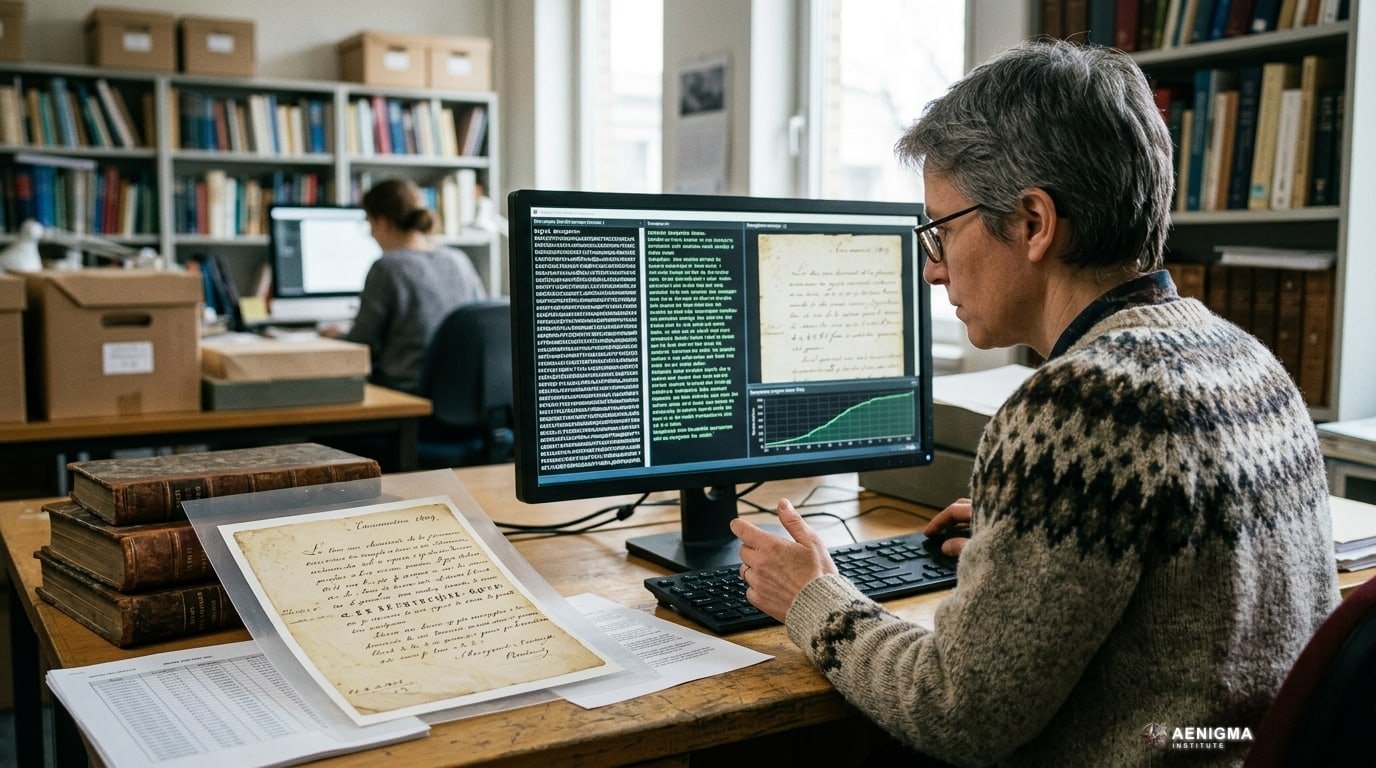
Napoleon's secret code from an 1809 letter has reportedly been deciphered by an artificial intelligence model in just six hours. The encrypted message, dating to the eve of the Austrian invasion, highlights the growing role of machine learning in historical cryptanalysis.
Why AENIGMA is covering this
The intersection of historical archives and artificial intelligence represents a significant frontier in modern research. Archives around the world hold countless encrypted manuscripts, diaries, and military dispatches that have remained unread due to the sheer volume of labor required to decode them. These shadow archives contain the private thoughts, secret strategies, and unvarnished communications of historical figures, offering a potentially transformative perspective on past events. If machine learning models can reliably transcribe and decrypt complex historical ciphers in a matter of hours, it could dramatically accelerate our understanding of history. The 1809 letter serves as a compelling case study for this technological shift. Understanding how military intelligence was communicated during the Napoleonic Wars provides deeper insight into the logistics, anxieties, and strategies that shaped European history on the eve of major conflicts. Documenting these technological applications helps track the evolving methods available to historians and archivists. As the tools for preserving and interpreting the written record advance, the barriers to accessing encrypted history are lowered. Exploring these developments highlights the ongoing effort to recover lost narratives and the innovative ways in which contemporary technology is being used to illuminate the enduring mysteries of the past.
What happened
The application of artificial intelligence to historical archives has introduced new methods for examining centuries-old documents, fundamentally altering how researchers approach unreadable texts. Archives across Europe house millions of pages of correspondence, much of it hastily written, damaged by time, or deliberately obscured. Recently, an engineer applied a modern artificial intelligence model, GPT-6 Astra, to an encrypted letter written during the Napoleonic era. The document dates to 1809, a period characterized by intense military preparation and widespread conflict across the European continent. For over two centuries, the specific contents of this message remained unread, protected by a complex homophonic cipher designed to frustrate enemy interception. According to recent accounts, the AI system managed to both transcribe the handwritten symbols and break the underlying code in a span of just six hours. Historically, breaking such a cipher required painstaking manual labor. Cryptographers would spend weeks or months conducting frequency analysis, identifying patterns, and testing hypotheses through trial and error. The physical condition of archival documents often complicates this process, as faded ink, degraded paper, and idiosyncratic handwriting make the initial transcription a formidable challenge in its own right. The use of a large language model to handle both the visual transcription of historical handwriting and the mathematical decryption of the text introduces a highly integrated workflow for historians. This approach attempts to bridge the gap between paleography—the study of historical writing systems—and cryptanalysis. The 1809 letter represents a tangible artifact from a critical juncture in European history. During this era, the rapid movement of troops and the coordination of vast armies relied entirely on written dispatches carried by couriers on horseback. These messengers faced constant threats from enemy patrols, spies, and harsh weather, making the encryption of sensitive information an absolute necessity. The survival of such a document for 217 years highlights the enduring nature of physical archives, even as the tools used to study them transition into the digital realm. The reported decryption event highlights a growing trend where computational power is directed toward the unsolved mysteries of the historical record.
What we know
The year 1809 places this encrypted letter precisely on the eve of the Austrian invasion, a defining moment in the Napoleonic Wars. During this time, the War of the Fifth Coalition was brewing, pitting the French Empire and its allies against the Austrian Empire and the United Kingdom. Secure communication across the vast expanses of Europe was vital for military logistics, strategic planning, and diplomatic maneuvering. Napoleon Bonaparte and his military commanders relied heavily on cryptography to protect sensitive troop movements, supply chain details, and tactical directives from falling into the hands of coalition forces. The encryption method favored during this period often involved homophonic substitution ciphers. Unlike a simple substitution cipher, where one plaintext letter always corresponds to one specific ciphertext symbol, a homophonic cipher assigns multiple symbols to high-frequency letters. For example, in the French language, vowels like 'E' or 'A' appear with great frequency. A homophonic system might provide five different symbols for 'E' and three for 'A'. This technique effectively flattens the frequency distribution of the ciphertext, making it highly resistant to standard code-breaking methods that rely on counting symbol repetitions to guess the underlying letters. The French military employed various iterations of these codes, sometimes changing them frequently or using different codebooks for different theaters of war. The evolution of these ciphers traces back to the Renaissance, but by the nineteenth century, the sheer scale of the Grande Armée necessitated a highly organized cryptographic network. These systems often incorporated nomenclators—specialized codebooks that included not only homophonic substitutions for individual letters but also unique symbols for common military terms, locations, or specific generals. This added layer of complexity meant that even if the basic alphabet was cracked, crucial strategic words remained obscured. We also know that modern artificial intelligence models possess significant capabilities in pattern recognition and data processing. Systems designed for natural language processing and machine learning can be adapted to recognize the statistical anomalies and structural rules of historical ciphers. These models can rapidly analyze vast amounts of text, identify linguistic patterns, and test millions of potential decryption keys in a fraction of the time it would take a human researcher. The integration of optical character recognition with advanced language models has increasingly allowed computers to assist in reading historical manuscripts.
What we don't know
The exact plaintext contents of the decrypted 1809 letter remain unspecified in the available data. It is not known whether the message contains routine logistical orders regarding supplies and troop billeting, sensitive strategic commands directed at high-ranking generals, or personal correspondence from the era. The historical impact of the letter cannot be fully assessed without understanding the specific information it conveys and the identities of the sender and recipient. The physical provenance of the document is also not detailed. The journey of the letter from the Napoleonic era to the present day—where it has been stored for the past 217 years, whether it resides in a national archive, a military museum, or a private collection—is currently unknown. Establishing the chain of custody is a standard part of historical research, providing context for how the document survived and why it remained undeciphered for so long. The condition of the physical paper, the type of ink used, and any accompanying unencrypted metadata on the envelope or margins are not described. Furthermore, the specific technical parameters of the artificial intelligence workflow are not fully transparent. We do not know the exact prompts provided to the GPT-6 Astra model, the nature of any specialized training data used to prepare the system for early nineteenth-century French, or the degree of human guidance required during the process. It is unclear how the model distinguished between accidental ink blots, faded paper, and intentional cipher symbols during the transcription phase. The error rate of the initial transcription, before the cryptanalysis began, is also unknown. It remains to be seen whether the AI model required a known plaintext attack—a method where a portion of the message, such as a formal greeting or a date, is already guessed to provide a foothold—or if it solved the homophonic cipher entirely from scratch. The internal mechanics of how the model navigated the potential presence of a nomenclator or specialized military jargon without prior context are not detailed in the current information.
What is claimed
It is reported that an engineer successfully utilized the GPT-6 Astra model to crack the 1809 Napoleonic cipher. The central assertion is that this artificial intelligence system completed the dual tasks of transcribing the historical document and breaking its homophonic code in exactly six hours. This timeframe is presented as a stark contrast to the 217 years the letter spent in an unread state, emphasizing the speed and efficiency of modern computational methods. The narrative suggests that the AI model was capable of combining visual recognition of the archival manuscript with advanced cryptanalysis into a single, streamlined workflow. Traditionally, these tasks are separated, requiring a paleographer to carefully transcribe the symbols before a cryptographer attempts to break the code. The claim indicates that the technology can autonomously navigate the complexities of early nineteenth-century French military encryption without the traditional, time-consuming manual labor usually required by human codebreakers. The reports imply that the model successfully handled the statistical flattening inherent in a homophonic cipher, identifying the multiple symbols used for high-frequency letters and reconstructing the original French text. This suggests a high level of pattern recognition and linguistic adaptability, allowing the system to process historical cryptography as a unified problem of translation and decryption.
What is verified
The story of the decryption has been covered by several media outlets, including Έθνος, Ancient Origins, and Parallaxi Magazine. These publications have reported on the engineer's use of the GPT-6 Astra model to address the 1809 cipher, bringing the intersection of artificial intelligence and historical research to public attention. It is a verified historical fact that 1809 was the year leading up to the Austrian campaign, making secure communication a documented priority for the French military at that time. The existence and mechanics of homophonic ciphers during the Napoleonic era are well-established in the cryptographic record, with numerous examples preserved in European archives. The use of such encryption methods was a standard practice for protecting sensitive state and military secrets during the early nineteenth century. Additionally, the technical capability of advanced AI models to process complex pattern recognition tasks and assist in cryptanalysis is a recognized development in computer science. The integration of transcription tools and natural language processing is a known area of active research within the digital humanities. Researchers have increasingly utilized machine learning to assist in reading damaged texts, translating ancient languages, and analyzing historical ciphers, demonstrating the broader utility of these technologies in archival settings.
Competing explanations
- Possible: An AI model, GPT-6 Astra, was used by an engineer to transcribe and crack the homophonic cipher of an 1809 Napoleonic letter in six hours.
What would change our assessment
Confirmation of the decryption's accuracy would require a thorough review by independent cryptographers and historians specializing in the Napoleonic era. Experts would need access to high-resolution images of the original encrypted letter to verify the initial transcription of the cipher symbols. Comparing the AI's transcription against the physical document ensures that no symbols were misinterpreted or hallucinated by the visual recognition software. The resulting French plaintext would need to be analyzed for linguistic authenticity. Historians would examine the vocabulary, grammar, and military terminology to ensure they align precisely with early nineteenth-century usage. Anachronistic phrasing or modern syntax would raise questions about the translation's accuracy. Cross-referencing the contents of the decrypted letter with established historical timelines, known troop movements, and the correspondence of key figures from 1809 would help anchor the document in its proper historical context. A detailed technical methodology outlining the engineer's process would clarify how the AI achieved the result. Access to the specific inputs, prompt logs, and the step-by-step progression of the model would allow computer scientists to understand the workflow. Replicating the process on other known, unsolved ciphers from the same period would demonstrate the reliability and consistency of the AI system, proving that the success was not an isolated anomaly but a repeatable method for historical cryptanalysis.
Sources
- Έθνος (supports)
- Ancient Origins (supports)
- Parallaxi Magazine (supports)
Protocol AENIGMA-EF-0.1