Evidence: Insufficient data Explanation: Not enough data yet
Shipwreck Padlock Mystery: What Internal Scans Really Reveal After 400 Years
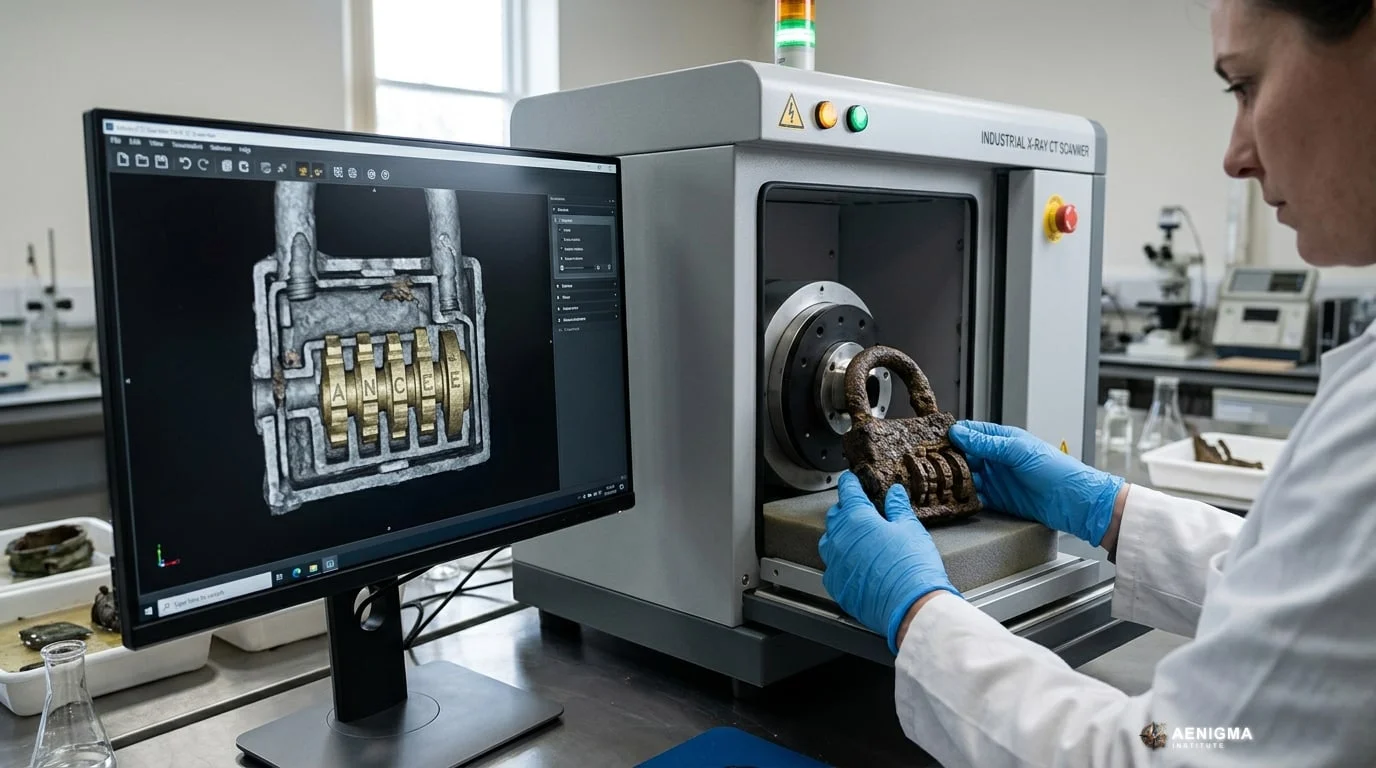
A four-hundred-year-old combination padlock recovered from an early modern shipwreck was examined using micro-computed tomography, as reported by Popular Science, revealing internal tumbler notches aligned to the letters ANCE. The non-destructive analysis illustrates how advanced industrial scanning can recover historical locking configurations without inflicting physical damage on fragile maritime artifacts. Independent confirmation and complete contextual documentation remain limited across public reporting.
Why AENIGMA is covering this
Non-destructive three-dimensional imaging represents one of the most critical methodological frontiers in modern cultural heritage preservation. For centuries, maritime archaeologists faced an unavoidable dilemma when confronting corroded composite artifacts: either preserve the physical exterior as an inaccessible, encrusted lump, or risk destroying internal components through invasive mechanical or chemical exploration. Examining how computed tomography resolves internal mechanical geometries allows the public to understand how conservation science actually operates behind museum walls. It demonstrates that the preservation of material heritage is no longer limited to surface observation, but encompasses the virtual extraction of mechanical data that remains otherwise hidden within impenetrable layers of corrosion. Covering these findings provides an opportunity to evaluate public scientific claims with strict analytical discipline. By distinguishing between verifiable physical observations—such as the digital reconstruction of mechanical notches—and broader speculative narratives about shipwreck lore, the publication maintains a rigorous, evidence-based perspective on the study of our shared maritime past.
What happened
A corroded four-hundred-year-old combination padlock recovered from an early modern shipwreck was analyzed using advanced micro-computed tomography, as reported by Popular Science. The non-invasive imaging process allowed researchers to look inside the sealed metal casing without physically forcing or chemically dismantling the delicate artifact. Digital reconstructions of the interior revealed that the internal notches on the locking tumblers were aligned to spell the letters ANCE. Maritime security devices from the late sixteenth and early seventeenth centuries rarely survive in working condition. Prolonged immersion in saltwater generates dense layers of mineral encrustation, while galvanic interaction between dissimilar metals typically fuses moving components into a single solid mass. Standard mechanical restoration of such objects frequently risks fracturing internal springs, pins, or bronze dials. Popular Science and syndicated outlets noted that by mapping thousands of cross-sectional X-ray projections into a volumetric model, investigators tracked the exact positioning of each internal disc. The discovery demonstrates the growing role of non-destructive testing in maritime archaeology, where preservation mandates prevent invasive handling. The imaging provides a clear look at how Renaissance-era artisans constructed portable mechanical security for trade vessels navigating global trade routes.
What we know
The artifact under examination is a multi-dial combination padlock dating roughly four centuries to the late Renaissance and Elizabethan period. Objects of this design were employed primarily to secure valuable cargo, navigational logs, personal correspondence, or trade specie stored in wooden sea chests aboard merchant and naval vessels. Unlike standard key-operated padlocks of the era, dial-based mechanisms relied on internal gating that permitted an internal shackle or bolt to withdraw only when specific lettered wheels aligned precisely. Micro-computed tomography, commonly abbreviated as micro-CT, operates on the same fundamental principles as medical computerized axial tomography but at vastly higher spatial resolutions. An industrial X-ray tube projects a conical beam through the target artifact while a precision stage rotates the object through 360 degrees. Thousands of two-dimensional transmission radiographs are captured by an electronic detector panel and converted into a three-dimensional matrix of voxels based on material density gradients. In maritime conservation, iron and copper-based alloys experience catastrophic chemical breakdown in marine environments. Seawater acts as an electrolyte, encouraging anaerobic bacteria and chloride ions to penetrate porous metal structures and form dense outer rinds of iron carbonate, quartz sand, and shell fragments known as marine concretion. Under conventional treatment protocols, uncovering internal details requires prolonged electrolytic reduction baths or mechanical micro-abrasion, both of which can destroy degraded internal components before their layout is recorded. Non-destructive virtual slicing sidesteps physical intervention by measuring the attenuation of radiation through the encrusted outer layers. Denser bronze and copper components produce different attenuation signatures than oxidized iron cores or hollow corrosion voids. Through segmentation software, conservators can isolate individual parts digitally, effectively disassembling the lock bolt, tumbler rings, and casing on screen while leaving the physical specimen completely untouched in its stabilized state.
What we don't know
Public reports do not provide the complete maritime archaeological context of the shipwreck from which the lock was recovered. Fundamental baseline details, including the identity of the vessel, the flag under which it sailed, the precise geographic coordinates of the wreck site, and the formal institutional registry where the artifact is curated, are omitted in circulating media accounts. The functional meaning of the four-letter combination ANCE remains unsettled. In late sixteenth-century Europe, lock combinations frequently corresponded to Latin religious mottoes, vernacular abbreviations, commercial marks, or personal initials chosen by the lockmaker or the chest owner. Without corroborating ship manifests, personal journals, or merchant ledgers tied directly to the vessel, any proposed reading of the letters remains an interpretive hypothesis rather than an established historical fact. It is also not known whether the combination discovered inside the mechanism represents the final operational code set by the crew before the ship sank, or merely an arbitrary manufacturing preset. Over decades of potential use or subsequent corrosion movement, internal tumblers may theoretically shift unless tightly mechanically bound. Establishing whether the lock was sealed around an intact chest hasp at the moment of deposition or discarded in an unlocked state requires complete contextual excavation records that have not been published in the available media summaries.
What is claimed
Media reports based on the Popular Science account claim that researchers have conclusively cracked the code of a four-hundred-year-old nautical mystery. Several secondary publications characterized the scan as solving an enduring maritime puzzle by revealing the four-letter sequence ANCE, presenting the code as an intentional password preserved perfectly beneath layers of seabed debris. The reporting asserts that the alignment of internal mechanical notches on the rotating dials demonstrates unequivocally that the lock was set to these four letters. Articles further suggest that this discovery provides direct insight into the cryptographic and security habits of early modern sailors, positioning the artifact as a remarkable example of Renaissance engineering surviving intact against centuries of marine corrosion. Some accounts emphasize the dramatic narrative of modern computer vision penetrating centuries of encrusted marine decay to read a forgotten personal secret. These narratives frame the four-letter sequence as a personal signature or deliberate code chosen by an individual facing disaster, linking the mechanical state of the artifact directly to the final dramatic hours of the lost ship.
What is verified
Verified data confirms that micro-computed tomography was utilized to generate internal density slices of a historic mechanical padlock, eliminating the need to physically open or damage the fragile object. The alignment of the mechanical notches on the internal rotating tumblers corresponds structurally to the external position reading the letters ANCE, establishing this configuration as a plausible mechanical state of the mechanism. The technical capability of high-energy micro-CT to distinguish between intact metal cores and surrounding corrosion layers on marine artifacts is thoroughly established across modern conservation science. Similar non-destructive imaging campaigns have successfully resolved internal gear trains on corroded astrolabes, clockwork remnants, and sealed iron strongbox locks recovered from sixteenth- and seventeenth-century underwater deposits. Beyond the physical orientation of the scanned components, however, external claims regarding the historical identity of the user, the symbolic meaning of the code word, and the specific narrative circumstances of the shipwreck cannot be verified from the technical data currently available. The physical observation is limited to the geometric orientation of internal notches; any attribution of intent or narrative significance remains interpretive.
Competing explanations
- Possible: Micro-computed tomography revealed the alignment of internal mechanical notches on the rotating dials, resolving the combination as ANCE without physical disassembly.
What would change our assessment
The evidentiary status of this discovery would advance from preliminary reporting to a fully established historical record with the publication of a formal archaeological conservation report. Such documentation would need to clearly define the provenance of the lock, the excavation methodology employed at the wreck site, and the stratigraphic layer where the item was recovered. A comprehensive metallographic analysis assessing the alloy composition of both the rotating dials and the central spindle would provide critical data regarding the lock's manufacturing origin. Differentiating between English, Dutch, French, or Iberian metallurgical signatures would anchor the artifact to a specific regional guild or production center, clarifying whether the lettering conforms to regional linguistic conventions. Archival discovery of contemporary merchant registers, trade inventories, or lockmaker pattern books documenting four-letter dial sequences would similarly ground the interpretation. If documentary evidence proved that ANCE was a standardized factory testing phrase or a widespread contemporary acronym, speculative interpretations regarding a private password could be decisively resolved.
Sources
- Popular Science (supports, primary)
- CretaOne (supports)
- Armees.com (supports, unverified)
- Storm Media (supports)
Protocol AENIGMA-EF-0.1