Evidence: Unsubstantiated Explanation: Not enough data yet
Bronze Age Hoard: What the Scottish Borders Discovery Really Shows
The Bronze Age hoard reported from the Scottish Borders has brought renewed attention to prehistoric craft and exchange in northern Britain. Accounts from BBC News and Yahoo News New Zealand indicate that an assemblage containing bronze axeheads, clay moulds, and a raw copper ingot was recovered following notification of statutory heritage authorities. Understanding the full historical weight of the finds requires rigorous scientific testing, detailed metallurgical study, and formal publication by National Museums Scotland.
Why AENIGMA is covering this
The Scottish Borders hoard deserves close public attention because it illuminates the complex technological systems and trade connections that sustained prehistoric societies long before written records existed. Discoveries containing raw ingots alongside casting debris are considerably rarer than hoards containing only finished weapons or ornaments. These production materials provide tangible insight into human skill, resource acquisition, and the specialized knowledge required to transform stone and fire into metal. The case also highlights the critical importance of heritage management protocols. In Scotland, the Treasure Trove system encourages responsible reporting by finder communities, which directly enables professional archaeologists to recover fragile materials that would otherwise be destroyed by unmonitored excavation. Clay casting moulds are exceptionally vulnerable to degradation; had the assemblage been retrieved without professional conservation, irreplaceable data regarding Bronze Age manufacturing techniques would have been lost. Covering this find allows the public to understand archaeology not merely as the recovery of ancient objects, but as a systematic forensic investigation. By separating early media statements from verified laboratory findings, readers gain a clear perspective on how artifacts are authenticated, studied, and integrated into our broader understanding of human history.
What happened
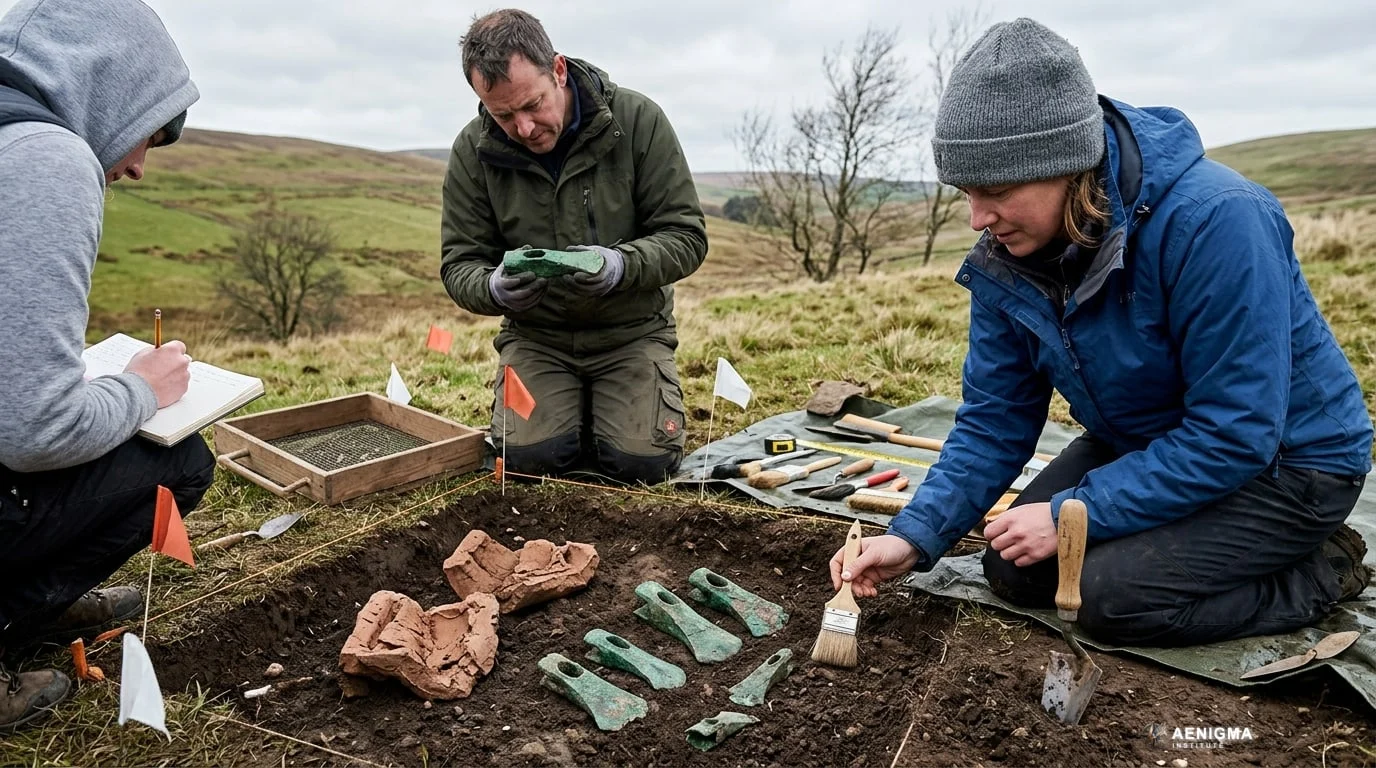
News outlets including BBC News and Yahoo News New Zealand reported the discovery of a prehistoric metal assemblage in the Scottish Borders, located by an individual using a metal detector. The find includes finished bronze implements alongside raw production materials and casting debris. Following the initial encounter, the find was brought to the attention of statutory heritage bodies responsible for archaeological discoveries in Scotland. The recovery of the material proceeded through established institutional protocols, culminating in controlled field recovery associated with National Museums Scotland. In modern archaeological practice, sensitive metallic groupings are frequently lifted as an intact earth block. This method preserves delicate micro-stratigraphy, fragile organic wrappings, and associated ceramic fragments that would otherwise disintegrate under open-air field conditions. The assemblage was subsequently transported into professional conservation laboratories for stabilization, detailed micro-excavation, and technical assessment. Early media accounts highlighted the presence of finished bronze tools, ceramic mould fragments used for casting, and an unworked copper ingot. These elements together point toward local metalworking activity rather than the simple deposition of circulating wealth. The announcement triggered widespread interest across Britain and the wider archaeological community. The discovery follows earlier high-profile finds from the same wider region, placing the Scottish Borders at the center of ongoing debates concerning Late Bronze Age technology, resource distribution, and community deposition practices.
What we know
The reported items form an assemblage typified by Late Bronze Age metalwork, an era in northern Britain spanning roughly 1000 BC to 800 BC. The items identified in media reports consist of bronze axeheads, fragments of fired clay casting moulds, and a lump of raw, unrefined copper. These components directly represent distinct stages of the metallurgical production chain, from raw material import to final tool finishing. In prehistoric Britain, copper was frequently alloyed with tin and sometimes lead to produce serviceable bronze alloys suitable for heavy-duty tools such as socketed axeheads. Raw copper ingots are comparatively uncommon in domestic deposits from this era. When present, they demonstrate access to inter-regional supply networks, as primary copper deposits were concentrated in specific geological zones across western Britain, Ireland, and continental Europe. The clay moulds represent another critical diagnostic element of the discovery. Late Bronze Age smiths typically utilized bivalve clay moulds formed around wooden or bronze models to cast socketed implements. Because these ceramic moulds had to be broken open to retrieve the cooled metal casting, surviving fragments provide direct evidence that metal was actively being melted and poured at or near the deposition site. The discovery also exists within a well-defined legal and institutional environment. Scotland operates under a distinct legal principle of bona vacantia, administered by the Treasure Trove Unit. Under this framework, all antiquarian finds found in the ground belong legally to the Crown and must be reported for assessment. This statutory system provides a pathway through which finds are protected from commercial dispersal and instead transferred to accredited museum collections for public benefit.
What we don't know
While the broad character of the assemblage has been reported by reputable media, numerous essential scientific parameters remain unpublished. The exact geological and chemical origin of the copper ingot has not yet been demonstrated through lead isotope analysis or trace-element fingerprinting. Without such laboratory data, researchers cannot determine whether the raw metal originated from British mines, Irish deposits, or continental networks in central Europe or the Mediterranean. The absolute chronology of the deposition remains unconfirmed by independent scientific dating techniques. Radiocarbon dates derived from associated organic remains, such as wood charcoal incorporated into the clay matrix of the casting moulds or preserved wooden haft fragments inside the socketed axes, are necessary to fix the assemblage into a narrow chronological horizon. Until radiocarbon assays are published, any assignment to specific ceramic or metalwork phases rests entirely on morphological comparisons. The structural nature of the find location is likewise undocumented in the public record. It remains unknown whether the hoard was buried within a domestic settlement, a fortified enclosure, an open agricultural landscape, or a marginal wetland environment. The presence or absence of surrounding settlement features, postholes, hearths, or ritual pits can only be resolved through systematic archaeological landscape survey. Finally, the intentionality behind the assemblage’s deposition remains open to interpretation. Archaeologists cannot yet establish whether the material represents a metalworker’s personal cache hidden during times of unrest, a workshop scrap hoard intended for remelting, or a deliberate, structured votive offering placed into the ground with no intention of retrieval.
What is claimed
Competing explanations regarding the discovery center on its socioeconomic context and cultural meaning. One primary interpretation holds that the assemblage of bronze axeheads, clay moulds, and the raw copper ingot represents a cohesive Late Bronze Age industrial cache. In this view, the find provides tangible evidence of an itinerant or resident smithy operating within regional metallurgical traditions identical to those documented in the Peebles Hoard. Proponents of this functional interpretation suggest that the assemblage constitutes a workshop assemblage: raw copper supplied the metal base, the axeheads served either as finished inventory or scrap metal reserved for alloying, and the broken moulds witness active local manufacturing. Such models view the Scottish Borders as a dynamic, self-sustaining center of production that integrated raw materials imported from outside the region into local material forms. A secondary, alternative perspective interprets the deposit through the lens of ritual practice. Throughout prehistoric Europe, the deposition of metalwork in the earth was rarely a purely utilitarian act. The deliberate burial of valuable productive equipment, including virgin metal and the very instruments used to produce tools, could reflect ceremonial decommissioning. In several documented European traditions, casting tools were ritually broken and buried upon the death of a master craftsperson or to mark communal boundaries, rather than discarded as casual waste. Media reports also suggest potential familial or collaborative links between this discovery and earlier finds in the area. While public interest naturally connects consecutive discoveries made in the same administrative county, archaeological specialists stress that stylistic similarities do not automatically prove that identical individuals, workshops, or specific decades were involved in creating both deposits.
What is verified
At present, the verified baseline of the story rests on consistent reports published by accredited media outlets, specifically BBC News and Yahoo News New Zealand. These sources independently report that a metal detector user discovered the cache, notified statutory authorities, and facilitated an institutional intervention led by National Museums Scotland. It is confirmed that the material recovered comprises finished bronze axes, ceramic mould components, and unworked copper metal. These components match the well-documented typological repertoire of Late Bronze Age northern Britain. Furthermore, the handling of the assemblage falls squarely within the statutory oversight of the Scottish Treasure Trove system, ensuring that custody, conservation, and legal processing remain under formal institutional governance. Beyond these basic empirical points, further claims regarding trade provenance, specific workshop identity, or absolute calendar dates remain unverified pending official scientific publication. The evidence status of the overarching find remains categorized as unsubstantiated until National Museums Scotland releases formal post-excavation reports and comprehensive material characterization.
Competing explanations
- Possible: The assemblage of bronze axeheads, clay moulds, and a raw copper ingot represents Late Bronze Age metal production and deposition directly linked to regional metalwork traditions seen in the Peebles Hoard.
What would change our assessment
The current evaluation of the discovery would advance substantially with the release of formal laboratory analyses. The application of non-destructive analytical techniques, including portable X-ray fluorescence (pXRF) and scanning electron microscopy coupled with energy dispersive X-ray spectroscopy (SEM-EDS), would definitively determine the elemental composition of the axeheads and the raw ingot. Lead isotope analysis of the copper ingot would provide a transformative evidentiary step. By matching isotopic ratios of lead impurities in the copper against established databases of European, Irish, and British prehistoric mines, researchers could trace the exact geographic source of the ore. This would determine whether the Borders community was obtaining metal from local British sources like Alderley Edge and the Great Orme, or drawing upon Atlantic maritime routes extending to the Iberian Peninsula or the Mediterranean. Petrographic and ceramic analysis of the clay moulds would yield similarly critical data. Thin-section petrography can identify mineral inclusions within the clay matrix, establishing whether the moulds were fabricated using local Scottish Borders alluvial clays or manufactured elsewhere and transported as portable equipment. Microscopic analysis of bronze residues adhering to the interior mould faces would also clarify which specific tool types were cast on site. Finally, a comprehensive stratigraphic report detailing the soil micro-environment and any associated radiocarbon determinations from secure archaeological layers would resolve the depositional date. Publication of these findings in a recognized archaeological journal or institutional monograph by National Museums Scotland will provide the necessary peer-vetted framework to resolve remaining ambiguities.
Sources
- BBC News (supports)
- Yahoo News New Zealand (supports)
Protocol AENIGMA-EF-0.1