Evidence: Supported Explanation: Not enough data yet
Phobos and the Martian Moons: Japan Prepares a Return Mission
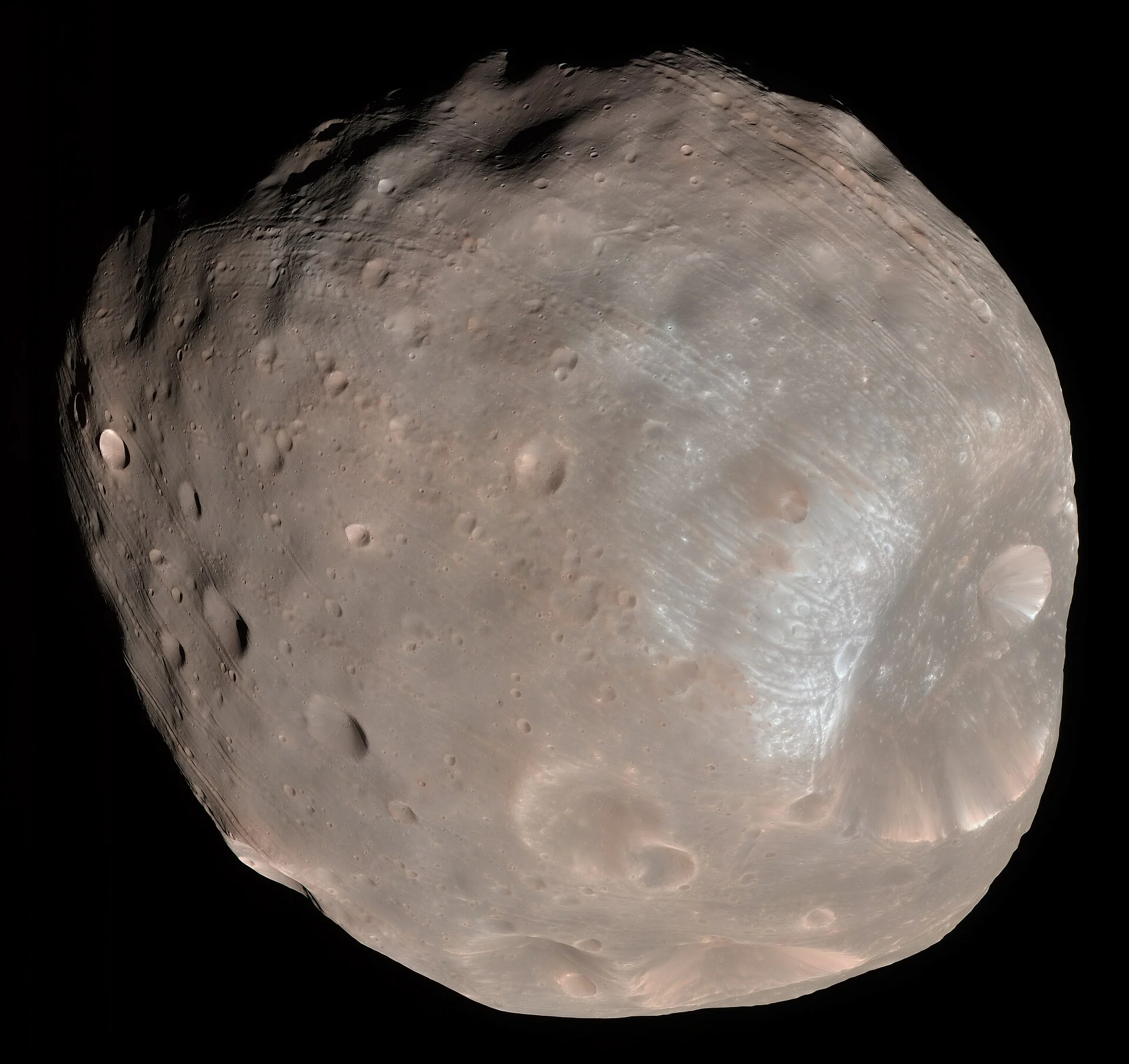
Phobos and Deimos remain two of the most puzzling small bodies in the inner solar system, dividing planetary scientists between the giant impact model and the captured asteroid theory. Japan is developing a dedicated sample-return mission to land on Phobos and bring pristine regolith back to terrestrial laboratories. Official announcements confirm international participation from space agencies including NASA to resolve the origins of the Martian system.
Why AENIGMA is covering this
The mission to Phobos represents one of the most ambitious planetary exploration efforts of the coming decade, targeting a mystery that has puzzled astronomers since the moons were first discovered in the nineteenth century. Resolving whether Phobos is an asteroid or impact debris addresses foundational questions about planetary system formation, debris disc dynamics, and orbital evolution in the inner solar system. Sampling Phobos also offers an ingenious pathway for planetary geology. Because Phobos has orbited Mars for billions of years, its surface acts as an unweathered repository that may have preserved ancient Martian material ejected by impacts before Mars lost its early magnetic field and surface water. AENIGMA maintains systematic coverage of small-body exploration, tracking verified engineering advancements, robotic sample-return protocols, and terrestrial laboratory developments. As space agencies finalize mission hardware and approach launch windows, separating documented engineering facts from theoretical models remains essential for an evidence-first understanding of deep space exploration.
What happened
Japan is advancing plans to send a sophisticated robotic spacecraft to Mars's largest moon, Phobos, with the objective of gathering material from its surface and bringing it back to Earth. Reports from New Scientist and official updates from NASA Science describe the initiative as an international effort to address long-standing questions regarding how the Martian moons formed. The mission will navigate into the Martian orbital environment, conduct detailed surveys of the Martian system, and land briefly on Phobos. Unlike flyby missions or orbiters that rely exclusively on remote instrumentation, this undertaking aims to secure physical samples of regolith and return them to terrestrial laboratories for comprehensive geochemical analysis. International space agencies are contributing critical scientific payloads and logistical support to the endeavor. NASA Science documents direct participation in the development of instrumentation, reflecting a shared priority across the planetary science community to investigate the origin and evolution of the Martian satellite system.
What we know
Phobos is an irregularly shaped body measuring roughly twenty-seven kilometers across its longest dimension, orbiting closer to Mars than any other known moon orbits its primary planet. Its orbit is exceptionally low, circular, and closely aligned with Mars's equatorial plane, causing Phobos to complete an entire revolution around Mars in just over seven and a half hours, faster than the planet's own rotational period. The moon's surface exhibits very low optical reflectivity, showing dark, spectral characteristics that resemble carbonaceous chondrite asteroids typically found in the outer main asteroid belt. These spectral signatures have long suggested to researchers that Phobos and its smaller companion Deimos could be primitive asteroids nudged inward and snared by the gravitational field of Mars early in the history of the solar system. Yet dynamicists face profound difficulties reconciling gravitational capture with the current orbital parameters of the Martian satellites. When small, unbound bodies are trapped by a planet's gravity, they generally enter eccentric, highly inclined, or chaotic trajectories, requiring complex dissipation mechanisms to settle into tight, near-circular equatorial paths. Because of these orbital constraints, an alternative hypothesis suggests that a massive collision struck early Mars, ejecting enormous volumes of planetary crust and mantle into orbit. Over time, this debris ring would have coalesced into small moonlets, naturally forming in nearly circular equatorial orbits around the planet's equator.
What we don't know
The fundamental origin of Phobos and Deimos remains completely unresolved due to insufficient data from current remote-sensing measurements. Without direct, laboratory-grade isotopic and petrological analysis of physical samples, researchers cannot definitively prove whether the moon represents captured primordial asteroid material or recycled impact ejecta from early Mars. Scientists do not yet know the degree to which Phobos's surface regolith has been altered by ongoing space weathering, micrometeoroid bombardment, and continuous exposure to cosmic radiation. Such processes can dramatically alter optical spectra, darkening and reddening celestial surfaces in ways that mimic carbonaceous asteroid compositions. It is also unknown how much material originating from the surface of Mars itself has been deposited on Phobos across billions of years. Large impacts on Mars frequently lofted rock fragments into orbit, and dynamic models suggest Phobos would have inevitably swept up significant quantities of ancient Martian ejecta, but the concentration and state of that cross-contamination remain unmeasured. Finally, the internal structural integrity of Phobos is undetermined. Planetary scientists cannot yet verify whether the moon is a coherent, fractured rock mass or a low-density rubble pile composed of loosely aggregated fragments held together by minimal self-gravity.
What is claimed
Proponents of the captured asteroid hypothesis argue that the low albedo, low bulk density, and flat, featureless reflectance spectra observed across Phobos are unmistakable signatures of primitive, carbonaceous asteroidal material. Under this interpretation, the moon represents a relic from the outer asteroid belt or the early outer solar system, preserved in a Mars-crossing orbit and subsequently captured. Conversely, supporters of the giant impact hypothesis claim that gravitational capture into nearly circular, coplanar orbits is statistically improbable under known orbital mechanics models. They contend that only an impact-generated debris disk could account for the tight equatorial alignment of both Phobos and Deimos, predicting that returned samples will reveal silicate minerals and isotopic compositions tied directly to Mars's early mantle and crust. Mission planners anticipate that collecting surface regolith from Phobos will serve a dual scientific purpose. By sampling the upper layer, the mission aims to collect both the native substrate of Phobos and fine particles of Martian rock blasted into space by impacts across geological epochs, effectively offering an indirect sample of ancient Mars alongside the moon's native geology.
What is verified
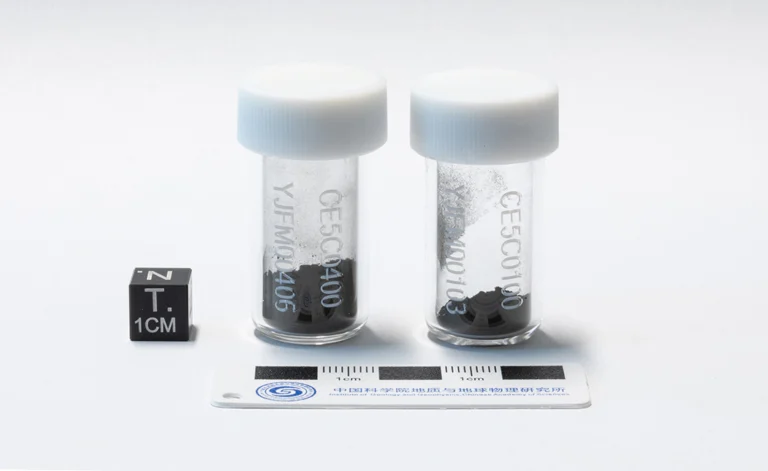
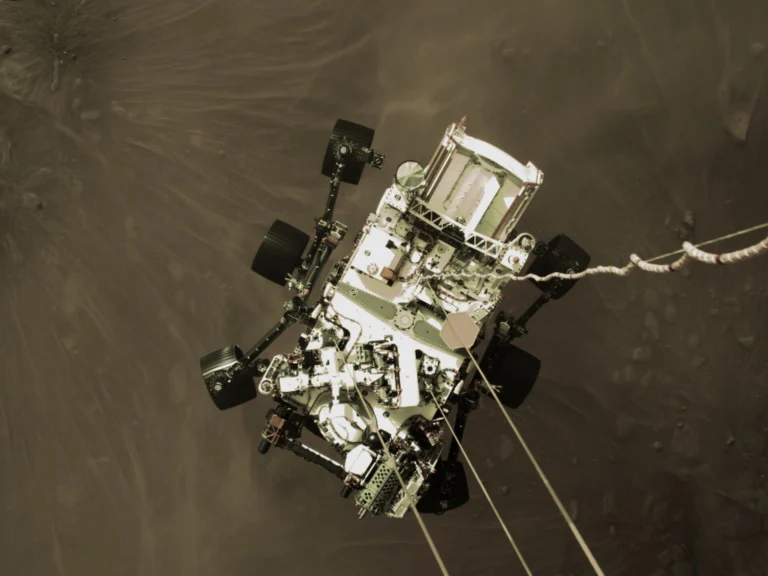
Verified mission documentation from NASA Science and reporting by New Scientist confirm that the mission architecture includes dedicated landing and sampling subsystems. Engineers have developed dual sampling mechanisms, integrating pneumatic systems and core drill tools designed to interact with the microgravity surface environment of Phobos. Pneumatic sampling systems are built to utilize pressurized gas to direct loose regolith grains and dust into containment canisters during brief surface touch encounters. In parallel, mechanical core drill systems are engineered to penetrate beneath the immediate weathered veneer, extracting coherent material from deeper layers that have been shielded from recent space radiation and solar wind. Extensive testing in simulated vacuum and low-gravity environments has verified the operational parameters of these collection tools. Ground testing demonstrates that combining a gas-assisted surface collector with a mechanical drill maximizes the likelihood of securing the target mass required for exhaustive isotopic analysis upon return to Earth. Independent tracking and trajectory calculations confirm that Phobos remains an accessible target for small-body sample return due to its weak gravitational well, allowing spacecraft to land, sample, and depart with significantly lower propellant requirements than would be necessary for a landing on Mars itself.
Competing explanations
- Possible: Phobos and Deimos coalesced from debris ejected by a massive collision on Mars, which explains their nearly circular equatorial orbits.
- Possible: The moons are primitive asteroids captured by Mars's gravitational field, consistent with their optical spectra and irregular shapes.
What would change our assessment
The current state of insufficient data would change definitively once physical samples are sealed in terrestrial cleanrooms and subjected to precise high-precision mass spectrometry and isotopic analysis. Laboratories on Earth possess analytical instruments that are orders of magnitude more sensitive than any miniature spectrometer that can be mounted on a robotic deep-space probe. Measuring the ratios of stable oxygen isotopes (specifically oxygen-16, oxygen-17, and oxygen-18) will immediately test the two competing origin models. If the oxygen isotope ratios match the distinctive planetary signature established by Martian meteorites, it will provide conclusive proof that Phobos coalesced primarily from Mars-derived debris produced in a giant impact. If the returned material displays isotopic compositions and volatile contents characteristic of carbonaceous chondrites or cometary matter—completely decoupled from the Martian fractionation baseline—the captured asteroid hypothesis will be confirmed. In that case, theoretical astrophysicists will need to revise dynamical capture models to explain how such a body settled into a circular equatorial orbit. The identification of organic compounds, hydrated minerals, and noble gas isotopic signatures trapped within the mineral matrix will further establish the thermal history and evolutionary path of the parent body. Any definitive detection of ancient, pristine Martian crustal fragments within the regolith would simultaneously unlock direct records of Mars's earliest atmospheric and geochemical environment.
Sources
- New Scientist (supports)
- NASA Science (supports, primary)
- NASA Science People (context)
Protocol AENIGMA-EF-0.1