Evidence: Supported Explanation: Explained
Moonquakes Threaten Planned NASA Artemis Landing Regions Across South Pole
Moonquakes and active thrust faults driven by lunar interior cooling pose significant structural hazards for planned NASA Artemis landing zones. Studies documented in The Planetary Science Journal and reported by TechNews show thousands of young scarps across the lunar surface capable of triggering intense, shallow ground shaking. Understanding these single-plate tectonic processes is vital for long-term lunar infrastructure.
Why AENIGMA is covering this
The transition from short-duration lunar exploration toward long-term human presence and industrial surface operations marks a critical shift in space engineering. Investigating planetary geology at candidate landing sites is necessary to protect astronaut safety, preserve scientific assets, and ensure that multi-billion-dollar outposts are engineered against natural environmental hazards. A clear understanding of lunar geophysics also dispels the persistent public misconception that planetary bodies lacking liquid water and plate tectonics are entirely motionless. Differentiating between Earth's complex plate boundary dynamics and the contraction-driven deformation of single-plate planetary bodies enriches public scientific literacy. By tracking the intersections of published geophysical research, media reporting, and mission operational planning, this coverage underscores the practical value of fundamental planetary science. Rigorous evaluation of the Moon's interior processes is not merely an academic inquiry; it forms the empirical foundation upon which the future of sustainable lunar exploration is constructed.
What happened
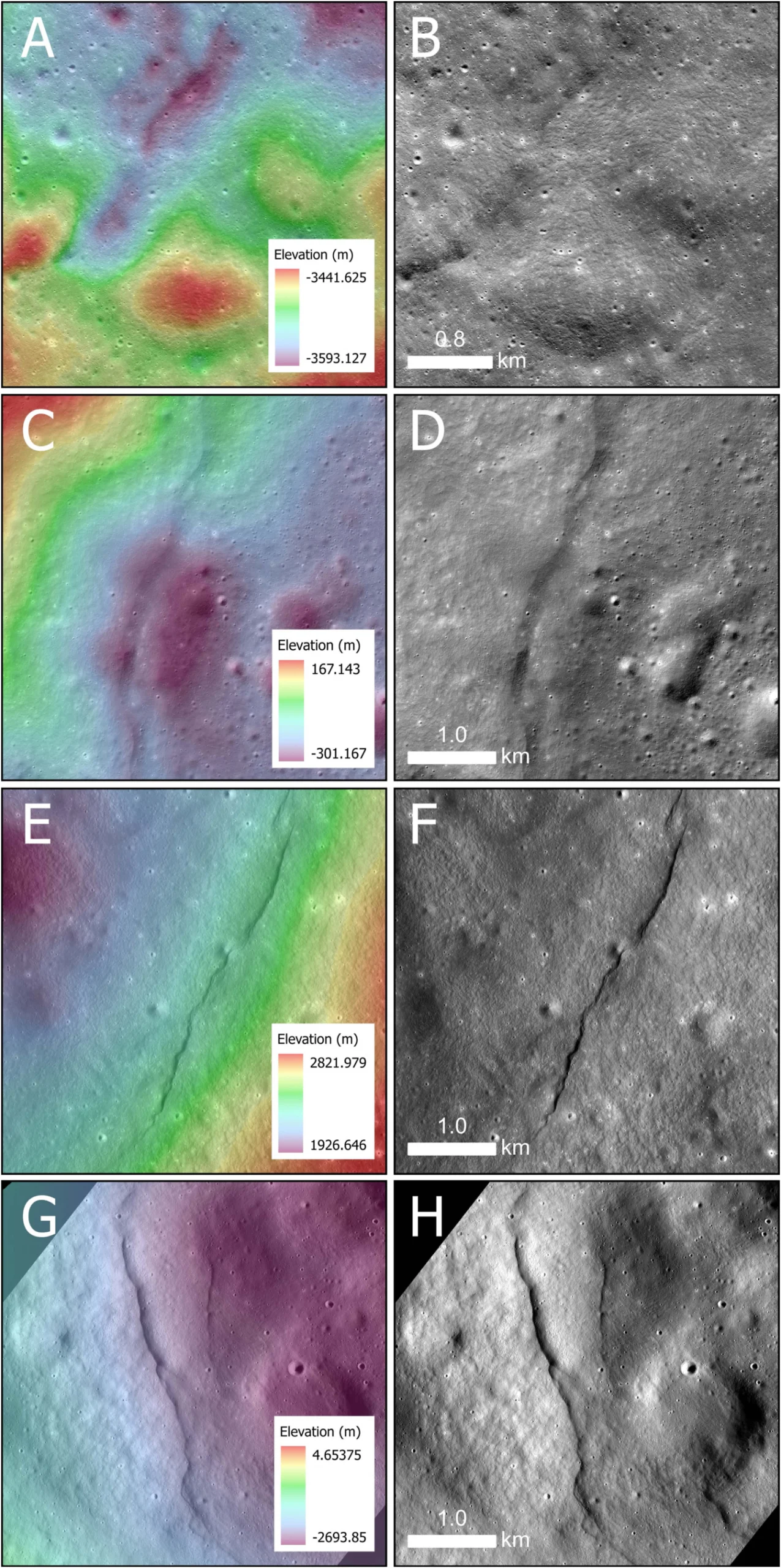
Planetary geologists analyzing surface imagery and seismic records have identified thousands of young thrust fault scarps across the lunar crust, indicating that the Moon remains tectonically dynamic. As reported by TechNews and contextualized in research published in The Planetary Science Journal, these compressional structures are directly linked to shallow seismic events known as moonquakes. Several of these geological features intersect regions under active consideration as candidate touchdown locations for NASA's Artemis program near the lunar south pole. The identification of ongoing faulting challenges long-standing historical assumptions that the lunar interior has settled into complete geological dormancy. High-resolution optical surveys have revealed extensive networks of small, lobate scarps cutting across impact craters, polar ridges, and polar basins. Because these scarps alter relatively young craters and regolith mantles, researchers conclude that thrust fault movement has occurred recently in geological terms and is likely ongoing today. The Artemis campaign intends to deploy crewed expeditions and semi-permanent surface installations to polar territories where permanently shadowed craters harbor valuable water ice reserves. However, the presence of active thrust faults introduces previously underestimated operational risks, ranging from prolonged regolith displacement to direct foundation destabilization. As human spaceflight programs plan extended surface stays, characterizing the seismic profile of these targeted landing corridors has shifted from a theoretical exercise to an immediate engineering requirement.
What we know
The Moon functions as a one-plate planetary body, lacking the interconnected network of moving crustal plates that defines terrestrial plate tectonics. On Earth, tectonic activity primarily arises at convergent, divergent, and transform boundaries where rigid slabs interact through subduction, rifting, and strike-slip translation. On the Moon, global contraction serves as the primary driver of lithospheric deformation. As the lunar interior steadily cools over billions of years, its overall volume contracts, generating compressive stresses that fracture the rigid upper crust and force rock masses upward along low-angle thrust faults. These thrust events manifest topographically as lobate scarps—curving, asymmetric ridges that typically span several kilometers in length and rise tens of meters above the adjacent terrain. Global orbital imagery gathered by modern lunar reconnaissance platforms has mapped thousands of these scarps across both the lunar near side and far side. Because these features consistently cut through small, unweathered impact craters, planetary geophysicists determine that they represent some of the youngest structural deformations on the lunar surface. Seismological data from the Apollo era provide direct empirical evidence that the lunar crust experiences distinct classes of seismic activity. Passive seismic experiments deployed between 1969 and 1972 recorded four operational categories of lunar ground motion: deep moonquakes occurring hundreds of kilometers below the surface driven by tidal stresses, thermal moonquakes generated by diurnal temperature swings, artificial and natural meteoroid impact tremors, and shallow moonquakes. Among these, shallow moonquakes represent the most energetic events, originating at depths between a few tens to a few hundred kilometers and releasing significant structural energy. Unlike earthquakes, which are rapidly attenuated by moisture and deep sedimentary layers, ground motion on the Moon is exacerbated by the absence of fluid saturation and the heavily fractured nature of the dry lunar regolith. Seismic energy scatters repeatedly throughout the shattered megaregolith with minimal dissipation. Consequently, shallow moonquakes can persist for dozens of minutes or even hours, exposing any surface installation to sustained high-frequency shaking.
What we don't know
Current knowledge regarding the exact frequency, precise focal depths, and local magnitude distributions of moonquakes across the lunar south pole remains constrained by the historical layout of passive seismometers. The Apollo seismic network operated strictly within an equatorial to mid-latitude belt on the lunar near side, leaving the polar regions entirely unmonitored by in-situ instruments. Consequently, while orbital imagery documents the geographic existence of scarps near the south pole, scientists do not possess direct, real-time seismic records from those high-latitude zones. The long-term slip rate along individual lobate scarps is also not definitively established. Current orbital mapping methods can demonstrate that a scarp is morphologically young based on crater degradation states and regolith cross-cutting relationships, but resolving whether displacement occurs in episodic, high-magnitude bursts separated by millennia or via more frequent, lower-intensity slips is impossible without dedicated local monitoring. Furthermore, the precise depth of fault planes beneath the lunar megaregolith layer remains uncertain. The mechanical properties of the shattered, porous upper layer differ markedly from the coherent crystalline bedrock underneath, complicating efforts to model how rupture energy propagates to surface outposts. Geotechnical engineers lack comprehensive empirical measurements regarding how unconsolidated polar regolith will behave when subjected to hours of sustained, low-gravity seismic vibration, particularly concerning slope instability and foundation settlement on crater rims.
What is claimed
Science reporting in TechNews emphasizes that candidate landing clusters for the upcoming Artemis missions coincide directly with mapped active fault scarps, potentially exposing planned human infrastructure to destructive moonquakes. The coverage highlights that these compressional landforms are not ancient, static relics, but active sites where crustal deformation can trigger significant ground accelerations and localized landslides. Discussions surrounding research from The Planetary Science Journal indicate that cooling-induced global contraction continues to generate sufficient deviatoric stress within the lunar lithosphere to cause slip along thrust surfaces. These assessments suggest that the lunar south pole, prized for its access to continuous solar illumination and subterranean volatile deposits, possesses an active seismic environment that cannot be disregarded during the selection of touchdown zones and habitat sites. Some technical projections argue that unanchored landing vehicles, delicate scientific equipment arrays, solar power masts, and rigid pressurized habitat modules could sustain structural fatigue or lose stability under the sustained duration of a shallow moonquake. The argument posits that mission planners must factor structural seismic resilience, ground isolation, and active fault avoidance into initial architectural blueprints rather than treating the Moon as an inert, vibration-free platform.
What is verified
The existence of lobate scarps throughout the lunar highlands and polar terrain is fully verified through extensive orbital imaging and stereophotogrammetric digital elevation models. These morphological structures display clear, crisp margins that dissect small micro-craters, confirming that deformation has occurred in geologically recent epochs and that the contractional stress field remains an active physical phenomenon within the single-plate lunar body. Archived data from the Apollo Passive Seismic Experiment reliably verify that shallow moonquakes reach magnitudes comparable to moderate terrestrial earthquakes and produce unusually extended durations of shaking. Re-examination of Apollo event hypocenters using modern relocation algorithms demonstrates that several detected shallow seismic events correlate closely with mapped lobate scarp systems. What remains verified is that the physical mechanism—interior thermal cooling driving global contraction—is thermodynamically sound, fully accepted by planetary geophysicists, and sufficient to explain the distribution of compressional faults without invoking terrestrial-style mantle convection or plate boundaries. The scientific consensus, as reflected in peer-reviewed planetary literature, agrees that the Moon is not entirely geologically dead, and that active faulting is a verified crustal process operating across the lunar globe.
Competing explanations
- Accepted: Continued cooling and late-stage contraction of the lunar interior compresses the crust, producing lobate scarps and thrust faults capable of shallow moonquakes.
What would change our assessment
The current assessment that shallow moonquakes present a tangible operational hazard to southern polar landing sites would be revised if deployment of modern, high-sensitivity seismometers in the polar regions demonstrates that local scarp systems are completely dormant. If in-situ monitoring detects no micro-seismic events along high-latitude lobate scarps over extended monitoring intervals, the risk profile for those specific sectors would be downgraded. Conversely, the assessment of risk would be substantially elevated if new seismic arrays record frequent, high-amplitude events originating near planned base locations. Direct observation of recent regolith displacement, boulder rolling, or fresh trench scarps captured by repeat high-resolution orbital imaging would provide unambiguous proof of ongoing, highly localized rupture. Further geotechnical testing of lunar regolith mechanics under sustained vibration could also refine current engineering models. If granular materials under lunar gravity are found to compact rapidly and resist cyclic liquefaction or slope failure during shaking, ground instability concerns for heavy infrastructure may be mitigated. Conversely, if low-gravity shaking accelerates granular flow on modest slopes, zoning restrictions around steep crater rims would require immediate expansion.
Sources
- 科技新報 TechNews (supports)
- The Planetary Science Journal (context, primary)
Protocol AENIGMA-EF-0.1