Evidence: Insufficient data Explanation: Not enough data yet
Treble Clef Cosmic Waves: What NASA's Chandra Data Really Shows
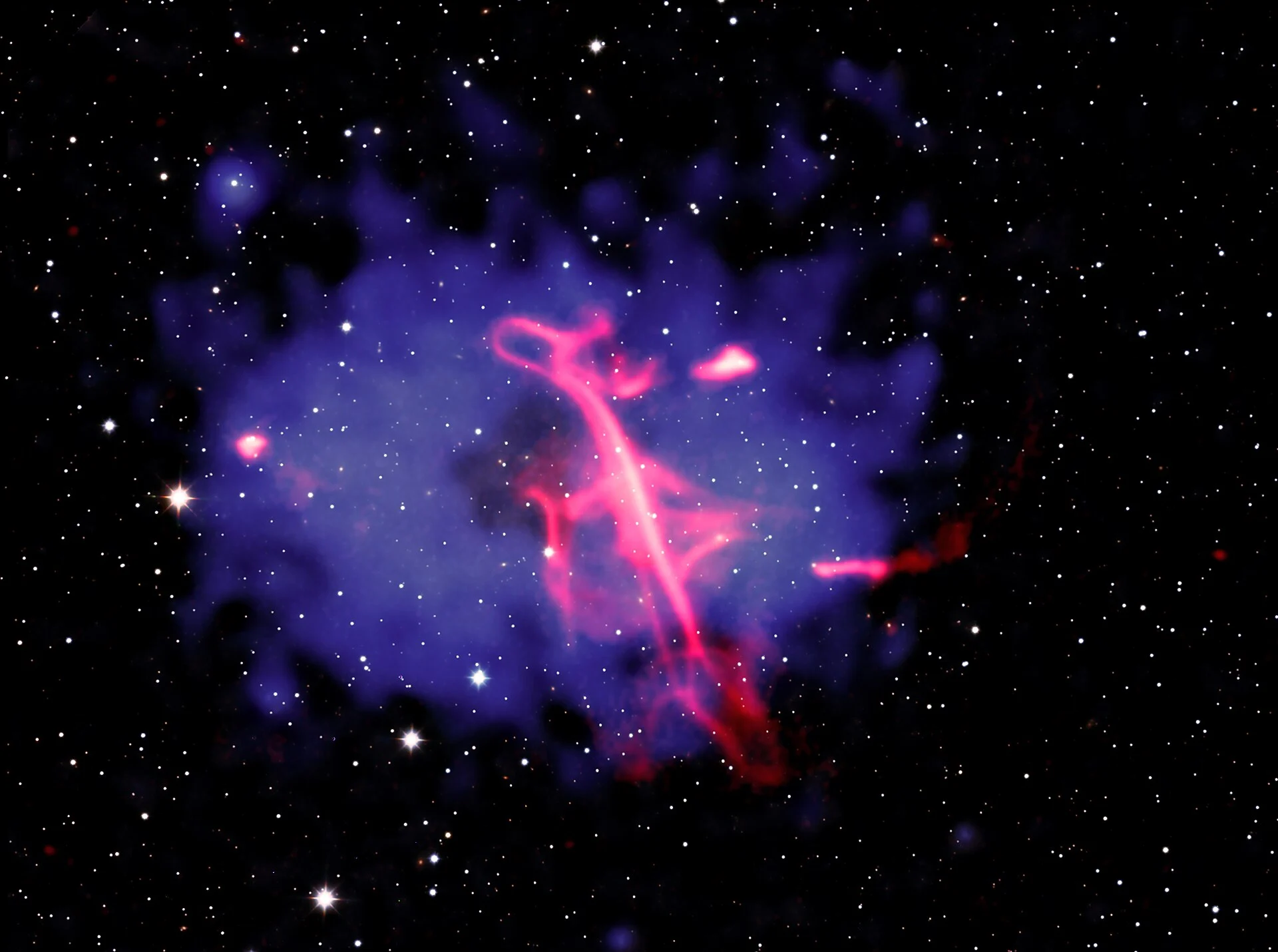
The treble clef cosmic structure observed across radio and X-ray wavelengths has drawn attention as astronomers investigate its physical formation mechanism. NASA's Chandra X-ray Observatory provides data suggesting the configuration stems from an active galactic nucleus outburst altered by colliding galaxy clusters. A closer examination of the observational evidence separates the dynamics of merging clusters from speculative interpretations of cosmic shapes.
Why AENIGMA is covering this
Astronomical discoveries that present familiar shapes frequently capture public interest, sometimes fostering ungrounded interpretations that obscure the underlying science. Reporting on the treble clef structure provides an opportunity to explain how high-energy astrophysics investigates complex cosmic structures using empirical observation rather than subjective visual association. Clarifying these mechanisms grounds the phenomenon firmly within established astrophysical principles. The case highlights the vital role of multi-wavelength astronomy in deconstructing energetic processes that remain invisible to optical instruments alone. By examining how radio emissions trace relativistic particles while X-ray sensors map surrounding thermal environments, observers gain an accurate appreciation of modern observational techniques. This multi-band approach exemplifies the rigors of modern space science, where disparate datasets are combined to test dynamic physical hypotheses. Documenting the status of the investigation also clarifies the boundary between what is observed and what is currently interpreted. While the treble clef pattern is an established physical observation, its proposed origin remains a working scientific explanation that awaits further observational testing. Tracking such developments reinforces the methodology of high-energy astrophysics, demonstrating how preliminary models evolve as more detailed data become available.
What happened
High-energy space telescopes and ground-based radio arrays periodically reveal morphological structures in deep space that resemble familiar terrestrial symbols. An intriguing formation resembling a musical treble clef emerged in radio wave observations of distant galaxy clusters, prompting astronomers to seek a physical explanation for its distinctive curves and loops. To determine the processes responsible for tracing such geometries across hundreds of thousands of light-years, researchers turned to X-ray observations gathered by NASA's Chandra X-ray Observatory. Chandra's imaging capabilities detect diffuse thermal radiation from superheated gas permeating galaxy clusters, illuminating areas where gravitational and kinetic energy interact. By cross-referencing radio wave patterns with thermal X-ray emissions, astrophysicists identified signatures of energetic outflows intersecting with large-scale cosmic gas motions. The data point to an interaction driven by an active supermassive black hole embedded in a dynamic galactic environment, where colossal kinetic forces reshape emitted plasma into curving filaments. Astronomical data repositories have cataloged the coordinates and multi-frequency profiles of the region for ongoing structural analysis. Rather than representing an isolated anomaly, the treble clef pattern illustrates the complex interplay between galactic feedback and environmental pressures operating across millions of years. As multi-wavelength analyses advance, the system provides a case study in how energetic ejections from central black holes deform when subjected to the turbulent crosswinds of colliding clusters.
What we know
Galaxy clusters represent the most massive gravitationally bound structures in the universe, containing hundreds or thousands of individual galaxies immersed in diffuse, high-temperature gas known as the intracluster medium. This intracluster gas reaches temperatures of tens of millions of degrees, causing it to glow brightly in the X-ray spectrum. NASA's Chandra X-ray Observatory is designed specifically to map the density, temperature, and structural gradients of this hot plasma with high spatial resolution. At the core of massive galaxies residing within these clusters, supermassive black holes intermittently enter active phases. During these outbursts, known as active galactic nucleus events, gravitational forces draw in surrounding matter while launching relativistic plasma jets perpendicular to the accretion disk. These jets emit synchrotron radiation observable by radio telescopes, creating extensive radio lobes that push against the surrounding intracluster medium. When galaxy clusters collide, the interaction generates massive shock waves, turbulence, and large-scale gas sloshing within the gravitational potential well. These environmental motions exert significant ram pressure on any existing radio lobes or expanding outflows. The physical collision between clusters acts as a dynamic hydrodynamic wind, capable of shearing, bending, and twisting straight plasma jets into complex curvilinear trajectories. Multi-wavelength observations combine disparate frequency bands to construct a comprehensive view of these phenomena. Radio data track relativistic electrons spiraling along magnetic fields, while X-ray observations map the thermal pressure distribution and bulk motion of the cluster gas. Infrared and optical data identify the stellar components and precise positions of member galaxies, contextualizing the energetic output relative to the host galaxy's position.
What we don't know
Despite the precision of modern X-ray and radio observatories, significant observational gaps remain regarding the precise history and temporal evolution of the system. Astronomers cannot observe the physical motion of these structures in real time, as hydrodynamic processes on cluster scales unfold over hundreds of millions of years. Current observations represent a single static snapshot, leaving open multiple potential sequences of events that could have produced the current three-dimensional morphology. The exact magnetic field strength and orientation within the radio-emitting filaments are not fully constrained by available measurements. Magnetic fields play a decisive role in confining relativistic plasma and determining synchrotron cooling rates, yet mapping field topologies in turbulent cluster environments presents severe technical difficulties. Without detailed polarimetric data across multiple radio frequencies, the degree to which magnetic confinement resists external gas stripping remains uncertain. It is also not definitively established whether the observed structure is the result of a single continuous black hole outburst or multiple recurring energetic episodes. Intermittent accretion activity can produce successive generations of plasma bubbles that interact with one another, creating layered shells and loops that mimic a single continuous filament. Furthermore, the true three-dimensional geometry is obscured by line-of-sight projection effects, meaning curved structures could either be planar features or helical projections viewed end-on. Finally, the exact mass distribution, merger velocity, and collision angle of the interacting subclusters remain subject to refinement. Variations in the relative velocity of the colliding systems significantly alter the modeled ram pressure, creating multiple viable hydrodynamic solutions. Until deeper multi-band spectroscopy can constrain the relative line-of-sight velocities of the interacting gas components, alternative geometric configurations cannot be entirely ruled out.
What is claimed
Public discussion and viral reporting often emphasize the visual likeness of cosmic formations to recognizable objects, labeling the structure a cosmic treble clef and inviting speculative commentary regarding its nature. In popular media, such patterns are occasionally framed as extraordinary mysteries or unexplained geometric puzzles drifting through space. These characterizations typically detach the visual silhouette from the underlying high-energy physics governing astrophysical plasma. In scientific discourse, the working explanation attributes the structure to a supermassive black hole outburst altered by the dynamic forces of colliding galaxy clusters. Proponents of this model explain that relativistic jets ejected from a central galaxy encountered intense hydrodynamic winds generated by the merger event. The resulting ram pressure bent the expanding lobes, while gravitational sloshing within the cluster core further curved the trailing filaments into the observed loop-and-stem configuration. This explanation presents a unified scenario that accounts for both the localized radio emission and the broader thermal gas distribution revealed by Chandra. It suggests that the apparent complexity of the treble clef shape requires no novel physics or exotic mechanisms. Instead, it frames the phenomenon as a predictable outcome of fluid dynamics, magnetic confinement, and gravitational acceleration occurring on an extragalactic scale.
What is verified
Verified observational records confirm that the region hosts an active galactic system situated within an interacting cluster environment. Radio telescope surveys independently establish the presence of extended synchrotron emission with distinct curved and looped filaments. Simultaneously, Chandra's high-resolution X-ray imaging verifies the existence of asymmetric, high-temperature intracluster gas, confirming significant disruption in the local cluster medium. Astrophysical models demonstrate that ram pressure stripping and gas sloshing are robust, well-documented phenomena capable of bending radio jets into wide-angle tails and narrow loops. Similar bending mechanisms have been documented across numerous other merging clusters, providing empirical precedent for hydrodynamic jet deflection. The spatial correlation between the deformed radio filaments and the X-ray density gradients confirms an active physical interaction between the two media. However, existing data do not constitute definitive proof that a black hole outburst combined with cluster merger dynamics is the sole operational mechanism. The current status of the explanation is evaluated as possible, reflecting the consistency of the hypothesis with available observations while acknowledging that alternative dynamic scenarios have not been completely excluded. Independent observational confirmation across higher-resolution spectroscopic channels remains necessary before this model can be finalized.
Competing explanations
- Possible: An outburst from a supermassive black hole combined with the dynamics of colliding galaxy clusters shaped the radio wave structure into the observed treble clef configuration.
What would change our assessment
The assessment of this phenomenon would shift if deeper multi-epoch X-ray observations revealed fine-scale surface brightness discontinuities, such as cold fronts or shock edges, directly aligned with the radio filaments. Detecting sharp thermal edges at the boundary of the radio loop would confirm that the plasma is confined and guided by cluster gas shocks. Such evidence would significantly elevate the confidence level of the merger-outburst model. Advanced radio polarimetry and Faraday rotation measurements could also transform the evaluation. If polarimetric analysis maps the internal magnetic field structure and demonstrates shear along the outer curves of the treble clef, it would provide direct proof of ram-pressure-induced stretching. Conversely, if the magnetic field vectors show an undisturbed helical configuration without external shearing, the bending would point toward an internal jet precession mechanism rather than environmental cluster winds. Hydrodynamic numerical simulations tailored to the exact mass profiles and relative velocities of the system would provide critical theoretical constraints. Replicating the precise three-dimensional geometry using realistic fluid dynamics models would demonstrate whether the observed projection naturally arises from standard merger conditions. If simulations fail to reproduce the closed-loop features under plausible physical assumptions, alternative mechanisms, such as multiple interacting binary black holes, would require serious consideration.
Sources
- NASA (supports, primary)
Protocol AENIGMA-EF-0.1