Evidence: Supported Explanation: Partially explained
Fast Radio Bursts Traced by Webb Telescope Across Deep Cosmic Time
Fast Radio Bursts remain among astronomy's most intriguing puzzles, and the James Webb Space Telescope has now pinpointed the host environment of the most distant example recorded to date. By measuring the signal's precise redshift at 2.148, astronomers identified an actively star-forming dwarf galaxy from the early universe. The discovery strongly favors a young, highly magnetic neutron star origin over long-term binary mergers.
Why AENIGMA is covering this
Tracking discoveries related to fast radio bursts is essential because these transients provide unique observational windows into both the life cycles of stars and the large-scale structure of the cosmos. As radio pulses cross billions of light-years, they interact with the diffuse, warm-hot intergalactic medium that accounts for the universe's missing baryonic matter. Measuring these bursts allows scientists to weigh the cosmic web directly. This event also highlights the observational synergy between global radio arrays and deep-space infrared observatories. Radio telescopes provide precise arrival times and dispersion profiles, but they rarely possess the spectroscopic capability to determine cosmological distances on their own. Space-based platforms like the James Webb Space Telescope supply the critical missing piece: the physical context of the host galaxy. Covering this milestone separates verified empirical measurements from theoretical astrophysics. Documenting the verified redshift of 2.148 and the dwarf host morphology clarifies what has actually been observed. At the same time, outlining the leading magnetar hypothesis alongside the unlikely binary merger model helps readers appreciate how astronomers reason from environmental clues to reconstruct events that unfolded billions of years ago.
What happened
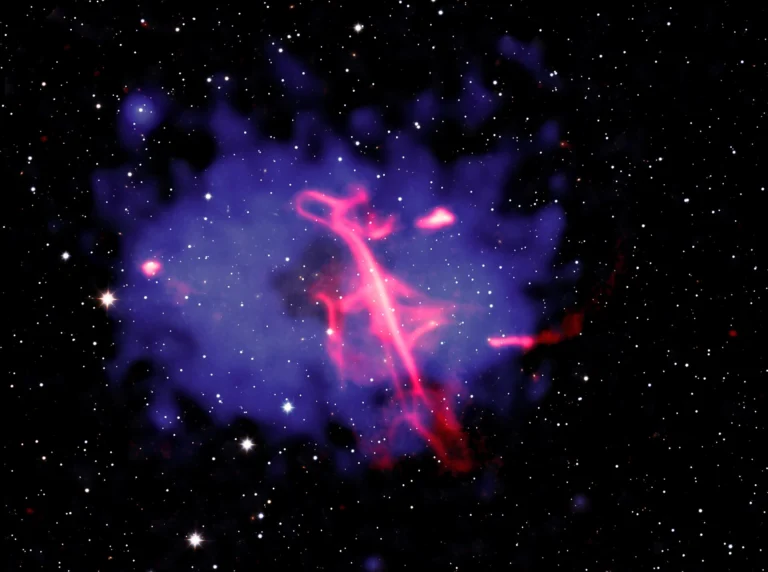
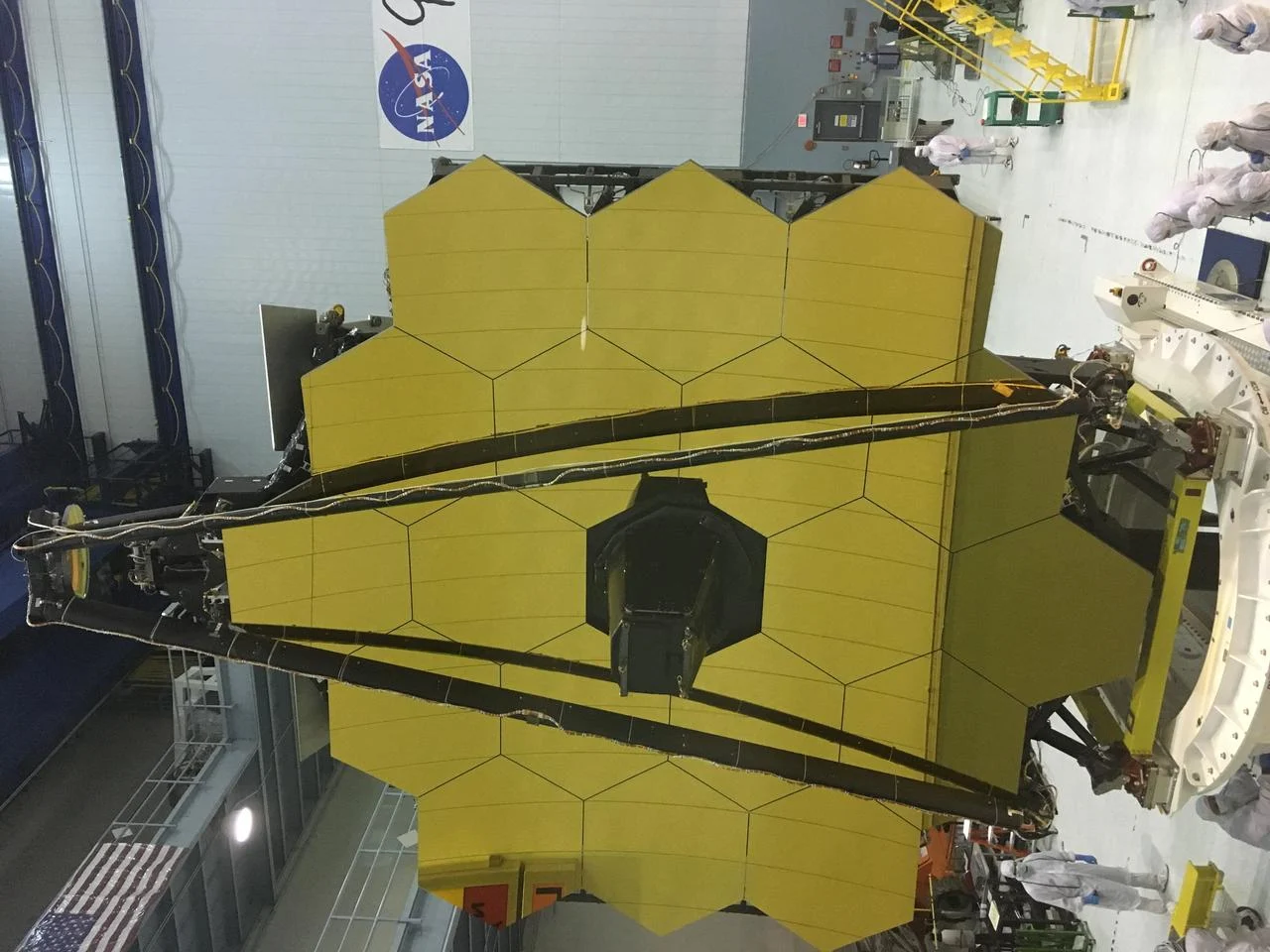
Astronomers deploying the James Webb Space Telescope have measured the precise distance to the farthest fast radio burst ever cataloged. By focusing the observatory's infrared instruments on the precise coordinates of the radio transient, the research team identified a faint, distant dwarf host galaxy. Spectral analysis of the host revealed a redshift of 2.148, placing the radio emission when the universe was only a fraction of its present age. Fast radio bursts represent brief, intense flashes of millisecond-duration radio energy that travel billions of light-years across intergalactic space. While thousands of these events have been recorded since their discovery in archival data in 2007, identifying their precise host environments has proven notoriously difficult. Most bursts appear at random positions on the celestial sphere, leaving faint or fleeting radio signatures that vanish before ground-based optical telescopes can lock onto them. The James Webb Space Telescope resolved the host galaxy behind this record-setting burst, showing it to be an actively star-forming dwarf system. NASA, alongside reports from Live Science and Scientific American, highlighted the observation as a critical milestone in understanding both the burst progenitor and the structure of the intergalactic medium. The measurement demonstrates that extreme radio transients were already active in dwarf galaxies during early cosmic epochs. Securing an exact host identification at this distance provides observational clarity for astrophysics. Rather than relying on indirect estimates of distance derived purely from radio dispersion models, direct infrared spectroscopy anchored the physical environment of the burst. The result links the radio pulse to a dwarf galaxy rich in rapid stellar production.
What we know
The physical properties of the host galaxy are now firmly established through spectroscopic observation. The James Webb Space Telescope determined that the host galaxy possesses a redshift of 2.148, which translates to a lookback time spanning most of cosmic history. This makes it the most distant confirmed fast radio burst host galaxy in the astronomical record. The data shows that the host is a dwarf galaxy undergoing vigorous star formation. In dwarf galaxies of this class, massive stars form in dense molecular clouds, burn through their nuclear fuel rapidly, and end their lives in core-collapse supernovae. Such environments produce young, extreme stellar remnants within mere millions of years, rather than the billions of years required for older stellar systems to evolve. Astronomers also know how the burst signal behaved as it traveled toward Earth. As electromagnetic pulses traverse the space between galaxies, they encounter the diffuse ionized plasma that makes up the cosmic web. Free electrons in this intergalactic plasma slow down lower-frequency radio waves slightly more than higher-frequency radio waves, producing a measurable dispersion delay. The extent of this dispersion correlates directly with the total column density of ionized matter the signal encountered along its line of sight. Because the exact redshift is known independently from Webb's infrared spectroscopy, the observed radio dispersion allows scientists to probe the distribution of matter in the distant cosmos. The signal confirms that fast radio bursts serve as sensitive natural probes of the diffuse, otherwise invisible intergalactic plasma connecting cosmic structures.
What we don't know
Despite establishing the host galaxy's redshift and general morphology, the exact internal engine of this specific burst remains unresolved. Fast radio bursts discharge enormous quantities of radio energy within milliseconds, but direct imaging of the emitting object is impossible across billions of light-years. Astronomers cannot observe the physical remnant directly; they can only evaluate its immediate galactic setting. Whether this particular source repeats over time is also unknown. Some cataloged fast radio bursts are known repeaters, firing multiple sporadic bursts over months or years, while others have been detected only once. If this distant source emits subsequent bursts, future radio observatories may be able to capture additional spectral signatures to test polarization and local magnetic field strengths. The detailed magnetic environment surrounding the progenitor also remains unmeasured. In several closer bursts, extreme Faraday rotation measures have revealed dense, highly magnetized plasma in the immediate vicinity of the source. For this record-setting burst, the existing radio data does not yet clarify whether the burst occurred inside a dense supernova remnant, an ionized nebula, or a cleaner interstellar pocket of the dwarf galaxy. Finally, the full population demographics of fast radio bursts at high redshift remain uncertain. Astronomers do not yet know whether high-redshift bursts share the exact luminosity distribution of modern, low-redshift bursts, or whether evolutionary changes in stellar metallicity alter the efficiency with which progenitors produce coherent radio emission.
What is claimed
Two competing theoretical models have been advanced to explain how extreme radio transients are produced within distant host galaxies. The leading interpretation proposes that the burst originated from a young, highly magnetic neutron star, commonly called a magnetar, born rapidly in the aftermath of a core-collapse supernova. Proponents argue that the actively star-forming dwarf host galaxy naturally supports this scenario, as such galaxies continuously generate massive stars that collapse quickly into energetic remnants. A competing hypothesis suggests that the burst could have arisen from the collision or merger of two compact stellar remnants, such as a binary neutron star system. In this merger scenario, gravitational wave radiation gradually drains orbital energy until the two dead stars collide, releasing cataclysmic flashes of radiation across the electromagnetic spectrum. However, researchers consider the compact binary merger scenario unlikely for this specific event. Binary neutron star systems generally require hundreds of millions to several billions of years of orbital decay before reaching coalescence. Given the host galaxy's young stellar population and active star formation at redshift 2.148, an evolutionary timeline requiring billions of years fits poorly with the observed environment. While the magnetar model serves as the leading explanation, researchers stress that the physical mechanism generating coherent radio emission from magnetar magnetospheres remains an area of ongoing theoretical debate. The claims regarding the source engine rely on circumstantial harmony with the host environment rather than a direct visual detection of the remnant itself.
What is verified
Several key facts in this investigation have been verified through calibrated instrumentation and documented analysis. The identification of the host galaxy is verified through James Webb Space Telescope infrared imaging and spectroscopy, which isolated the faint galactic counterpart at the precise coordinates provided by radio interferometry. The spectroscopic redshift of 2.148 is also fully verified. This measurement relies on distinct emission lines observed in the host galaxy's infrared spectrum, establishing its distance beyond the margin of error associated with photometric estimates. It confirms that the radio pulse originated in the distant early universe rather than within a foreground galaxy along the line of sight. Additionally, the classification of the host as an actively star-forming dwarf galaxy is verified by Webb's photometric colors and spectral profiles. The galaxy exhibits the classic signatures of compact, low-mass systems rich in young, luminous stars and ionized interstellar gas. What is not verified is the precise identity of the burst progenitor. Direct observational verification of a magnetar or any other specific physical body at a redshift of 2.148 is currently beyond the resolving power of any telescope. The leading magnetar model remains an inference derived from the host galaxy's verified characteristics.
Competing explanations
- Leading: The fast radio burst was generated by a young, highly magnetic neutron star formed rapidly after a supernova in an actively star-forming dwarf galaxy.
- Unlikely: A collision between two orbiting neutron stars would typically require billions of years of orbital decay, making it incompatible with the host dwarf galaxy's young stellar population.
What would change our assessment
The current assessment that the burst originated from a young core-collapse remnant would face serious challenges if subsequent high-resolution observations reveal an older, quiescent underlying stellar population. If deeper infrared imaging shows that the burst occurred within an ancient globular cluster or an evolved stellar halo embedded in the host system, the compact binary merger scenario would gain substantial credibility. Detecting subsequent radio bursts from the exact coordinates would also alter astrophysical evaluations. If the source repeats regularly, researchers could monitor its pulse structure, polarization angle swings, and rotation measures over extended periods. A repeating pattern would firmly eliminate any cataclysmic, destructive origin such as a binary neutron star collision, proving that the central engine survives the burst. Conversely, an observational revision of the line-of-sight geometry could also affect the conclusions. If sensitive deep-field imaging were to detect a faint, previously overlooked intervening galaxy directly along the line of sight, scientists would need to re-evaluate whether the burst occurred in that foreground system or if gravitational lensing magnified the background signal. Further development of theoretical models regarding coherent radio emission could also change how astrophysicists assess the progenitor. If advanced magnetohydrodynamic simulations demonstrate that young magnetars cannot produce coherent pulses of this extreme energy without disrupting their magnetospheres, astronomers would be forced to reconsider alternative exotic engines.
Sources
- NASA (supports, primary)
- Live Science (supports)
- Scientific American (supports, unverified)
Protocol AENIGMA-EF-0.1