Evidence: Unsubstantiated Explanation: Not enough data yet
Origin of Asteroid Bennu: Isotopic Ratios and Formation Models
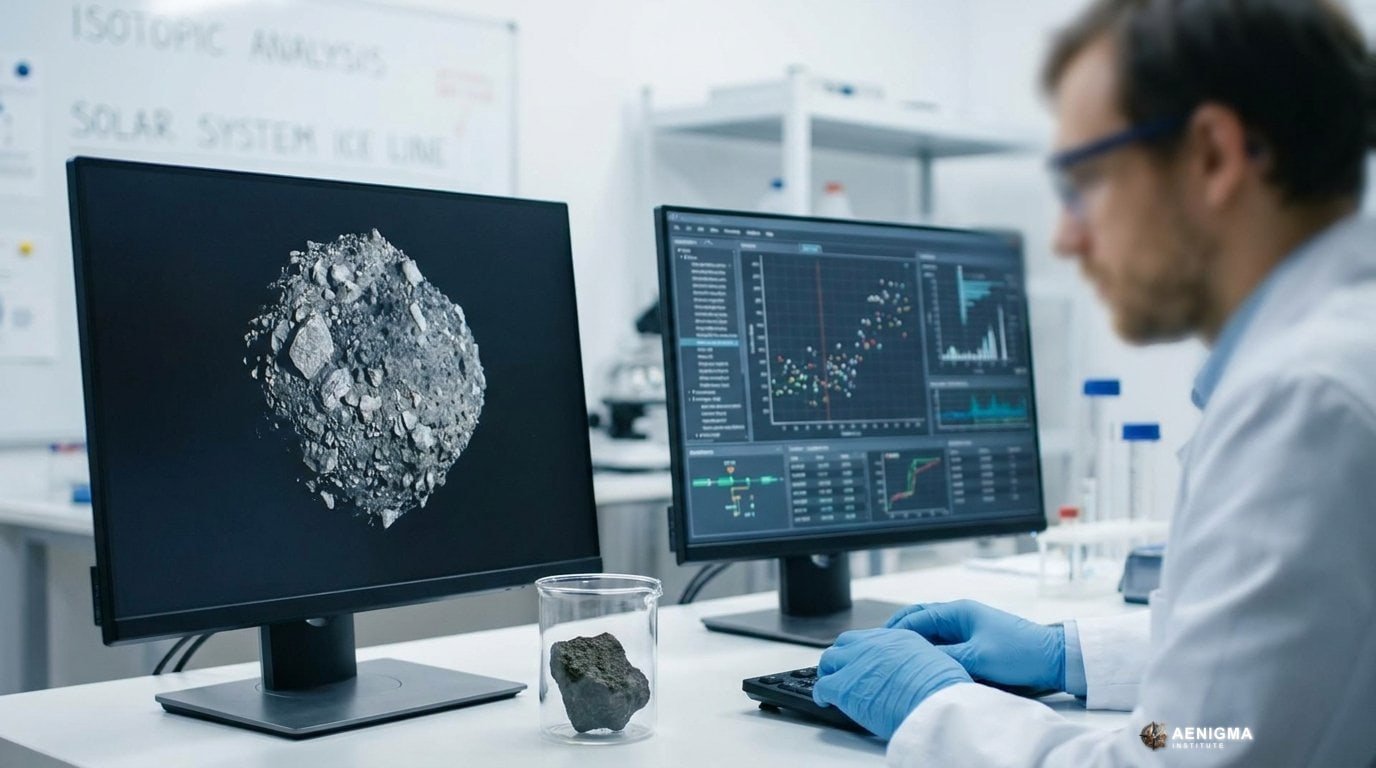
Recent media reports discuss the origin of the asteroid Bennu based on new isotopic data. While earlier models suggested an origin in the outer solar system, current interpretations propose a formation near the solar system's ice line. The evidence for these specific formation models remains unsubstantiated, and there is currently insufficient data to confirm a single explanation.
Why AENIGMA is covering this
AENIGMA is covering this topic to separate the observed isotopic data from the interpreted formation models, providing clarity on what is physically measured versus what is theorized about the early solar system.
What happened
Media outlets, including Futura Sciences and TechNews, have reported on the origins of the asteroid Bennu. The coverage focuses on a study published in Science Advances that analyzes the asteroid's composition to determine where it formed during the early stages of the solar system.
What we know
Researchers have measured specific isotopic ratios of iron, titanium, and chromium in samples from the asteroid Bennu. These measurements constitute the observed data. Previously, it was suggested that Bennu formed in the outer solar system beyond the Kuiper belt, an interpretation based on its high water and clay content; this explanation has now been ruled out by the researchers.
What we don't know
It is not known exactly where Bennu formed. The exact mechanisms of dust mixing in the early solar system and the precise influence of Jupiter's gravity on this specific asteroid's formation cannot be definitively proven with the current samples.
What is claimed
It is claimed that Bennu formed near the solar system's ice line. In this interpreted model, Jupiter's gravity blocked larger grains from passing but allowed fine dust from both the inner and outer solar system to mix, creating the specific isotopic signature observed in the asteroid.
What is verified
It is verified that the isotopic ratios of iron, titanium, and chromium in the Bennu samples have been measured and published in Science Advances. It is also verified that Futura Sciences and TechNews reported on these findings.
Competing explanations
- Ruled out: Bennu formed in the outer solar system beyond the Kuiper belt, an interpretation previously based on its high water and clay content.
- Possible: Bennu formed near the solar system's ice line, where Jupiter's gravity blocked larger grains but allowed fine dust from the inner and outer solar system to mix.
What would change our assessment
The assessment would change if additional samples from Bennu or other similar asteroids were analyzed, providing a larger dataset of isotopic ratios. Further astronomical modeling that can independently confirm the dust-mixing dynamics near the ice line would also be required to move the explanation status beyond insufficient data.
Sources
- Futura Sciences (supports)
- TechNews (supports)
Protocol AENIGMA-EF-0.1