Evidence: Unsubstantiated Explanation: Not enough data yet
Quantum entanglement at CERN: What the zeptosecond Higgs boson decay really shows
Quantum entanglement at CERN involving the decay of the Higgs boson has sparked discussions about particles connected across unimaginably short lifespans. Recent reports highlight a potential three-state quantum connection between real and virtual particles lasting only a fraction of a zeptosecond.
Why AENIGMA is covering this
It is essential to separate the verified physics of subatomic quantum entanglement from sensationalist claims about rewriting relativity. Quantum mechanics frequently attracts mystical or exaggerated interpretations, especially when dealing with counterintuitive concepts like entanglement and virtual particles. When complex high-energy physics is translated for the public, the nuance of statistical inference is often lost in favor of dramatic narratives about overturning established science. By explaining the actual mechanics of qutrit entanglement and detailing how virtual particles participate in these quantum states, we provide a clearer picture of modern scientific inquiry. Detailing how the ATLAS detector reconstructs the quantum states of particles that survive for only a fraction of a zeptosecond highlights the incredible engineering and mathematical rigor involved in these experiments. This approach clarifies the boundary between established science and ongoing investigation, ensuring the public understands the data-driven nature of particle physics without falling for exaggerated headlines.
What happened
Deep beneath the French-Swiss border, the Large Hadron Collider at CERN accelerates protons to near the speed of light before smashing them together. These high-energy collisions recreate the conditions of the early universe, allowing physicists to observe the fundamental building blocks of matter. Among the myriad of particles produced in these microscopic fireballs is the Higgs boson, a highly unstable entity that decays almost immediately after it is formed. Recent attention has focused on a specific decay pathway where the Higgs boson transforms into two Z bosons. The timeframe for this event is extraordinarily brief, lasting only a fraction of a zeptosecond, which is a billionth of a billionth of a second. During this fleeting moment, an intriguing quantum phenomenon is observed. One of the resulting Z bosons is considered a real particle, possessing the standard mass expected of it, while the other is a virtual particle, existing temporarily with a different mass before decaying further. Observations from the ATLAS detector suggest that these two particles, despite their different states and incredibly short existence, exhibit quantum entanglement. This means their quantum properties remain deeply connected, regardless of the physical distance separating their eventual decay products. The French science publication Sciencepost recently highlighted this phenomenon, noting the profound implications of particles maintaining a shared connection across such an infinitesimal lifespan. The narrative surrounding this event often emphasizes the counterintuitive nature of quantum mechanics, where separated entities seem to communicate or share states in ways that defy classical physics.
What we know
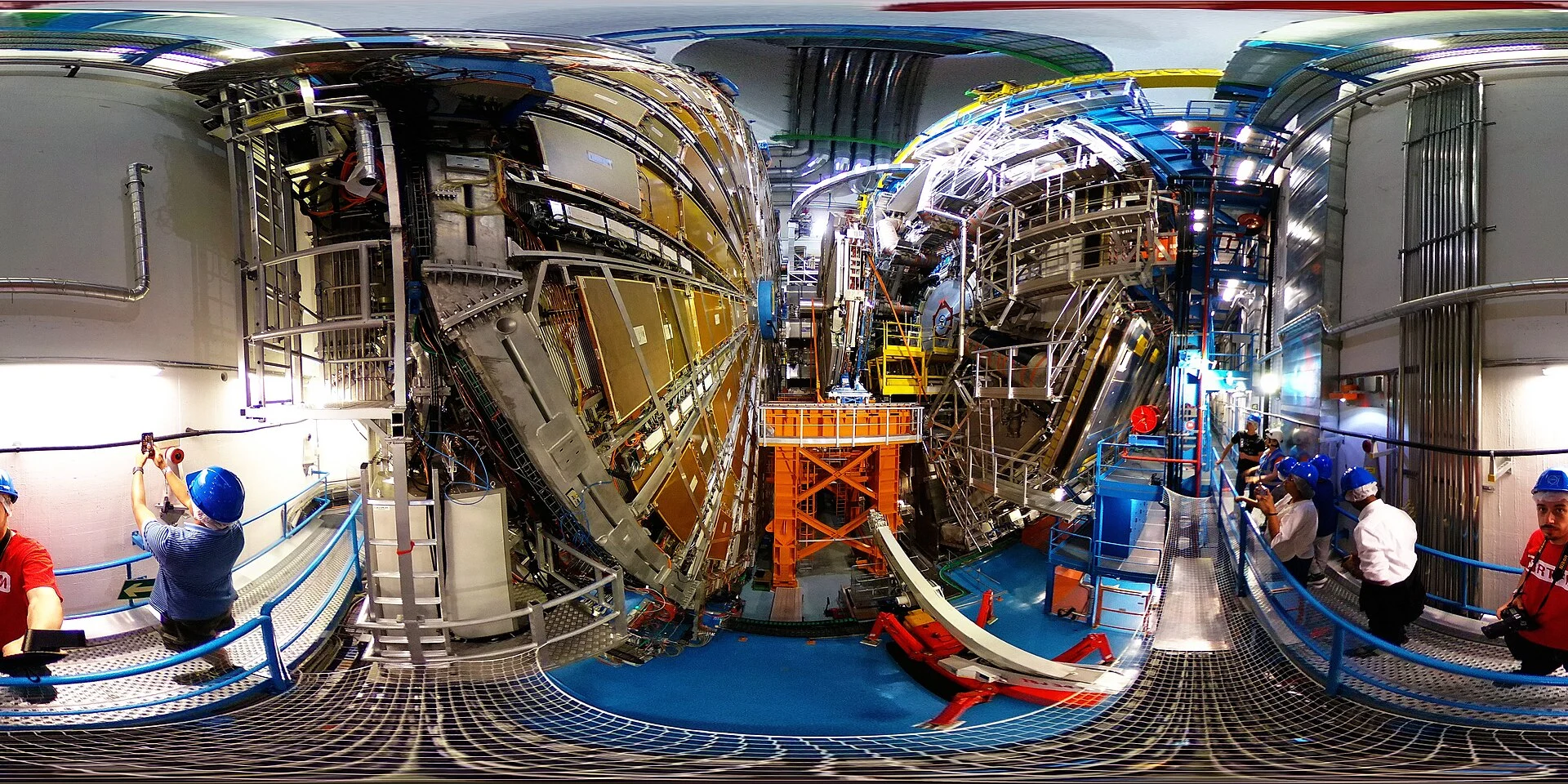
To understand this phenomenon, it is necessary to look at the established framework of the Standard Model of particle physics. The Higgs boson, discovered at CERN in 2012, is responsible for giving mass to other fundamental particles. When it decays, it does not simply vanish; it transforms into other particles according to strict conservation laws. One of its known decay channels results in a pair of Z bosons. The Z boson is a carrier of the weak nuclear force, which is responsible for processes like radioactive decay in atoms. Because the Higgs boson does not have enough mass to produce two fully real Z bosons, one must be virtual. Virtual particles are a well-understood feature of quantum field theory. They are temporary fluctuations that exist just long enough to mediate a force or facilitate a decay, borrowing energy from the vacuum before quickly resolving into stable particles. Quantum entanglement is another foundational concept. It describes a situation where multiple particles interact in such a way that the quantum state of each particle cannot be described independently of the state of the others. In this specific CERN observation, the entanglement involves the spin states of the Z bosons. Because Z bosons have a spin of 1, they can exist in three distinct spin states: -1, 0, and +1. In quantum information terms, a system with three possible states is called a qutrit, as opposed to the more common qubit which has only two states. The entanglement between the real and virtual Z boson is therefore modeled as a bipartite qutrit system. The ATLAS detector, a massive machine standing 25 meters tall and 46 meters long, is designed to capture the aftermath of these collisions. It cannot see the Higgs boson or the Z bosons directly because they decay far too quickly. Instead, ATLAS measures the stable particles they leave behind, such as electrons and muons. By precisely tracking the trajectories, energies, and angles of these final decay products, physicists can reconstruct the entire event backward in time. The kinematics of the electrons and muons provide a highly accurate mathematical footprint of the parent Z bosons. Through complex data analysis, researchers can infer the original spin states of the Z bosons and determine the degree to which they were correlated, thereby observing the signature of quantum entanglement.
What we don't know
Despite the sophistication of modern particle detectors, the extreme environment of high-energy collisions leaves several questions open. The exact boundary and transition mechanics between a virtual particle and a real particle in these specific decay channels are incredibly difficult to isolate. While the mathematics of quantum field theory handle virtual particles seamlessly, observing their dynamic behavior in real-time during a zeptosecond decay process remains beyond current technological capabilities. Physicists can only measure the final, stable products and infer what happened in the intermediate stages. Furthermore, the full implications of a qutrit entanglement system in this high-energy regime are not entirely mapped out. Most practical experiments involving quantum entanglement and quantum computing utilize low-energy photons or trapped ions operating as qubits. Observing a three-state qutrit system in the chaotic aftermath of a proton-proton collision introduces new variables. It is not yet known if this specific type of entanglement behaves exactly as predicted by current models under all conditions, or if subtle deviations might appear as more data is collected. The current explanation status remains categorized by insufficient data because the statistical volume of these specific, rare Higgs-to-Z-boson decay events is still building. Researchers do not yet know if this observation will perfectly align with the Standard Model once a massive dataset is finalized, or if it will point toward new, undiscovered physics.
What is claimed
The primary proposition surrounding this event is that the correlated spin states observed in the decay products of the Higgs boson demonstrate quantum entanglement between a real and a virtual Z boson. It is proposed that this connection functions specifically as a three-state qutrit system. The narrative presented in media reports often frames this as a profound mystery, emphasizing that particles previously thought to share nothing after separation are actually deeply linked, even if that link only holds for a billionth of a billionth of a second. Some popular interpretations extend these observations into broader claims about the nature of reality. It is sometimes suggested that such high-energy entanglement challenges our fundamental understanding of space and time, or that it might force a rewriting of the rules of relativity by demonstrating instantaneous connections at subatomic scales. The focus is heavily placed on the paradox of a tangible, real particle maintaining a structured quantum relationship with a transient, virtual particle, presenting it as a groundbreaking shift in how physicists view the subatomic world.
What is verified
The foundational physics underlying this event are thoroughly verified. Quantum entanglement is a proven reality of nature, demonstrated in countless experiments over the past several decades, earning the Nobel Prize in Physics in 2022. The existence of the Higgs boson and its role in the Standard Model are also verified facts, as is its decay pathway into Z bosons. The concept of virtual particles is not a fringe theory; it is a verified, essential component of quantum electrodynamics and quantum chromodynamics, without which the behavior of subatomic forces cannot be accurately calculated. The engineering and observational capabilities of the ATLAS detector are similarly verified. The methods used to track leptons, measure their momentum in strong magnetic fields, and reconstruct the invariant mass of parent particles are standard, highly reliable practices in high-energy physics. It is a verified fact that the kinematics of decay products carry the spin information of their parent particles. However, the specific characterization of this exact real-virtual Z boson pair as a fully entangled qutrit system, and the broader philosophical claims about rewriting relativity based on this single decay channel, remain subjects of ongoing investigation rather than closed, verified textbook facts.
Competing explanations
- Possible: The correlated spin states observed in the decay products of the Higgs boson demonstrate quantum entanglement between a real and a virtual Z boson, functioning as a three-state qutrit system.
What would change our assessment
To move the understanding of this specific qutrit entanglement from an area of insufficient data to a confirmed, detailed discovery, physicists require a massive increase in collision statistics. The Large Hadron Collider operates in distinct phases known as Runs. Accumulating vastly more data during the current Run 3, and eventually the High-Luminosity LHC upgrade, will provide the sheer volume of Higgs boson decays needed to reduce statistical uncertainties. Independent verification is also a crucial step in particle physics. The CMS experiment, another massive general-purpose detector located on the opposite side of the LHC ring, would need to observe the exact same spin correlations in their independent dataset. Researchers must also rigorously rule out any background noise, alternative kinematic effects, or detector biases that could mimic the mathematical signature of qutrit entanglement. Reaching a five-sigma statistical significance—meaning there is less than a one in a million chance that the observed correlation is a random fluke—is the traditional threshold required to confirm such phenomena. Until these massive datasets are fully analyzed and cross-checked between independent collaborations, the precise nature of this zeptosecond entanglement remains a compelling but developing area of study.
Sources
- Sciencepost (supports)
Protocol AENIGMA-EF-0.1