Evidence: Unsubstantiated Explanation: Not enough data yet
Amelia Earhart's Plane and What the Nikumaroro Anomaly Really Shows
A ground inspection on Nikumaroro Island, reported by Sing Tao Daily, confirmed that a prominent visual anomaly spotted in satellite imagery consists of coral-encrusted driftwood rather than the wreckage of Amelia Earhart's Lockheed Electra 10-E. The outcome directly disproves the specific claim of an identified aircraft structure on the shoreline while leaving the broader mystery of the flight unresolved. Because the physical evidence does not match aviation debris, the claim that the aircraft had finally been located remains unsubstantiated.
Why AENIGMA is covering this
Reporting on the Nikumaroro expedition provides essential clarity to an international public narrative that frequently conflates preliminary photointerpretation with verified archaeological discovery. High-contrast satellite imagery easily fosters viral claims regarding legendary historical mysteries, creating widespread impressions that long-standing historical questions have been settled. Establishing the true physical nature of the feature through direct field observation restores factual accuracy to the public record. Covering these findings also clarifies the difference between a single disproven visual anomaly and the broader, ongoing scientific investigations into trans-Pacific navigation and twentieth-century aviation history. Legitimate historical and archaeological inquiries depend on transparent reporting of negative results, which are vital for refining search models, understanding taphonomic processes on coral reefs, and redirecting resources away from false targets. Finally, the case underscores the irreplaceable necessity of ground-truthing in modern remote-sensing investigations. While satellite systems provide valuable regional surveillance capabilities, orbital data alone cannot replace meticulous on-site physical analysis. Documenting how natural marine processes can mimic engineered structures provides a valuable reference point for future archaeological evaluations in equatorial coastal environments.
What happened
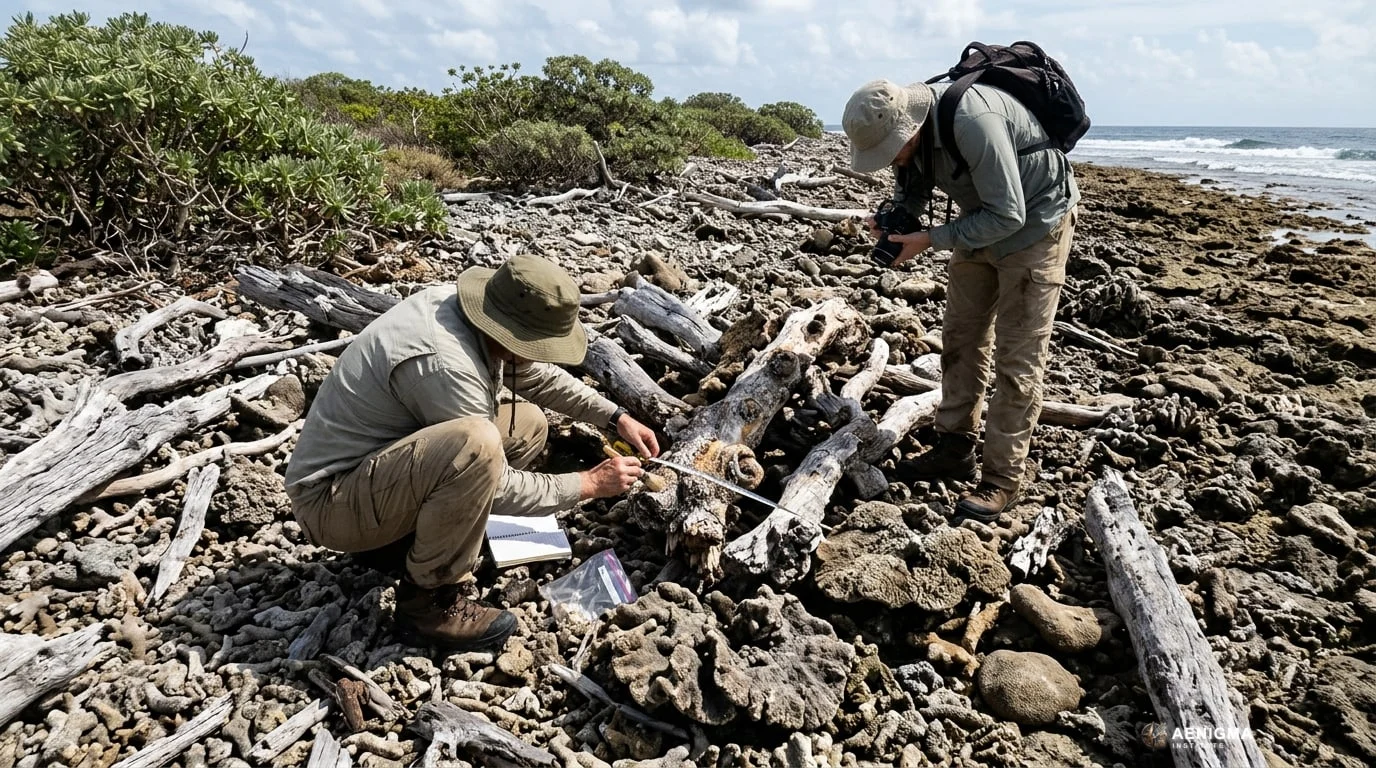
A field expedition to Nikumaroro Island has confirmed that a high-contrast visual feature detected on satellite imagery is not the missing aircraft of Amelia Earhart. Direct physical examination of the site revealed that the anomaly was caused by large drift logs heavily coated in carbonate deposits formed by coral sand, rather than metallic structural remains. The findings, reported by Sing Tao Daily, conclusively rule out the hypothesis that the specific shoreline feature represents the Lockheed Electra 10-E that vanished during an attempted circumnavigational flight in July 1937. Remote-sensing imagery had previously drawn international attention to the location, raising speculation that exposed structural fragments or an engine block might be resting along the shoreline. Investigators who traveled to the remote atoll conducted an on-site assessment to verify whether the target exhibited any characteristics of aeronautical alloys, riveted construction, or mechanical components. Upon close approach, the surface features that had mirrored the reflective properties of engineered sheet metal dissolved into natural coastal debris. The search area on Nikumaroro, an uninhabited coral atoll in the southwestern Pacific nation of Kiribati, has long been a focal point for researchers evaluating the castaway hypothesis. The hypothesis suggests that Earhart and navigator Fred Noonan landed on the exposed reef flat after failing to locate their refuelling stop at Howland Island. While interest in the atoll remains high, the direct verification of this particular satellite target eliminates one of the most visible recent leads.
What we know
The physical survey of the site documented an accumulation of large fallen trees that had drifted onto the reef flat and become cemented by local marine geological processes. Over time, exposure to waves, sunlight, and pulverized coral sand created a thick, pale casing of calcium carbonate around the organic timber. This mineral encrustation produced a dense, highly reflective exterior that mimicked the geometric appearance and brightness of manufactured material when viewed from orbital altitudes. Direct physical inspection remains the definitive standard in remote sensing and coastal archaeology. Satellite sensors capture reflected electromagnetic radiation across discrete bands, but they cannot resolve chemical composition, structural cross-sections, or manufacturing marks at microscopic scales. What appeared in orbital imagery as a potentially linear, metallic anomaly lacked any structural aluminum, fasteners, wiring, or aeronautical mechanical systems when examined on the ground. Pacific atoll environments are dynamic systems where high-energy storms transport significant organic debris and maritime detritus across vast oceanic distances. Coral sands rich in aragonite and calcite readily precipitate within intertidal zones, rapidly encrusting stranded organic matter in a concrete-like shell. This natural mineralization process regularly alters the visual and spectral properties of beached objects, complicating aerial and satellite photointerpretation. The surveyed anomaly had been viewed as a primary candidate for remaining physical evidence of the 1937 flight. The ground assessment definitively concluded that the object is entirely non-aeronautical in origin, disproving the proposal that intact wreckage from the Electra was resting in plain view at this location. While this specific lead has been ruled out, researchers continue to study the historical documentation and environmental context surrounding the central Pacific route.
What we don't know
The ultimate geographic location of the Lockheed Electra 10-E remains entirely unproven. It is unknown whether the aircraft came to rest in deep abyssal waters along the flight path between Lae, Papua New Guinea, and Howland Island, or if it made landfall on an isolated reef before being swept over the fringing barrier into deep ocean trenches. Bathymetric gradients surrounding Pacific atolls drop steeply to depths exceeding several thousand meters, creating substantial barriers for systematic sonar and visual underwater mapping. Researchers do not have conclusive physical artifacts linking Nikumaroro to Earhart or Noonan with diagnostic certainty. While previous historical surveys on the atoll recovered historical fragments including improvised tools, shoe remnants, and cosmetic containers, none possess unique serial numbers, manufacturer stamps, or definitive provenance directly associating them with the 1937 crew. The degree to which these recovered items represent early twentieth-century colonial settlement, indigenous Pacific navigation, or shipwreck survivors remains an open question. Environmental degradation rates on equatorial coral reefs present additional uncertainties for preservation models. Exposure to high-salinity marine environments, tidal scouring, and intense solar radiation rapidly corrodes aluminum alloys such as Alclad 24S, which constituted the fuselage and wings of the Electra. It is not known whether thin-gauge aircraft panels could have survived decades of surf-zone action intact, or whether any remaining components would have fragmented and scattered across deep submerged slopes.
What is claimed
Visual interpretations of recent high-resolution satellite imagery led observers to claim that a distinct, pale, angular feature on the reef flat represented identifiable wreckage from Earhart's twin-engine aircraft. Proponents argued that the geometry, high albedo, and shoreline position of the anomaly were consistent with a detached engine cowl, a wing section, or a collapsed fuselage segment resting near the edge of the vegetation line. These interpretations spread widely across digital platforms and international media. The claim suggested that advanced optical sensors from orbit had successfully resolved an eighty-year-old archaeological question without the immediate need for extensive maritime salvage operations. Proponents pointed to apparent rigid outlines and reflective surfaces that seemed anomalous against the surrounding coral rubble and lagoon sands, presenting the images as plausible evidence of twentieth-century aeronautical manufacturing. Furthermore, the presence of the anomaly was integrated into broader narratives surrounding the Nikumaroro castaway hypothesis, with suggestions that the object could represent the final identifiable trace of the aircraft before complete environmental erasure. Media summaries amplified these visual assessments, framing the anomaly as a potential breakthrough in aviation history.
What is verified
On-site verification by the joint field team established that the reflective anomaly consists of natural drift timber encased in marine carbonate rock. The survey team carried out tactile and close-range visual evaluations of the target, documenting the complete absence of metal framing, structural rivets, mechanical systems, or synthetic composites. The pale, high-reflectance signature recorded by orbital sensors was produced by sun-bleached coral sand cemented around the wood by marine precipitation. Remote-sensing science recognizes that optical satellite imagery is prone to interpretive errors when applied to fine-scale archaeological exploration. Spatial resolution limitations, shadow effects, sun angles, and coastal mineral encrustation regularly generate false positives that resemble rectilinear, engineered objects. Ground-truthing confirmed that the anomaly was a product of these natural geological and biological interactions rather than manufactured hardware. The findings verify that the specific hypothesis regarding this coastal feature is ruled out. While the expedition demonstrated the capability of field teams to access and rigorously test remote targets on uninhabited atolls, it confirmed that no surviving airframe components were located at the surveyed position.
Competing explanations
- Possible: Ground inspection by the joint expedition determined the visual anomaly was an accumulation of large drift trees coated in shiny concrete-like carbonate from coral sand.
- Ruled out: The hypothesis that the satellite anomaly represented the wreckage of Amelia Earhart's Lockheed Electra 10-E was disproven by direct examination of the site and remaining debris.
What would change our assessment
A change in the assessment of any Pacific anomaly would require the recovery and diagnostic identification of verified aeronautical materials. In aviation archaeology, confirming the identity of a missing aircraft requires components that can be conclusively tied to the specific airframe design, such as parts bearing manufacturer part numbers, stamped production inspection marks, or identifiable serial plates. For a Lockheed Model 10-E Special, structural elements matching the precise engineering blueprints of the model would serve as compelling evidence. Laboratory metallurgical testing would also be necessary to validate recovered materials. Confirming the presence of specific proprietary copper-bearing aluminum alloys, structural rivets, and period-accurate primer formulations would distinguish early twentieth-century aviation remnants from generic maritime debris or later military wreckage. Non-destructive compositional analysis would establish the chronological and industrial context of any discovered alloys. In the underwater domain, definitive validation would depend on high-resolution optical video or side-scan sonar records revealing intact structural assemblies, such as Pratt & Whitney R-1340 Wasp engines, variable-pitch propeller hubs, or recognizable fuselage landing gear assemblies resting on the sea floor. Until diagnostic hardware with clear provenance is located and verified, the status of the missing aircraft remains unsolved.
Sources
- 星島日報 (supports)
Protocol AENIGMA-EF-0.1