Evidence: Unsubstantiated Explanation: Not enough data yet
Quantum atomic necklace: what the ultracold physics experiments really show
The quantum atomic necklace, formed by chilling particles into a single line, is being examined as a potential demonstration of long-theorized many-body physics. Recent reports from Live Science describe experiments where ultracold atoms were arranged in one dimension to observe collective quantum states. Current laboratory evaluations remain unsubstantiated, with insufficient data to confirm whether these transient atomic groupings represent enduring multi-particle bound states or temporary intermediate dynamics.
Why AENIGMA is covering this
The investigation of one-dimensional quantum fluids represents one of the foundational challenges of modern condensed matter and atomic physics. Testing theoretical frameworks that originated in the early decades of quantum theory against modern laser-cooling platforms allows researchers to assess whether mathematical models developed for idealized systems hold true in real laboratory conditions. Covering these developments highlights the immense technical sophistication required to manipulate matter at the individual atom level while clarifying how experimental realities can diverge from theoretical ideals. Public interest in quantum phenomena frequently outpaces experimental verification. Scientific reporting often translates subtle deviations in indirect absorption signals into definitive announcements of exotic quantum states or revolutionary technological milestones. By examining the precise physical mechanics governing optical lattices, one-dimensional constraints, and atom loss channels, this publication provides readers with a grounded, evidence-first evaluation of current experimental capabilities. Understanding the distinction between an indirect time-of-flight measurement and direct quantum imaging is essential for evaluating progress in contemporary physics. As laboratories worldwide strive to build coherent quantum simulators, separating confirmed empirical observations from plausible theoretical models ensures that public understanding matches the true state of scientific discovery.
What happened
Specialized laboratory reports covered by Live Science describe an experiment where researchers cooled a gas of atoms to temperatures approaching absolute zero and restricted their movement to a single spatial dimension, resembling a miniature necklace or linear chain. By utilizing cross-propagating laser beams to construct an optical lattice, the experimenters trapped these particles within microscopic potential wells, effectively suppressing lateral movement and forcing them to interact exclusively along a single axis. Under these stringent geometrical constraints, investigators observed behavioral signatures that match theoretical predictions first outlined roughly a century ago during the formative era of quantum mechanics. As the atomic interactions were tuned to attractive regimes, the particles appeared to cluster into correlated composite units rather than immediately collapsing into dense three-dimensional molecular clusters. Observers tracked these configurations to evaluate whether the ensemble realized long-standing mathematical models describing one-dimensional quantum fluids. Media reporting quickly drew widespread attention to the arrangement, framing the linear alignment as a newly manufactured quantum necklace that directly confirms historical hypotheses about multi-particle coherence. However, tracking the precise quantum states of multiple interacting particles along a single dimension requires rigorous distinction between stable multi-particle bound states and fleeting statistical fluctuations. The resulting observations have prompted careful scrutiny across the physical sciences to establish exactly what was measured inside the vacuum apparatus.
What we know
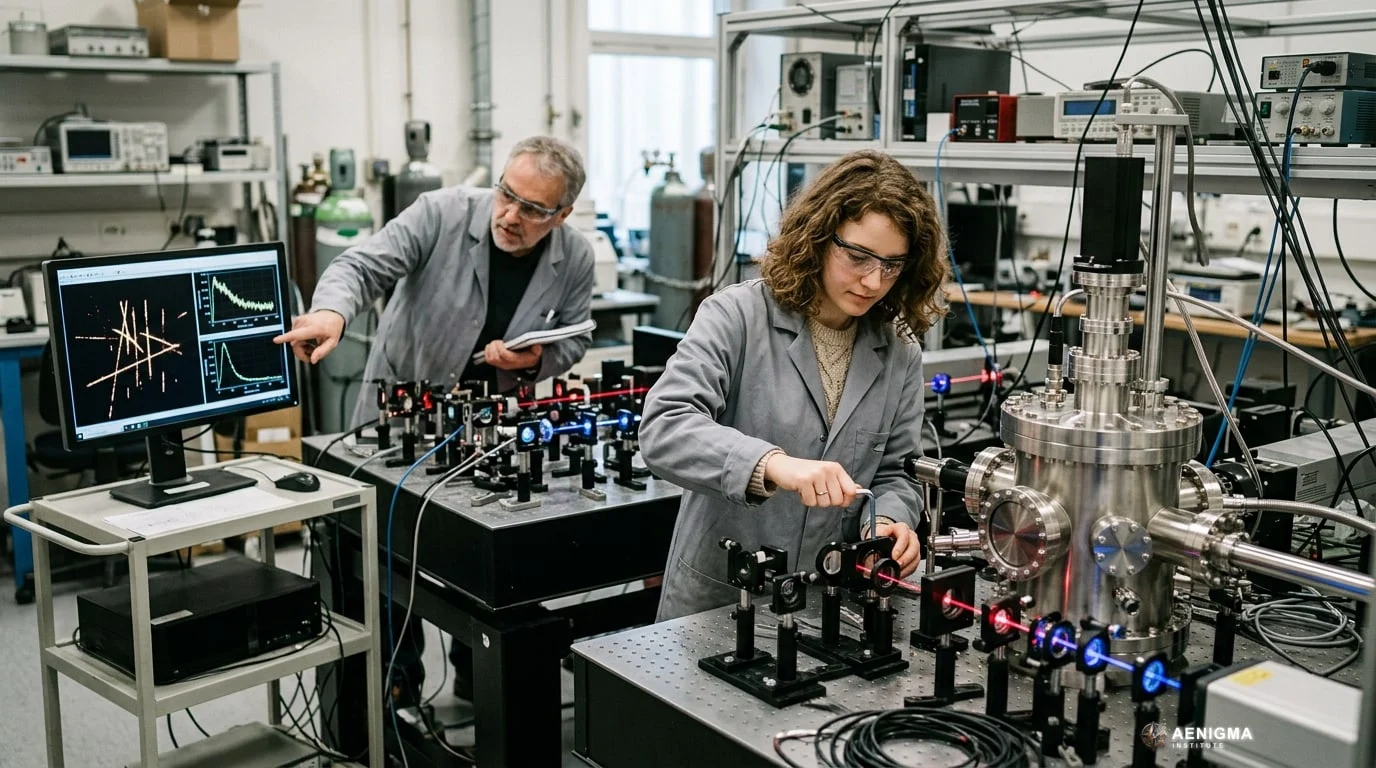
Physicists have long established that reducing the dimensionality of a physical system fundamentally alters the quantum statistical behavior of interacting particles. In an ordinary three-dimensional environment, cooling a dilute gas of bosonic atoms to nanokelvin temperatures produces a Bose-Einstein condensate, where a macroscopic fraction of particles occupies the lowest available quantum state. When attractive interactions between particles in a standard three-dimensional condensate become strong, the attractive force overcomes kinetic zero-point pressure, leading rapidly to a catastrophic mechanical collapse known colloquially in laboratory settings as a bosenova. In strictly one-dimensional geometries, the physical landscape behaves in a completely different manner. Quantum fluctuations become magnified when particles cannot move around one another, preventing conventional long-range phase order from forming at non-zero temperatures. Instead, one-dimensional systems can often be treated using exact analytical frameworks, such as the Bethe ansatz or generalized hydrodynamics, where particles organize into highly correlated collective states. Depending on the sign and strength of the interactions, these systems can mimic strongly repulsive fermions or form composite multi-particle bound structures. To construct such environments, experimentalists project intersecting laser beams into ultra-high vacuum chambers. Interference patterns between the opposing beams create standing light waves, forming a periodic array of potential wells known as an optical lattice. When the transverse potential barriers are engineered to be exceptionally deep, particles lack the kinetic energy to tunnel laterally between neighboring tubes. The atoms are thus confined to independent, pencil-shaped waveguides where their motion is essentially one-dimensional. Within these one-dimensional tubes, researchers can tune the s-wave scattering length between atoms using external magnetic fields via Feshbach resonances. This capability enables laboratory control over whether the confined particles experience mutual attraction or repulsion. When attractive interactions are applied in one dimension, theory predicts that atoms can form multi-body bound states, often referred to as quantum solitons or string-like clusters, without suffering the immediate three-dimensional spatial collapse that plagues bulk gases.
What we don't know
Despite these theoretical frameworks, current experimental evaluations leave fundamental questions unresolved regarding the exact nature and longevity of the observed atomic clusters. Most notably, standard laboratory instruments struggle to track individual particles in real time within dense linear configurations. It remains unconfirmed whether the observed features represent stable, multi-particle bound clusters predicted by generalized hydrodynamics or merely fleeting, non-equilibrium transients formed as atoms rapidly rearrange. A primary ambiguity stems from atom loss mechanisms that persist in physical experiments. Even inside an optical lattice designed to enforce one-dimensional kinematics, atoms still possess finite spatial wavefunctions that sample three-dimensional short-range interactions. When three or more atoms collide within a narrow spatial envelope, three-body recombination frequently occurs. In this process, two atoms bind into a conventional diatomic molecule while the binding energy is transferred as kinetic energy to the remaining atom, ejecting all involved particles from the optical trap. Because three-body recombination happens on microsecond or millisecond scales, determining the true lifetime of the proposed bound states remains elusive. If the multi-atom groupings disintegrate into conventional molecular dimers and energetic fragments faster than macroscopic hydrodynamics can equilibrate, the system cannot be considered a genuine, persistent quantum fluid phase. Without continuous, single-site resolved tracking, researchers cannot definitively rule out that the perceived signatures are simply artifacts of localized atom depletion rather than stable quantum necklaces. Additionally, the exact role played by residual transverse motion is not fully quantified. Optical lattices provide harmonic confinement that is steep, but finite. If high-energy collision events or interaction-induced couplings transfer momentum into the transverse radial degrees of freedom, the one-dimensional approximation breaks down. Current published data have not sufficiently isolated the boundary where pure one-dimensional physics ends and multi-channel three-dimensional scattering begins.
What is claimed
Laboratory reports and primary media narratives assert that experimenters succeeded in locking atoms into a coordinated one-dimensional necklace that manifests a hundred-year-old quantum phenomenon. These accounts maintain that the particles formed collective bound states governed by integrable many-body quantum mechanics, providing empirical proof for historical equations developed during the earliest development of wave mechanics. Proponents of this interpretation argue that the signatures gathered during the expansion and release of the trapped atomic cloud match the mathematical expectations of generalized hydrodynamics. They assert that the atoms maintained strong multi-body correlations along the length of each tube, resisting both spontaneous thermal dispersion and violent three-dimensional collapse. Under this viewpoint, the laboratory configuration represents a verified realization of stable, high-order quantum strings behaving as independent collective entities. Furthermore, the narrative suggests that these one-dimensional necklaces offer a pristine model system for developing future quantum information platforms and studying non-equilibrium thermalization. By demonstrating that multi-particle attractive states can be sustained without falling victim to rapid three-body loss channels, advocates claim the technique unlocks new avenues for manipulating highly entangled states in scalable optical architectures.
What is verified
A rigorous review of the verified evidence reveals a much more nuanced physical picture. What has been empirically verified is the successful preparation of ultracold atoms held within high-aspect-ratio optical potentials, accompanied by measurable changes in macroscopic kinetic distributions when the interatomic interaction strength is adjusted. Researchers have established that the atoms are strictly confined within isolated one-dimensional tubes at the onset of the procedure. Beyond this geometrical confinement, empirical confirmation of persistent multi-particle bound states remains unsubstantiated. The measurements utilized in these setups do not typically provide direct, non-destructive snapshots of particles linked together in real space. Instead, standard experimental protocols rely heavily on indirect diagnostic techniques, such as time-of-flight imaging and expansion energy measurements. In a time-of-flight sequence, the confining optical potentials are abruptly switched off, allowing the atomic ensemble to expand into free space before being illuminated by a resonant probe laser to create an absorption shadow on a camera. While the spatial distribution of the expanding cloud reflects the initial momentum distribution of the particles, it constitutes an integrated, indirect measurement. Extracting the existence of specific multi-particle bound clusters from momentum profiles requires extensive mathematical modeling and deconvolution. Direct quantum gas microscopy, which captures fluorescence from individual atoms located at specific optical lattice sites, offers direct spatial confirmation in other areas of quantum simulation. However, applying such direct imaging simultaneously with rapid interaction tuning remains an extraordinary technical hurdle. Consequently, the available data only verify that the cloud exhibits anomalous momentum distributions consistent with strong interactions; they do not substantiate direct visual proof or unequivocal structural confirmation of a physical atomic necklace.
Competing explanations
- Possible: Ultracold atoms constrained to a one-dimensional line form transient multi-particle bound clusters matching generalized hydrodynamics predictions.
- Possible: Three-dimensional short-range interactions cause atom loss and decay into conventional diatomic molecules, limiting the lifetime of the bound states.
What would change our assessment
To advance the evidentiary standing of this quantum phenomenon from unsubstantiated to verified, experimental groups must provide definitive, time-resolved measurements that isolate the structural makeup of the atomic clusters. The most decisive development would be the implementation of single-atom-resolved, in situ quantum gas microscopy during the period when the attractive interactions are active. Capturing spatial correlations directly along the one-dimensional lattice would confirm whether atoms are genuinely positioned in correlated multi-body strings or simply undergoing rapid stochastic collisions. Independent laboratories would also need to replicate the findings across diverse atomic species and optical configurations. Confirming that the phenomena persist across different isotopes with well-characterized scattering profiles would demonstrate that the results are not byproducts of a particular experimental calibration error or trap asymmetry. Systematic variations of the transverse confinement depth would further clarify the precise threshold where three-dimensional scattering disrupts the one-dimensional regime. Furthermore, researchers must quantitatively track atom loss channels using coincident detection techniques capable of measuring the products of three-body recombination in real time. If experimentalists can establish that the decay rate into ordinary diatomic molecules is orders of magnitude slower than the formation and lifetime of the bound states, competing explanations centering on conventional chemical loss would be ruled out. Developing comprehensive numerical simulations of the full non-equilibrium dynamics without relying on simplifying integrable approximations would also establish whether generalized hydrodynamics uniquely explains the measured momentum profiles.
Sources
- Live Science (supports)
Protocol AENIGMA-EF-0.1