Evidence: Insufficient data Explanation: Not enough data yet
CERN and Mistral AI: What Does the Physics Foundation Model Really Show?
CERN and Mistral AI have announced an initiative to explore foundation artificial intelligence models for high-energy physics analysis. The collaborative project, known as Flare, is designed to test whether large-scale models trained on particle collision simulations can streamline complex scientific data processing. While the technical ambitions reflect the immense data challenges of the Large Hadron Collider, the operational performance of such an approach remains to be demonstrated in active physics workflows.
Why AENIGMA is covering this
The exploration of artificial intelligence foundation models at the world's premier particle physics laboratory represents a significant development at the intersection of fundamental science and advanced computing. Tracking this initiative provides insight into how scientific institutions are attempting to manage unprecedented data volumes. The computational demands facing high-energy physics will intensify significantly with the High-Luminosity Large Hadron Collider project, which is scheduled to operate in the coming years. Upgrades to the accelerator complex will increase collision rates, causing dozens of overlapping proton-proton interactions—known as pileup—within a single detector readout cycle. This dramatic rise in collision density will produce tracking environments containing thousands of simultaneous charged particle tracks, placing extreme demands on traditional reconstruction algorithms. Classical computing architectures face scaling challenges under these high-pileup conditions, driving the research community to explore parallel computing, hardware accelerators, and novel machine learning techniques. CERN has a long history of driving innovations in computing infrastructure to meet physical research needs, from the inception of the World Wide Web to the development of distributed grid computing networks. Examining the partnership with Mistral allows readers to follow how contemporary machine learning methods are being evaluated against the stringent, empirical requirements of high-energy experimental physics.
What happened
International news reports from France 24, Mirage News, and CNA state that the European Organization for Nuclear Research, known as CERN, has entered into an agreement with the artificial intelligence company Mistral. The project focuses on developing a large-scale foundation model named Flare, specifically tailored for scientific research and high-energy physics data reconstruction. Under this collaborative framework, the model is expected to be trained on extensive datasets generated by simulated particle collisions from the Large Hadron Collider. The stated objective is to investigate whether a generalized foundation architecture can unify disparate data-processing pipelines, which have traditionally relied on discrete, task-specific algorithmic tools. The announcement comes as computational facilities in fundamental physics prepare for significant increases in data production. As experimental facilities scale their physical apparatus to observe increasingly rare particle interactions, data processing systems must handle larger volumes of sensor readouts while maintaining precision and computational feasibility.
What we know
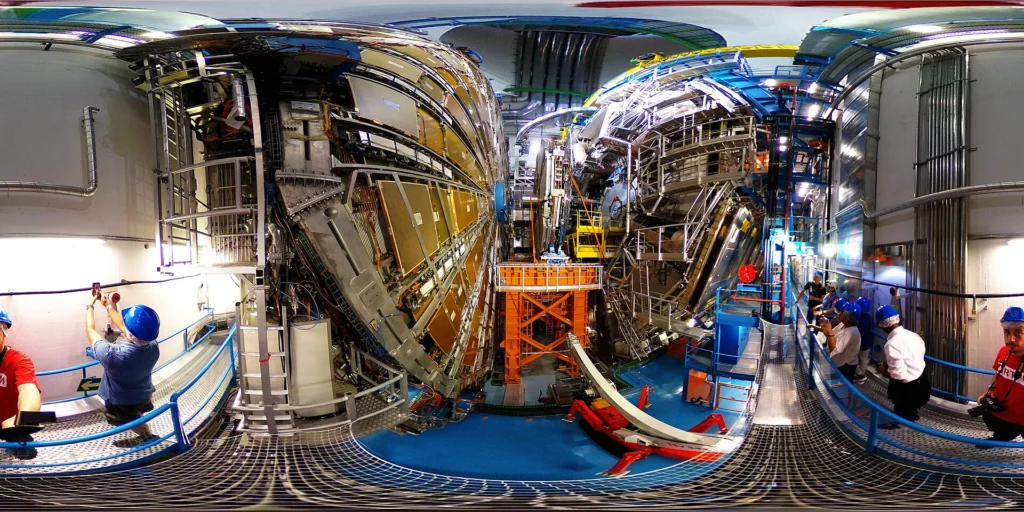
High-energy physics experiments operate at some of the largest data scales in modern science. The Large Hadron Collider accelerates beams of protons and heavy ions to near the speed of light, bringing them into collision inside massive multi-layered detectors such as ATLAS, CMS, ALICE, and LHCb. These physical interactions occur at frequencies reaching tens of millions of times per second. Because no existing computing architecture can record every individual collision event in full detail, experimental physics relies on tiered trigger systems. Hardware-level triggers make instantaneous decisions to filter out baseline background noise, passing only a tiny fraction of candidate events to high-level computing farms. Even after aggressive filtration, the raw telemetry, calibration data, and reconstructed event files recorded across CERN experiments accumulate to exabyte-scale data repositories distributed globally across the Worldwide LHC Computing Grid. Data reconstruction represents the analytical bridge between raw electronic signals and interpretable particle physics. Inside a detector, a collision generates showers of secondary particles that interact with silicon tracking pixels, drift chambers, electromagnetic calorimeters, and muon spectrometers. The recorded readout consists of discrete electrical charges, arrival times, and spatial coordinate hits. Traditionally, turning these raw digital signals into physical observables—such as particle trajectories, momenta, charges, and energy depositions—involves complex, sequential software stacks. Algorithmic methods such as Kalman filtering for track reconstruction and specialized clustering algorithms for calorimeter showers have formed the backbone of particle physics computing for decades. These mathematical methods are strictly rooted in the geometry of the detectors and the known laws of electromagnetism and relativistic kinematics. Over the past decade, high-energy physics researchers have progressively introduced machine learning into specific phases of this pipeline. Deep neural networks, convolutional networks adapted to calorimeter grid geometries, and graph neural networks modeling irregular detector hit arrays have demonstrated efficiency improvements in isolated tasks, such as distinguishing bottom quarks from lighter quarks or identifying tau leptons. The current initiative with Mistral introduces a different architectural philosophy: moving from isolated, single-purpose neural networks toward unified foundation models. In natural language processing and computer vision, foundation models are trained on massive, unstructured datasets using self-supervised objectives, learning general latent representations that can be adapted to diverse downstream tasks. In this framework, the Flare initiative intends to test whether similar principles can be applied directly to simulated collision data.
What we don't know
Public reports regarding the partnership leave several fundamental technical parameters unaddressed. The specific architecture of Flare has not been detailed, including the parameter size of the neural network, the precise training objective functions, or the computational budget allocated to the project. It is not publicly known which specific high-energy physics workflows will be integrated into the initial training phases. Modern collider experiments utilize heterogeneous software frameworks tailored to the unique hardware geometries of individual subdetectors, and the degree to which a single foundation model can generalize across distinct physical instrument architectures remains unclarified. Furthermore, the timeline for potential deployment is unannounced. Public disclosures do not specify whether Flare is intended as an exploratory academic study, a proof-of-concept software demonstrator, or an operational component destined for integration into the primary data-reconstruction chains of the LHC experiments. Crucially, published information does not indicate how the model handles systematic uncertainties. High-energy physics analyses require rigorous, quantifiable error propagation and precise knowledge of detector resolution limits. How an end-to-end foundation model maintains interpretability and tracks uncertainties across complex collision events remains an open question.
What is claimed
News coverage and institutional releases claim that CERN and Mistral are establishing a joint initiative to build Flare as a dedicated scientific foundation model. The core claim is that large-scale AI architectures can streamline and unify the reconstruction of particle collision data from the Large Hadron Collider. Proponents of foundation models in physical sciences suggest that training on vast volumes of simulated particle events will enable a single model to understand complex topological correlations across detector sub-systems. In theory, this could reduce the necessity for multiple hand-tuned algorithmic stages, simplifying the computational pipeline and accelerating event reconstruction. The collaboration is also framed in the context of long-term computational strategy. With data rates anticipated to expand dramatically in the coming decade, experimental programs are actively seeking alternative computational paradigms to prevent storage and processing bottlenecks from constraining scientific discovery.
What is verified
Verified facts are currently limited to the administrative and programmatic existence of the agreement between CERN and Mistral. Mirrored reports confirm that the two entities have established a working partnership to investigate the application of foundation models to high-energy physics analysis, focusing on the Flare project. It is also verified that CERN possesses both the physical datasets and the detailed simulation environments necessary for training large-scale computational models. The laboratory maintains multi-decadal simulation systems, most notably software engines based on Geant4, which model the precise passage of particles through material and detector media according to the Standard Model of particle physics. Beyond the announcement of the partnership and its research focus, no operational performance data, benchmark results, or peer-evaluated scientific outputs have been published to date. As of now, the technical feasibility of replacing or augmenting primary reconstruction pipelines with the proposed foundation model remains unverified in experimental conditions.
Competing explanations
- Possible: CERN and Mistral have agreed to collaborate on training a large-scale foundation model, named Flare, using simulations of particle collisions from the Large Hadron Collider to unify and streamline scientific data reconstruction.
What would change our assessment
The current assessment of this initiative as preliminary would change if technical benchmark results were published in the scientific literature. Rigorous evaluation of any machine learning tool in high-energy physics requires detailed comparative studies against established reconstruction baselines, such as standard tracking algorithms and energy reconstruction routines. For researchers to evaluate Flare's effectiveness, the project would need to release concrete metrics regarding reconstruction efficiency, fake track rates, computational inference speed, and energy resolution. These metrics would need to be evaluated across both dense, high-multiplicity collision environments and rare physical signal topologies. A substantive shift would also occur if the project demonstrated robust generalizability without introducing hidden biases. In experimental particle physics, machine learning models trained on simulations risk learning specific modeling artifacts rather than true physical laws, potentially biasing searches for new physics beyond the Standard Model. Finally, the direct integration of Flare into active analysis pipelines by one of the major LHC detector collaborations—validated through standard blinded analysis procedures and formal collaboration review—would provide definitive evidence regarding the model's operational viability.
Sources
- France 24 (supports)
- Mirage News (supports, primary)
- CNA (supports)
Protocol AENIGMA-EF-0.1